
“`html

The road that leads to Epuyen, Argentina, Jan. 11, 2019. An Argentine judge has ordered 85 residents of a remote Patagonian town to stay in their homes for at least 30 days to help halt an outbreak of hantavirus in which nine people have died.Gustavo Zaninelli/AP
As global healthcare authorities hasten to manage and control the hantavirus epidemic stemming from a passenger vessel, they may consider examining how Argentina successfully curbed a comparable occurrence and diminished its propagation.
The nation underwent an episode from November 2018 to February 2019 that generated 34 verified contaminations and 11 fatalities all traced to the Andes virus, the equivalent hantavirus variety suspected to have been detected among the patients from the cruise liner.
According to a 2020 publication in the New England Journal of Medicine, the Argentine proliferation back then was largely instigated by three ailing persons who went to congested social gatherings while experiencing symptoms.

The road that leads to Epuyen, Argentina, Jan. 11, 2019. An Argentine judge has ordered 85 residents of a remote Patagonian town to stay in their homes for at least 30 days to help halt an outbreak of hantavirus in which nine people have died.Gustavo Zaninelli/AP
Based on the research, the Argentine outbreak, which took place during the country’s spring and summer, involved individuals who were in proximity at a birthday celebration, jointly attended a memorial service, or had other interactions involving intimate contact.
Argentine health administrators acted quickly and implemented protocols to restrain the contagion: segregating those who were ill and enforcing quarantine measures for those who had been exposed. An Argentine judge even decreed that 85 inhabitants of an isolated Patagonian community remain confined to their dwellings for a month.
Locals were also encouraged to don face coverings to impede the viral transmission.
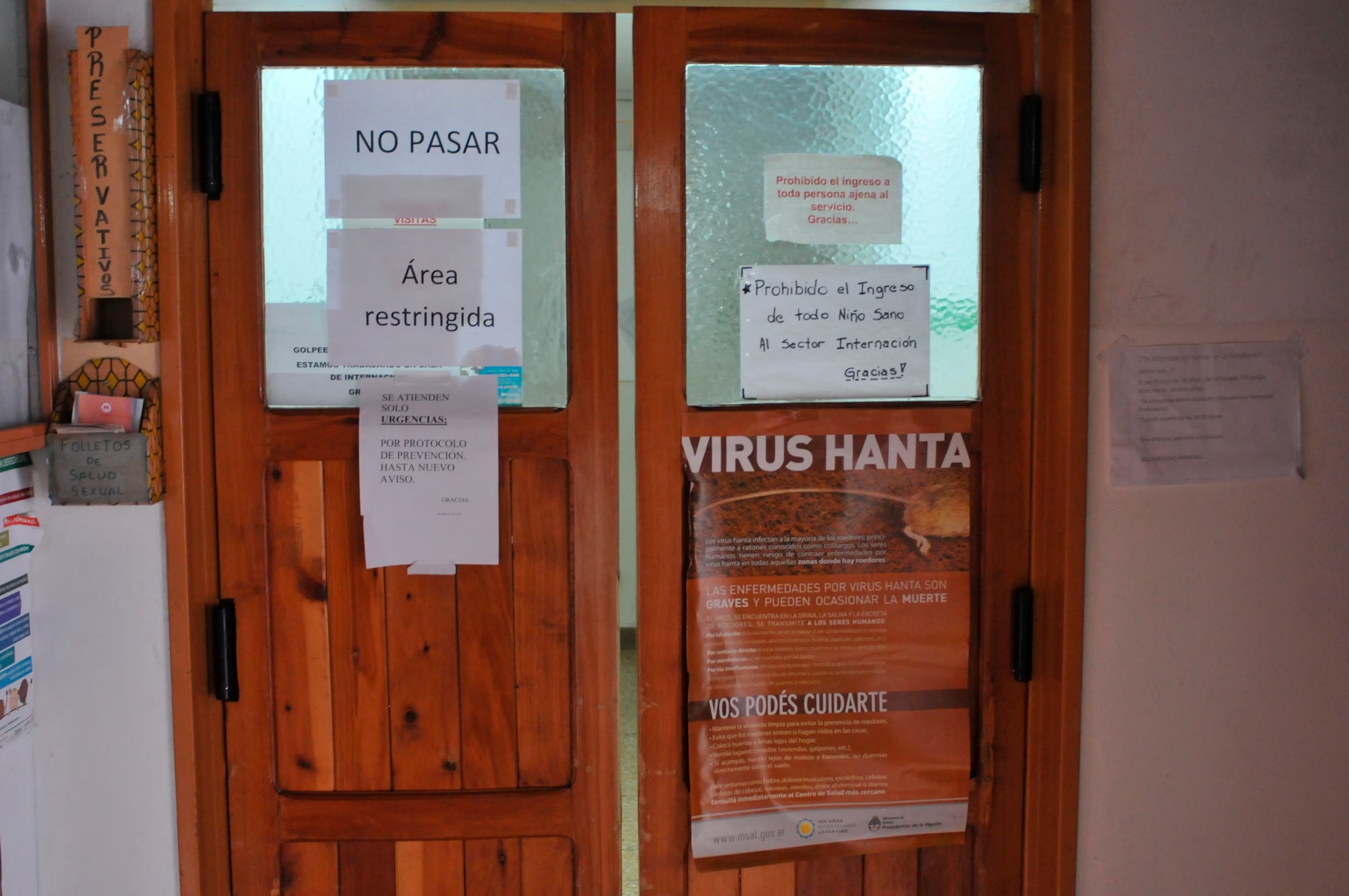
Signs that read in Spanish “don’t pass” are posted on the doors at the local hospital in Epuyen, Argentina, Jan. 11, 2019. An Argentine judge has ordered 85 residents of a remote Patagonian town to stay in their homes for at least 30 days to help halt an outbreak of hantavirus in which nine people have died.Gustavo Zaninelli/AP
According to the report, these endeavors considerably curtailed dissemination.
This week, health authorities in multiple nations with both substantiated and speculated instances, for example, the Netherlands and Spain, have adopted comparable strategies to those utilized in Argentina a year prior, isolating patients in secure medical facilities and endeavoring to trace their travels.
The MV Hondius cruise vessel, accommodating the outstanding travelers, was slated to berth in the Canary Islands on Saturday within a secluded zone. As of Friday, the projected course of action was to transport those passengers via separated flights back to their respective countries, as declared by the Spanish administration.
Hantaviruses are typically transmitted via rodents, such as rats and mice, primarily via contact with their urine, excrement, or saliva. While transmission may arise from a rodent bite or scratch, such cases are infrequent, as per the CDC.
Person-to-person transmission of hantaviruses is also possible, but rare, and has only been considered plausible for one subtype originating from South America, the Andes strain, according to the WHO.
Hantavirus engenders two syndromes: hantavirus pulmonary syndrome (HPS) and hemorrhagic fever with renal syndrome (HFRS).
Based on CDC findings, HPS symptoms commonly manifest within a span of one to eight weeks after exposure to the virus, with preliminary indicators encompassing fever, weariness, and muscular soreness. Around half of HPS patients will manifest headaches, chills, vertigo, sickness, emesis, looseness of the bowels, and pain in the abdomen.

A man wearing a mask waits for clients at his shop, with a sign posted that reads in Spanish “We are all family in Epuyen, be supportive, use a mask” in Epuyen, Argentina, Jan. 11, 2019. An Argentine judge has ordered 85 residents of a remote Patagonian town to stay in their homes for at least 30 days to help halt an outbreak of hantavirus in which nine people have died.Gustavo Zaninelli/AP
The CDC notes that the late symptoms, characterized by coughing, respiratory distress, and constriction in the chest as the lungs become saturated with fluid, arise roughly four to ten days following the onset of the initial phase of ailment.
As per CDC statistics, approximately 38% of individuals who develop HPS respiratory indications may succumb to the illness.
“`
Sourse: abcnews.go.com