
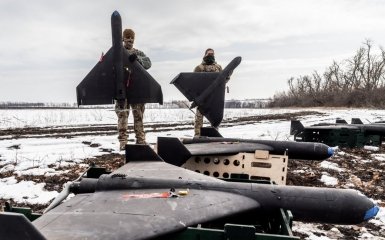
Share Source: The Financial Times
The West needs to learn from the experience gained on the front lines in Ukraine, accelerate innovation, and create the industrial base necessary to produce at the scale and speed that the next conflict will demand.
Main theses:
- Western countries should learn from Ukraine's experience and accelerate innovation to produce an industrial base in large volumes for future conflicts.
- Russia is fielding new types of drones that could provide an advantage in war by using artificial intelligence and fiber-optic technology.
The West needs to prepare for a “drone vs. drone” war
The Russians are adapting to a new era of warfare, including the use of jamming-resistant fiber-optic drones that can hit soldiers in trenches or tunnels, even through forests and in bad weather.
Russia has begun developing jet-powered Shahed kamikaze strike drones, which are much faster and harder to intercept.
This year, the aggressor country plans to increase their use to 1,000 per day in order to force Ukraine to surrender.
To counter this, Ukraine is building the necessary systems to stay on the front lines, using unmanned aircraft for reconnaissance and surveillance, as well as an extensive network of radars and artificial intelligence-based systems to collect, integrate, and analyze data on battlefield events and future threats.
Ukraine must be ready for the next phase of war, with swarms of drones, remotely controlled and increasingly automated with artificial intelligence.
It adds that each side is withdrawing its most valuable personnel from the front, and new generations of drones are achieving greater range and increased lethality thanks to better batteries, sensors, and aerodynamics.
Share
Automating operations so that personnel can work safely behind the front lines has become an urgent priority for Ukraine, which plans to further distance drone pilots from the front lines this year.
The article predicts that future wars will be defined by unmanned weapons.
The combination of unblocked satellite communications, cheap spectrum networks, and precise GPS guidance means that the only way to fight will be drone-on-drone combat.
The publication says that drones exchange data in real time, meaning that many inexpensive platforms could act as a single weapon. In addition, they are capable of carrying air-to-air missiles to destroy attackers, as a fighter jet does, but will be cheaper and more widespread.
The winners of these drone battles will be able to advance with the help of unmanned land and sea vehicles that move slowly but can carry heavier loads.
These air, ground, and sea formations will absorb the initial fire and expand the impact zone, which is becoming increasingly robotic. Only after the first waves of machines have passed will human soldiers follow.
Share
After the war in Ukraine ends, the result could be a tense peace that will teach Western countries as many lessons as the conflict itself.
It is possible that in the future a “drone wall” could be created along the border between Russia and Ukraine, with automated drones monitoring the border like an intelligent electric fence.
It is added that since such UAVs are valuable targets for the enemy, they will need to be armed to repel attacks and create a strong border several kilometers high and the same width.
As for ballistic and cruise missiles, which have extreme accuracy at much higher speeds than drones and are extremely difficult to shoot down, it is possible that they will be deployed in the thousands on both sides.
Share
The publication emphasized that as they gather at the Munich Security Conference to discuss defense issues for Europe and the world, Western leaders must recognize that they are not yet ready for a new era of war.
The West's current ability to increase production in wartime remains amateurish at best.
The possession of autonomous systems and the ability to produce such weapons in large quantities will determine the outcome of future wars. Therefore, the publication suggests, the West needs to learn from the experience gained on the front in Ukraine, accelerate innovation and create the industrial base necessary to produce at the volumes and at the speed that the next conflict will require.