
Read in English Share Source: Defense Express
The FP-7 essentially repeats Fire Point's approach with the FP-5 “Flamingo”, simplifying and removing all additional complications in order to save the most valuable thing – time and speed up the emergence of a Ukrainian wartime ballistic missile.
Main theses:
- The Ukrainian FP-7 ballistic missile is an iteration of the Fire Point approach with the FP-5 'Flamingo', simplifying and accelerating the development process.
- The missile has a claimed range of up to 200 km, a warhead of 150 kg, and a maximum speed of up to 1,500 m/s.
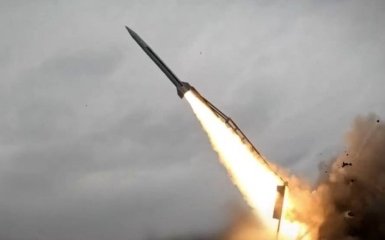
Fire Point showed a video of the launch of the FP-7 missile
The launch of the Ukrainian FP-7 ballistic missile from the Fire Point company was publicly demonstrated for the first time, which was announced by the company's general designer and co-owner, Denis Shtilerman.
The video captures the launch and first stage of the rocket's flight, the appearance of which was announced in the fall of 2025.
Congratulations FP7) pic.twitter.com/FxgCHVHMET
— Denys Shtilierman (@DenShtilierman) February 27, 2026
Recall that this is a missile with a declared flight range of up to 200 km and a warhead of 150 kg. Its maximum speed is up to 1500 m/s (5400 km/h), it can reach an altitude of up to 65 km, and the total flight time is 250 seconds. The declared deviation from the aiming point is 14 meters.
The missile itself, as the developers openly stated, is based on the 48N6 anti-aircraft missile (created during the Soviet era) from the Russian S-400.
It retained its layout, aerodynamic solution, but its body is made of composite material, and of course it has a completely different “stuffing”, both electronics and fuel. At the same time, the decision to take an already proven design as a basis definitely allowed to save the most important thing – time.
At the same time, it is worth paying attention to some features of the Ukrainian FP-7. In Fire Point, as with the FP-5 “Flamingo”, they went the way of accelerating work by simplifying. In particular, instead of the standard solution for 48N6 or 5B55 with a “cold” or “mortar” start, when the rocket is first thrown to a height of 30 meters by an ejection charge, and then it turns on the solid-fuel engine. In FP-7, the start is normal, “hot”.
Share
It is also carried out by moving along a guideway that has a slope, not vertically. This is also about simplification and acceleration. In addition, it seems that the control surfaces are not folding at the moment. And this is also about accelerating work by eliminating any complications.
Also, the FP-7 launcher itself is as simplified as possible and, as in the case of the “Flamingo”, is created on the basis of a standard trailer. And in the end, it's not just about simplicity, it's about masking the launcher. That is, in general, we are talking about a wartime ballistic missile, with the understanding that it is possible to remake its launch and put it in a transport-launch container later.
It should be noted that FP-7, as stated by Fire Point, was supposed to be codified by the end of 2025, or at least pass all the necessary tests for this.