
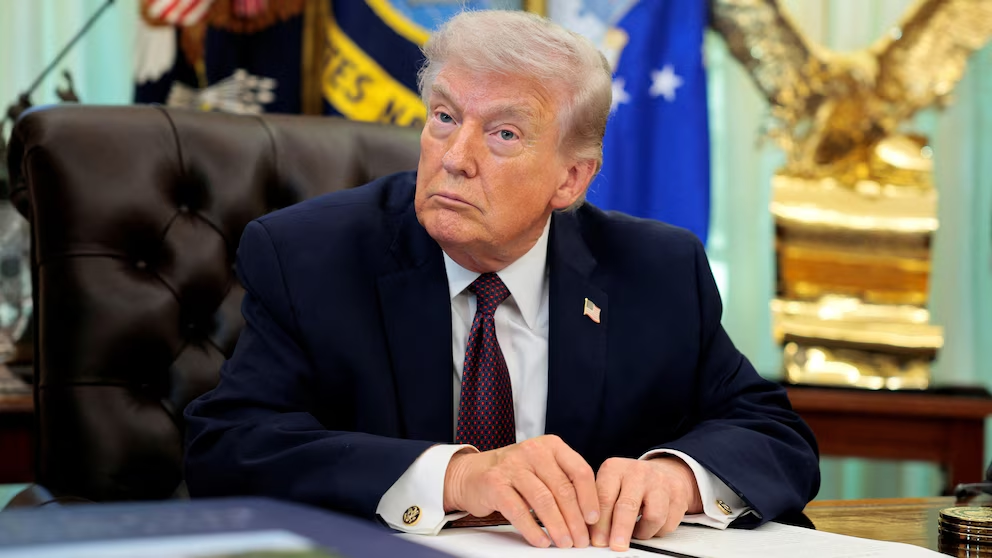
President Donald Trump is seen signing an executive order within the White House’s Oval Office, located in Washington, D.C., on March 31, 2026. Evan Vucci/Reuters
On Tuesday, President Donald Trump authorized an executive action to establish a national registry of citizens qualified to cast their ballots and modify certain aspects of the process for postal voting.
This directive is poised to trigger legal disputes, as the Constitution firmly entrusts the authority to determine the “Times, Places, and Manner” of elections to the states, not the federal administration.
In response to the announcement, Democratic Senate Minority Leader Chuck Schumer conveyed his message on social media, asserting to the White House, “See you in court. You will lose.”
The president’s action arises amid Trump’s stalled endeavors to advance the SAVE America Act, which—in conjunction with other domestic priorities of the president—aims to radically reshape the federal government’s involvement in voter registration and election administration in the lead-up to the midterms.
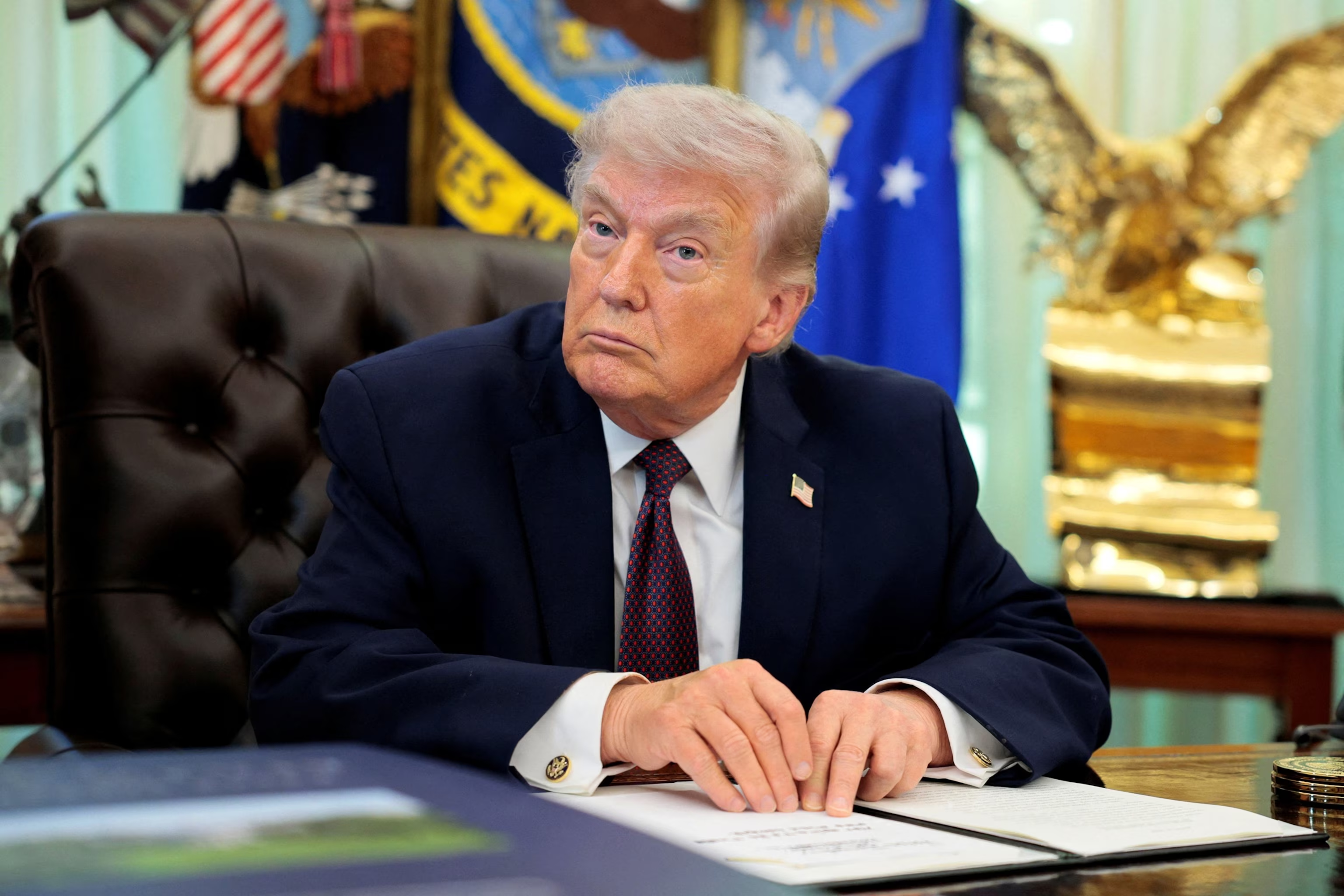
President Donald Trump attends to sign an executive order in the Oval Office of the White House in Washington, D.C., March 31, 2026.Evan Vucci/Reuters
The recent directive endeavors to impose limitations on absentee ballots, stipulating that these ballots can only be dispatched to individuals listed on each state’s certified mail-in ballot roster. It further modifies the layout of mailed ballots, integrating barcodes intended to streamline ballot tracking.
According to the executive order, a ballot must be “designated as Official Election Mail” via a U.S. Postal Service design, possess an “Intelligent Mail barcode” from USPS, and “undergo a mail envelope design review by the USPS” to guarantee design suitability.
Trump has repeatedly presented unsubstantiated claims regarding fraud in mail-in voting.
However, a November 2025 assessment by the Brookings Institution concluded that “instances of fraud concerning any type of mail ballots were exceedingly scarce.”
“We ascertain an average total mail voting fraud percentage across the 2016, 2018, 2020, and 2022 general elections of merely 0.000043%, representing approximately four instances of mail voting fraud for every 10 million mail votes,” the report stated.
Additionally, the Heritage Foundation, a conservative think tank responsible for Project 2025, documented 387 cases of illicit utilization of absentee ballots across all recorded elections since 1982.
Election regulations, encompassing the monitoring and counting of mail-in ballots, are governed by individual states. The executive order asserts that states failing to comply may forfeit federal funding.
Eliza Sweren-Becker, the deputy director of the voting rights program at the nonpartisan Brennan Center for Justice, communicated to ABC News on Tuesday that Trump’s executive order lacks both enforceability and constitutionality.
She commented, “It’s akin to the executive order the President enacted last year concerning elections. This order is unconstitutional. The President possesses no jurisdiction over federal elections. That authority is vested in states and Congress.”
Staff secretary Will Scharf elucidated the rationale underpinning the bill during its presentation to the president.
“We are confident that, taken together, the provisions within this executive order will bolster election security going forward, ensuring that past abuses within our election system are not replicated in subsequent elections,” Scharf remarked.
“The irregularities in mail-in voting are well-known,” Trump stated during the signing of the order.
Despite his long-standing criticism, Trump recently utilized a mail-in ballot to participate in a special election in Florida.
Trump pledged to challenge any ruling that overturns his order. Democrats have indicated their intent to contest it in court.
Senate Minority Leader Chuck Schumer, in response to White House press secretary Karoline Leavitt’s X post promoting the order, posted, “See you in court. You will lose.”
Marc Elias, a Democratic-affiliated lawyer frequently involved in voting rights matters, posted on X that he intends to file a lawsuit.
“This represents a substantial and unconstitutional voter suppression initiative aimed at empowering Trump to compile a list of individuals permitted to vote by mail. We anticipate this will lead to the targeting of Democrats for widespread disenfranchisement. We will initiate legal action, and we will prevail.”
ABC News’ Ivan Pereira, Oren Oppenheim, and Nathan Lee contributed to the reporting of this article.
Sourse: abcnews.go.com