
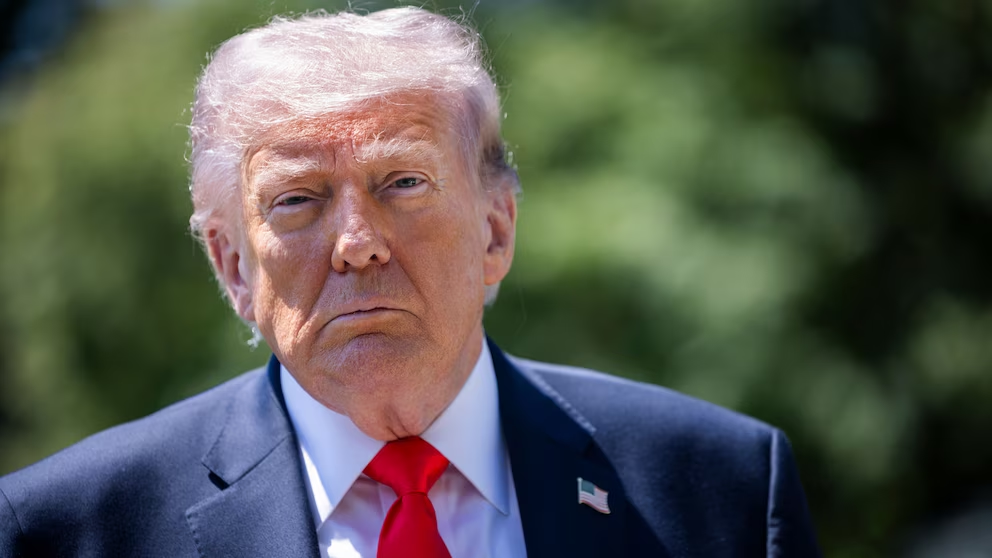
President Donald Trump leaves the White House, May 1, 2026, in Washington.Jim Lo Scalzo/EPA/Shutterstock
With the Iran conflict having plunged the world economy into a petroleum shortfall and petrol prices peaking at a four-year apex, Americans' assessments of President Donald Trump across multiple topics are profoundly in the red, with sizable majorities expressing disapproval of his handling of each issue gauged, as per an ABC News/Washington Post/Ipsos survey utilizing Ipsos' KnowledgePanel.
In spite of significantly unfavorable circumstances for Trump and his political group, Democrats are ahead, though not decisively, in the congressional elections presently.
Trump's endorsement figure has declined to 37%, the nadir of this presidential tenure, and his 62% rejection number represents a historic zenith throughout his two presidential stints.
The survey reveals Trump also struggles to gain approval on all quantified subjects, given that two-thirds of Americans perceive the nation as proceeding in the incorrect course, and the Democratic Party's advantage over the GOP has risen somewhat to 5 points for the midterm races.
Trump's approval score
Trump's approval statistic has slightly reduced from 39% in February to 37%, while his disapproval has edged upward from 60% to 62%, comparable to his marks upon departing office after his initial term, shortly following the Jan. 6, 2021, onslaught on the U.S. Capitol structure perpetrated by belligerent pro-Trump advocates.
Trump's aggregate approval score is reinforced by his party's devoted adherents. An absolute 85% of Republicans favor Trump, a number that has remained mostly stagnant during his second term. However, the percentage of Republicans strongly endorsing Trump has diminished. Currently, 45% of Republicans offer their strong approval, down from 53% in September and the lowest amongst Republicans spanning both terms.
Within MAGA Republicans, 95% give their overall approval, encompassing 61% who show strong endorsement. Total approval descends to 64% among non-MAGA Republicans, with merely 13% of non-MAGA Republicans expressing robust endorsement. MAGA Republicans are self-identified proponents of the MAGA movement, comprising 66% of the Republican faction, according to this poll.
Trump's approval standing among independents has plummeted to a historic low for both his tenures. A mere 25% approve of his overall job execution, a dip from 30% in October and higher during his initial term.
Approximately three-quarters of Americans disapprove of Trump's management of the living costs in the U.S. (76%), with about a quarter giving their approval (23%). Nearly as many disapprove of his strategy concerning inflation (72%), an increase from the 65% who disapproved in February. Fewer than 3 in 10 approve of Trump's management of inflation. During his quest for the presidency, Trump consistently vowed to reduce expenses for Americans.
Approximately two-thirds of Americans are critical of Trump's stewardship of the economy (65%) — a historic peak over both of Trump's presidential periods and approximately equivalent to then-President Joe Biden's nadir evaluation regarding the economy in ABC/Post polling during September 2023 (64%).
Similar proportions of Americans express disapproval of Trump's conduct related to Iran (66%), as well as connections with U.S. allies (65%), while roughly a third approve of his administration of each. A majority of Americans assert that the U.S. engaging military action against Iran constituted an error.
About 6 in 10 Americans disapprove of Trump's approach to taxes, while marginally less than 4 in 10 approve — a topic on which he aimed to sway Americans during this spring season.
"Every single American at every income classification — there's additional funds in their wallets this week due to the Republican taxation strategies," Trump articulated previously this month during a roundtable function promoting his "no tax on tips" initiative.
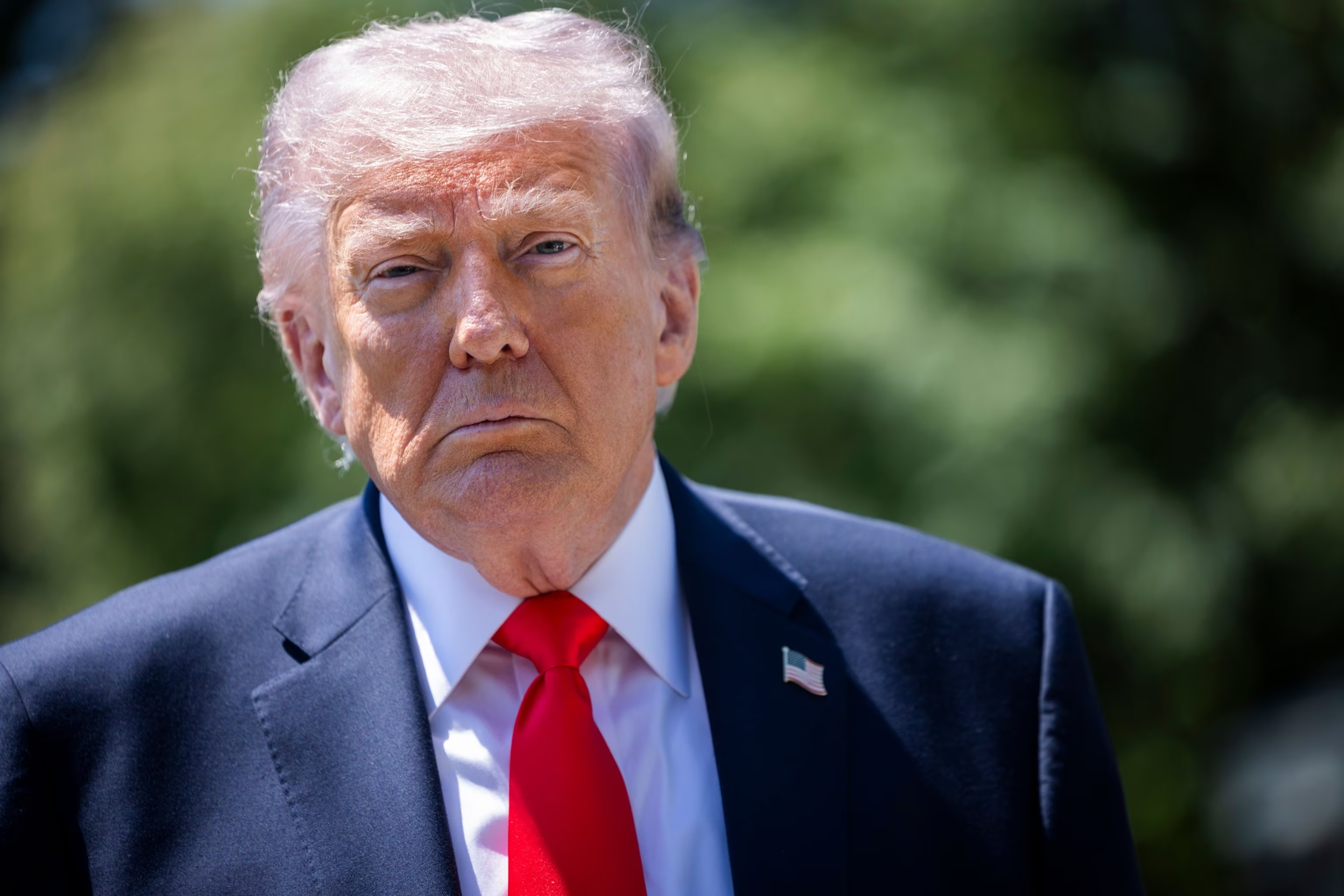
President Donald Trump departs the White House, May 1, 2026, in Washington.Jim Lo Scalzo/EPA/Shutterstock
Concerning immigration, 59% disapprove and 40% approve, nearly identical to his scores in February, signifying nominal movement months following Trump's Operation Metro Surge where federal immigration and border officers were stationed across Minnesota to enforce immigration laws, imprisoning thousands and causing the deaths of two U.S. citizens.
Trump's strongest suit remains his handling of immigration issues at the U.S.-Mexico border, where 54% disapprove and 45% approve. Nevertheless, these scores are slightly less favorable than those registered in the February ABC/Post/Ipsos survey.
Almost half of all Americans (46%) deem Trump as "excessively conservative."
Beyond specific concerns, around 7 in 10 Americans assert that Trump lacks honesty and trustworthiness, two-thirds claim he does not thoughtfully consider vital decisions, and around 6 in 10 opine that he lacks the mental sharpness required to serve as president. More than half believe Trump is not in sufficiently sound physical condition to perform effectively as president (55%) and that he lacks the qualities of a strong leader (54%).
Despite promising to "drain the swamp" and address governmental waste, approximately half of Americans perceive that the extent of corruption in Washington has escalated since Trump assumed office last year (49%), with roughly 3 in 10 believing it has stayed constant and about 2 in 10 suggesting it has diminished.
Midterms
At this juncture in the electoral process, Democrats exhibit greater motivation and are more disposed to acknowledge the significance of these midterm elections. Furthermore, independents favor Democratic candidates for the House of Representatives by a substantial margin.
Among registered voters, 49% express their intent to vote for the Democratic candidate were midterm elections to occur today, while 44% indicate they would vote for the Republican, representing a statistically notable 5-point disparity, a slight increase from the 2-point lead Democrats possessed in the February and October ABC News/Washington Post/Ipsos polls.
Leading up to the prior midterms, in an April 2022 ABC/Post poll, registered voters were divided nearly evenly between the two parties, and Republicans secured control of Congress. During an April 2018 ABC/Post poll, Democrats led by 4 points, subsequently winning the House in November.
Among independent voters, the poll determines that Democrats hold a commanding 20-point advantage over Republicans, 52% to 32%. In April 2022, they exhibited an even split (42%-42%), whereas in 2018, they backed Democrats by a mere 6 points (44%-38%).
Almost all Democratic voters profess their intent to support their party's House contender, with Republican voters conveying similar sentiments about their party's candidate. Approximately two-thirds of Republicans and Republican-leaning independents suggest that Republican leaders should adhere to Trump's guidance, in contrast to just about one-third who advocate for the party to be steered in a distinct direction.
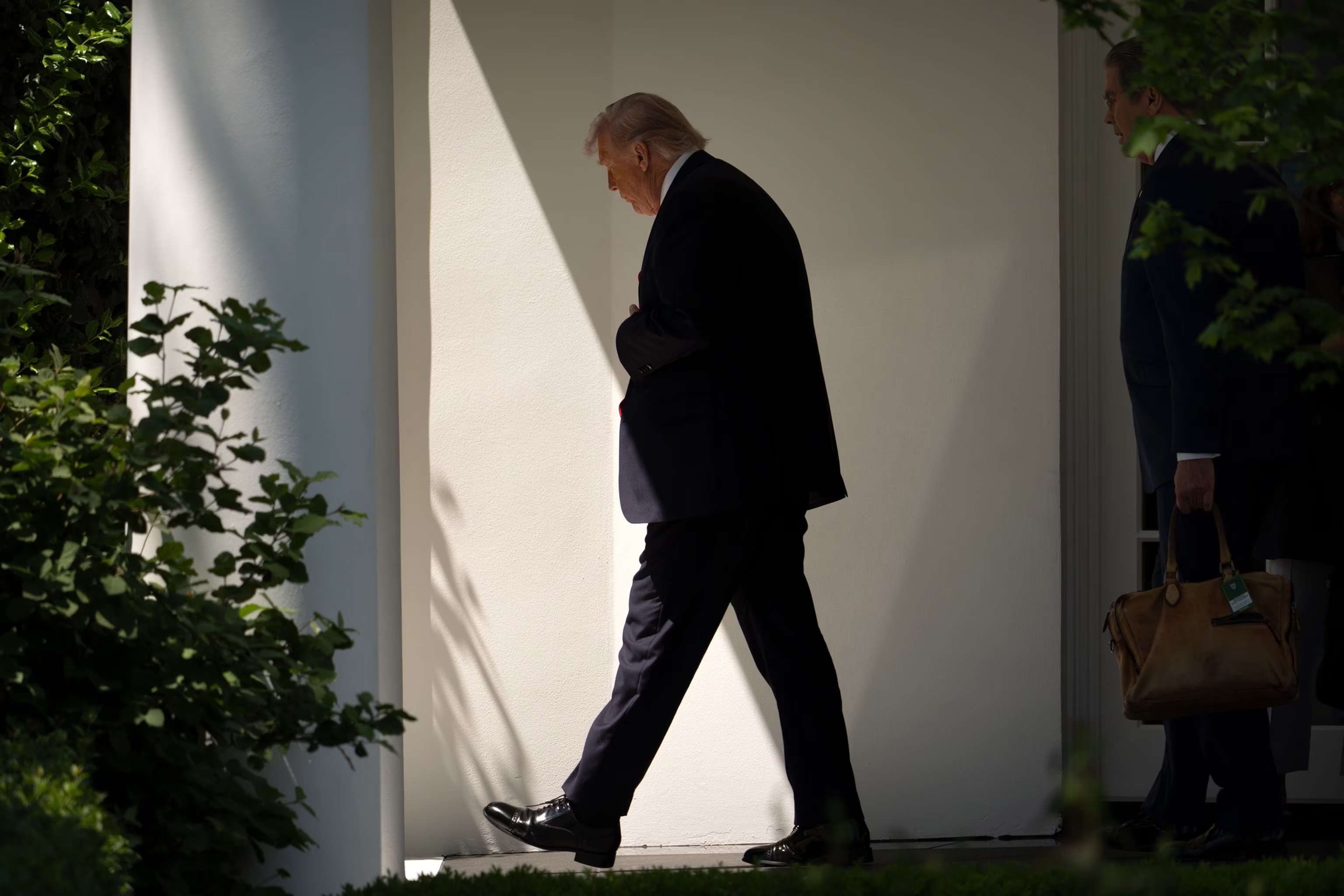
President Donald Trump departs the Oval Office at the White House, May 1, 2026, in Washington.Mark Schiefelbein/AP
Democratic voters also hold a notable lead in their perception of the election's importance: 61% articulate that their vote this year is "substantially more crucial" than past midterm elections, compared to 35% of Republicans sharing this sentiment. Shortly preceding the 2022 midterms, a September ABC/Post poll revealed comparable proportions of Democratic (39%) and Republican (38%) voters asserting that voting that year held considerably more significance.
Regarding the certainty to vote, 79% of Democratic registered voters indicate they are "absolutely certain to vote" — unchanged from February. However, Republican voters are narrowing the gap. At present, 72% of Republicans express their certainty to vote, up from 65% in February.
Trust on issues
Notwithstanding Trump's diminished approval figures and the Democratic Party's advantage in vote preference, Americans do not afford Democrats substantially greater confidence in addressing pertinent issues, and slightly more contend that Democrats lean excessively left compared to those who believe Republicans are excessively conservative.
Slightly over half of Americans, 53%, posit that the Democratic Party is excessively liberal, fractionally surpassing the 49% who deem the Republican Party as excessively conservative. Amongst independents, 50% consider the Democratic Party as excessively liberal, edging up to 53% who view the Republican Party as excessively conservative.
Across 11 individual topics assessed, Americans repose greater trust in Democrats on only three issues, Republicans on just two, and are split between the two parties on the remaining issues.
Americans repose more faith in Democrats than Republicans to manage healthcare, education, and the costs of living.
Traditionally, Democrats have maintained an advantage over Republicans in handling healthcare and education. Presently, Americans trust Democrats over Republicans to manage healthcare by 17 points and to handle education and schools by 8 points. They trust Democrats over Republicans to manage the costs of living by a slimmer margin of 5 points.
Americans place greater confidence in Republicans than Democrats on immigration and crime. Concerning immigration, the Republican lead has diminished to 5 points, compared to a 12-point margin held in a November 2023 ABC/Ipsos poll. However, an ABC/Ipsos poll from October 2022 indicated a difference of merely 3 points between the two parties.
The Republican Party's 14-point lead on trust to address crime over Democrats aligns with levels documented in 2022 and 2023 ABC/Ipsos surveys.
Americans are split almost evenly in their trust of either party to handle the economy, inflation, taxes, corruption, Iran, and AI.
Republicans have conventionally held a lead in economic affairs, with the last instance of the two parties being tied occurring in 2014. However, public sentiment is now divided between the parties on this subject: Republicans (34%) and Democrats (33%).
With respect to inflation, Americans are divided roughly into thirds between entrusting Democrats (31%), Republicans (30%), and neither (33%), which constitutes an improvement for Democrats compared to previous data. In ABC/Ipsos polls dating back to 2022, Republicans maintained a double-digit lead over Democrats on managing inflation, with even more considerable leads documented in ABC/Post telephone surveys between 1990 and 2022.
Americans are also split threefold on handling taxes, with trust distributed between Republicans (34%), Democrats (31%), and neither (30%). Similar trends were observed in ABC News/Ipsos surveys from 2022 and ABC/Post telephone polls from 2018.
Concerning corruption, a 44% plurality report that they do not trust either party, with 26% expressing greater trust in each respective party.
Regarding Iran, Americans are split into approximate thirds when asked whether they trust Democrats, Republicans, or neither party. Regarding AI, 51% indicate they trust neither party.
Direction of country and Trump policy decisions
Two-thirds of Americans suggest that the country is heading in the wrong direction, encompassing over 9 in 10 Democrats and nearly 8 in 10 independents. MAGA Republicans are considerably more disposed to believe that the country is progressing in the right direction (87%) compared to non-MAGA Republicans (49%).
Four different policies that Trump campaigned on or that his administration later enacted are broadly unpopular.
The Trump administration has substantially reduced federal medical research financing, with 78% opposing this, including majorities of Democrats (90%), Republicans (65%), and independents (79%). Even 60% of MAGA Republicans oppose diminishing federal funding for medical research.
The White House has sought a record $1.5 trillion for defense spending. Roughly two-thirds of Americans (65%) oppose increasing U.S. military spending from $1 trillion to $1.5 trillion, including majorities of Democrats (87%) and independents (75%). Two-thirds of Republicans (67%) support this, increasing to 76% among MAGA Republicans.
Trump has advocated for ending birthright citizenship in the U.S., suggesting that children born to parents who are neither American citizens nor legal permanent residents should not automatically become citizens because they still owe political "allegiance" to a foreign nation. The Supreme Court heard arguments in this case last month.
About two-thirds of Americans oppose terminating birthright citizenship (65%), including nearly 9 in 10 Democrats and 7 in 10 independents. Approximately 6 in 10 Republicans endorse this, rising to almost three-quarters of MAGA Republicans.
The Supreme Court is also considering the Trump administration’s termination of humanitarian protections for thousands of immigrants without judicial review. Roughly 6 in 10 Americans oppose discontinuing temporary legal status for migrants from conflict-ridden countries, incorporating 84% of Democrats and 64% of independents. About two-thirds of Republicans (68%) support this, climbing to 76% of MAGA Republicans.
Administration approvals
Aside from Trump's diminished approval scores, members of his administration do not fare appreciably better, but greater numbers of Americans express neutrality toward them.
Federal Reserve Chairman Jerome Powell, whom Trump appointed during his initial term but who is technically not a member of his administration, fares better: 36% of Americans approve of his performance, 29% disapprove, and 35% express no opinion. Trump has criticized Powell over the Fed’s rate policy. His term as chairman concludes in May.
While 35% approve of Vice President JD Vance, 48% disapprove.
Just 31% approve of Robert F. Kennedy Jr.'s performance as secretary of Health and Human Services, with 50% disapproving and 19% having no opinion. A comprehensive 4 in 10 vehemently disapprove of him.
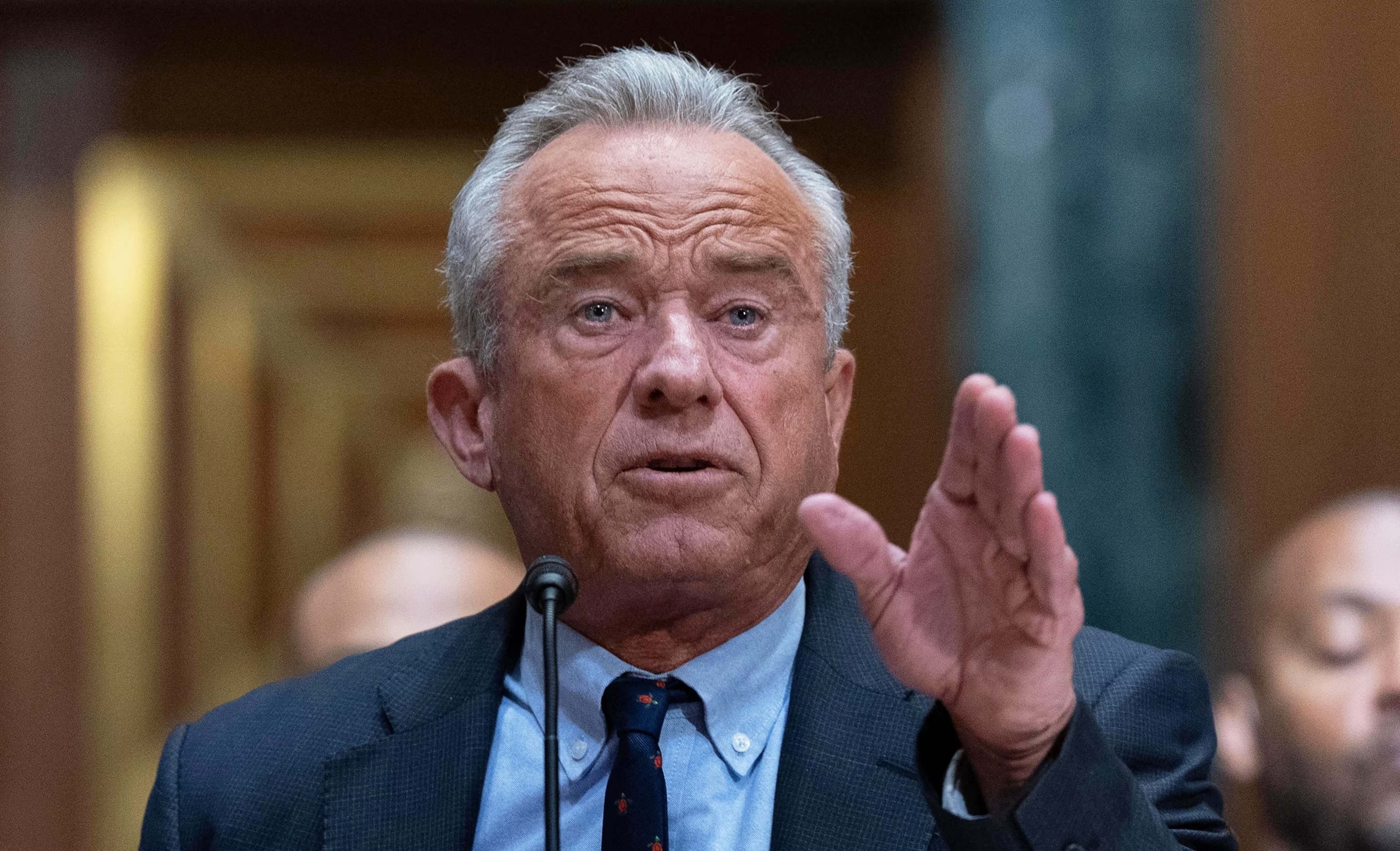
Health and Human Services Secretary Robert F. Kennedy Jr. testifies before the Senate Committee on Finance hearing on Capitol Hill, April 22, 2026, in Washington.Jose Luis Magana/AP
FBI Director Kash Patel follows closely behind, with 27% approving and 46% disapproving, and an additional 27% having no opinion.
Secretary of State Marco Rubio also is in the negative, with 33% approving and 40% disapproving, with another 27% expressing no opinion.
Methodology — This ABC News/Washington Post/Ipsos survey was implemented with 2,560 U.S. adults as a whole and encompasses a margin of error of +/- 2 percentage points. Error margins are greater among subgroups.
Refer to the PDF for comprehensive results and comprehensive methodology.
ABC News' Liz Schreier played a role in this account.
Email [email protected] to be included in ABC News' polling circulation listing.
More ABC News surveys are available at abcnews.com. Media contacts: Jeannie Kedas and Van Scott.
Prior distributions:
Americans disapprove of Trump ballroom by a 2-to-1 margin; even further oppose his signature on money: ABC News/Washington Post/Ipsos survey
Americans hold increasingly downbeat outlooks regarding their individual finances, with a majority viewing the employment of U.S. military forces against Iran as a misstep: ABC News/Washington Post/Ipsos poll
Sourse: abcnews.go.com