
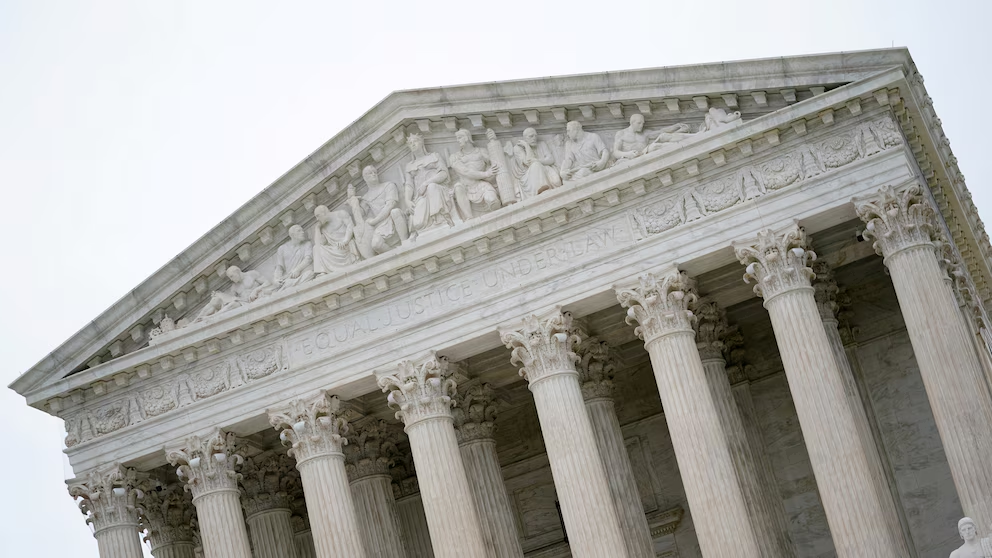
The U.S. Supreme Court edifice in Washington, April 29, 2026. Nathan Howard/Reuters
The High Court on Wednesday invalidated Louisiana's congressional blueprint as an illegal racial gerrymander and delivered a setback to Section 2 of the Voting Rights Act, a seminal statute that has extensively barred electoral practices which have the consequence of diminishing the impact of racial minority voters.
In a 6-3 determination, the Supreme Court's conservative faction essentially heightened the standard for challenges to electoral maps that curtail the equal prospect for minority voters to nominate candidates of their preference, even absent proof that lawmakers had a specific intention to discriminate.
Justice Samuel Alito penned the opinion, which asserted that states contravene the Voting Rights Act solely when "evidence offers persuasive reason to believe that the State purposely crafted its districts to grant minority voters diminished opportunity due to their ethnicity."
The adjudication reverses lower court verdicts that determined Louisiana's map, formulated following the 2020 census, breached the Voting Rights Act considering that merely one of six districts held a Black majority. Greater than one-third of the state's voting-age demographic is Black.
Those tribunals had instructed Louisiana to incorporate a subsequent majority-Black district, an endeavor which in turn overtly hinged on race. Alito contended that this action infringed on the entitlements of white voters under the 14th Amendment's equal protection provision.
"That map constitutes an unconstitutional gerrymander, and implementing it would violate the plaintiffs' constitutional prerogatives," Justice Alito articulated for the majority.
"In deliberating whether the Constitution sanctions the deliberate application of race to abide by the Voting Rights Act, we commence with the overarching principle that the Constitution virtually never permits the Federal Government or a State to engage in bias grounded on race," the court appended.
In a disagreement articulated aloud from the bench, Justice Elena Kagan remarked that the judgment was "sweeping and consequential." Justices Sonia Sotomayor and Ketanji Brown Jackson associated themselves with Kagan's dissent.
"If other states emulate Louisiana's example," Kagan composed, "the minority citizens inhabiting those states will no longer possess an equitable possibility to elect candidates of their preference."
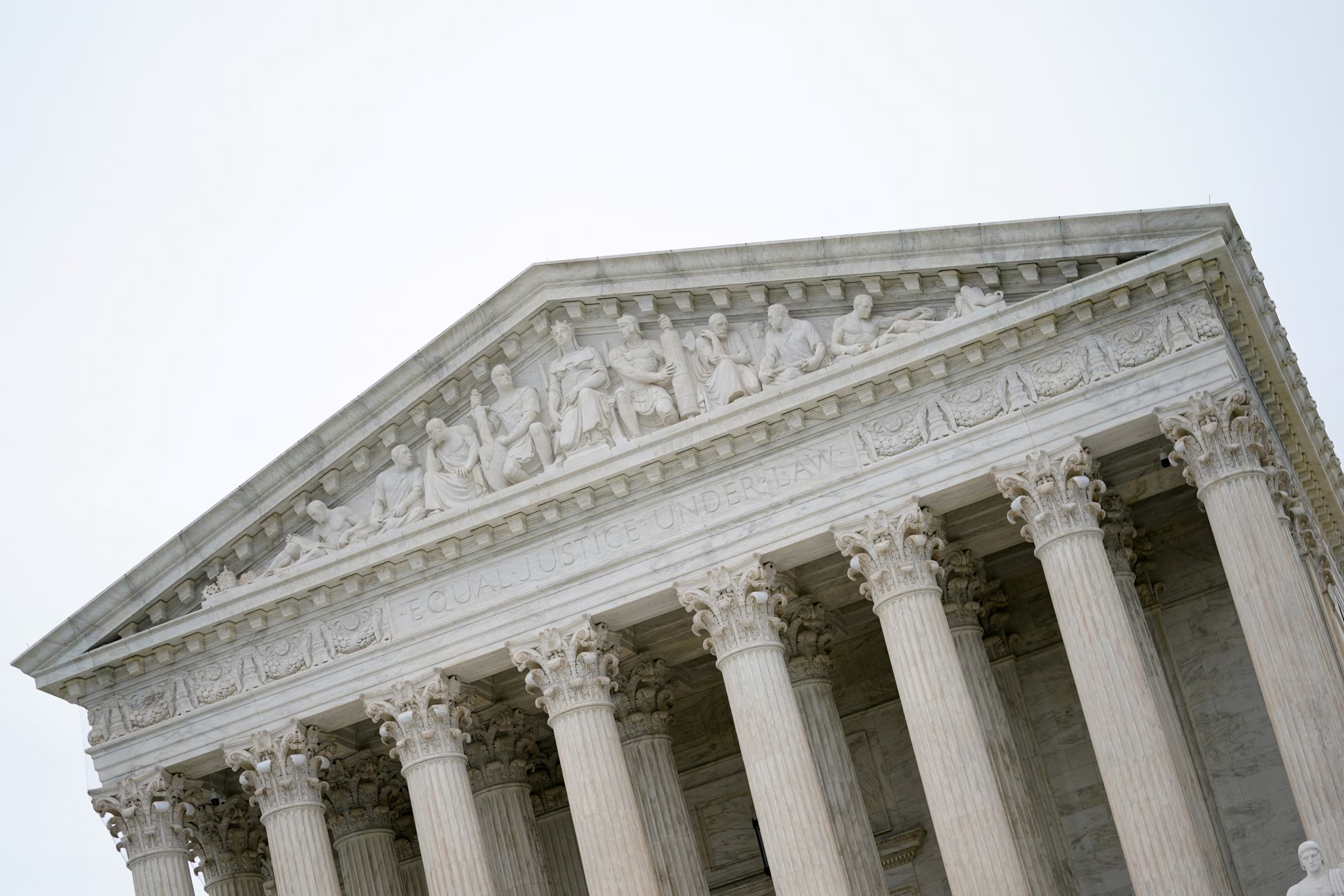
The U.S. Supreme Court structure in Washington, April 29, 2026.Nathan Howard/Reuters
Section 2 of the Voting Rights Act has traditionally served as a safeguard against states "clustering" Black voters into districts and "fragmenting" communities of color into other districts with the objective of weakening their electoral sway.
Tribunals that have uncovered a contravention of Section 2 then instruct states to revise their maps, centering on race, to guarantee that minority voters are accorded an equitable likelihood at political engagement. The law does not mandate verification of intent to discriminate, conversely prohibiting any discrimination in effect.
"Under the Court's perspective of Section 2," Kagan wrote, "a State can, with no legal ramifications, methodically undermine minority citizens' voting strength. … The majority asserts merely to be refreshing our Section 2 law, as though through a handful of technical adjustments. But in actuality, those 'updates' gut the law, with the result that it will not address even the archetypal instances of vote diminution."
The White House lauded the Supreme Court ruling as a "complete and utter triumph for American voters."
"One's ethnicity should not determine which congressional district they are placed in. We commend the court for bringing an end to the unconstitutional exploitation of the Voting Rights Act and safeguarding civil liberties," White House spokesperson Abigail Jackson articulated in a statement.
Civil rights organizations had cautioned that the case could exert a devastating consequence on minority voters' authority throughout the South and culminate in lessened minority representation in Congress moving forward.
The NAACP branded the court's determination a "crippling hit to what persists of the Voting Rights Act" and "a permission slip for dishonest politicians aiming to manipulate the system by suppressing entire populations."
"The Supreme Court betrayed Black voters, betrayed America, and betrayed our democracy," NAACP President Derrick Johnson conveyed in a statement. "This pronouncement represents a significant regression for our nation and poses a hazard to erode the hardly-earned triumphs we’ve contended for, bled for, and perished for. But the citizenry can still resist. Our prime defense and offensive is the voting booth, and we’re poised to mobilize voters in the midterm elections to assure we can elect representatives who safeguard our interests."
Exceeding a dozen states, predominantly in the South, that maintain court-ordered majority-minority congressional districts could potentially endeavor to redraw their maps to do away with those districts for partisan benefit. The majority of majority-minority districts are symbolized by Democrats.
It's not instantly apparent how extensive the consequence of the verdict in the Louisiana matter will be or whether additional states will venture to overhaul their maps so proximate to the November election.
The court's adjudication did not progress as distantly as certain civil rights proponents had apprehended, striking down Section 2 entirely. Conversely, Justice Alito explicitly observed that electoral maps can remain open to challenge for eroding the impact of minority voters, and tribunals can remain able to instruct map revisions — spotlighting race — to bolster equitable opportunity.
However, the court placed considerable new constrictions on the influence of the law, instituting a considerably stiffer criterion for substantiating that an electoral map biases against minority voters in the onset.
"To triumph, the plaintiff must isolate race from politics by substantiating that the former determined a district's borders," Alito penned, and that the mode in which districts were delineated "fosters a convincing premise that premeditated discrimination transpired."
Appalling numerous advocates of the Voting Rights Act, the court also constructively declared that established racial inequities in elections have considerably subsided countrywide.
"Discrimination that transpired some time ago, alongside present-day inequalities that are labeled as the ongoing 'impacts of societal discrimination,' are entitled to considerably less consideration" in a case alleging a Section 2 infringement, Alito penned.
"Far more pertinent are prevailing data and prevailing political circumstances that elucidate prevailing deliberate discrimination," he expressed for the majority.
Sourse: abcnews.go.com