
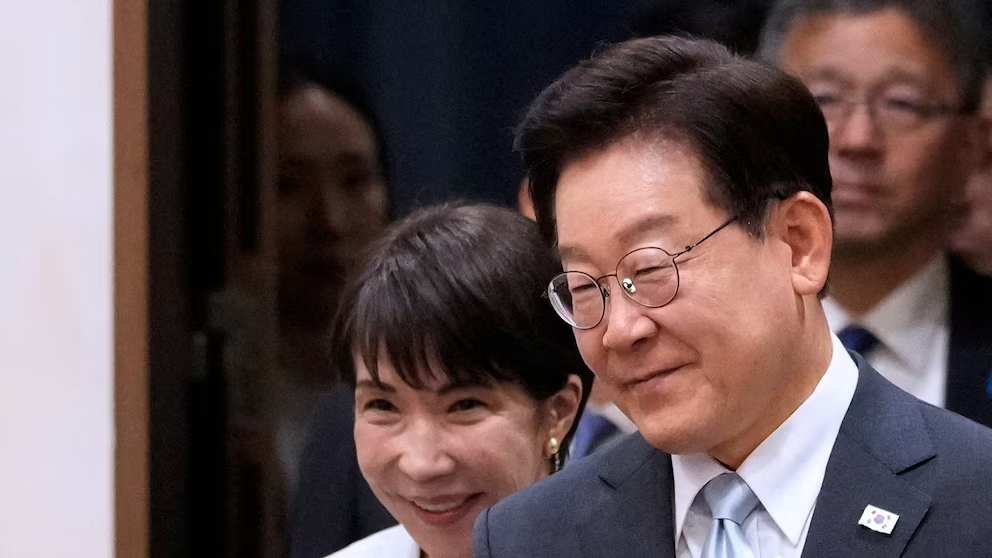
Japanese Prime Minister Sanae Takaichi and South Korean President Lee Jae Myung arrive to hold a joint press conference in Andong, South Korea, Tuesday, May 19, 2026. Ahn Young-joon/via Reuters
SEOUL, South Korea — The ruling Democratic Party of South Korea achieved a significant victory in nationwide local elections on Wednesday, solidifying President Lee Jae Myung’s authority just one year into his tenure, although the opposition conservatives managed to secure the mayoral seat in Seoul.
Voter participation reached 61%, marking the highest turnout for a local election in three decades.
As President Lee commences his second year in office on Thursday, his approval ratings hover around 60%, according to major South Korean polling organizations. This places him second only to former President Moon Jae-in in terms of approval ratings at the one-year mark since 1987.
When South Koreans elected Lee a year ago, it followed a severe constitutional crisis, sparked when then-President Yoon Suk Yeol declared martial law on December 3, 2024, with the stated aim of "eradicating anti-state elements."
He dispatched troops towards the National Assembly to prevent legislators from rejecting the martial law declaration. The attempt was thwarted within hours, leading to Yoon’s impeachment and removal by the Constitutional Court four months later, which precipitated the snap election that brought Lee to the presidency.
Communicating Openly
President Lee has adopted an exceptionally transparent approach to the presidency. He broadcasts weekly cabinet meetings live, a first in Korean history, and his office provides on-camera briefings more frequently than its predecessor.
Furthermore, Lee leverages social media to announce policies, challenge unfavorable media coverage, engage with public queries, and express his viewpoints – often without the careful scrutiny that a formal statement would undergo. His aides describe this as a conscious strategy to connect directly with citizens, bypassing the traditional communication channels and staff layers that typically mediate presidential messages.
"He is accessible to the public, a clear contrast to politicians before him," noted Park Myoung-ho, a political science professor at Dongguk University.
However, this communication style has also attracted criticism. In May, Lee used social media to criticize Starbucks Korea concerning a promotional campaign that some observers linked to a 1980 massacre of pro-democracy demonstrators, labeling the company as "low-grade profiteers" engaging in "gutter-level conduct."
"Considering the significant authority vested in the presidency, this approach is overly direct and lacks sufficient filtering," commented Lee Hyun-woo, who lectures on political processes at Sogang University, cautioning that the president’s messages may be misinterpreted due to the public’s familiarity with measured and formal presidential discourse.
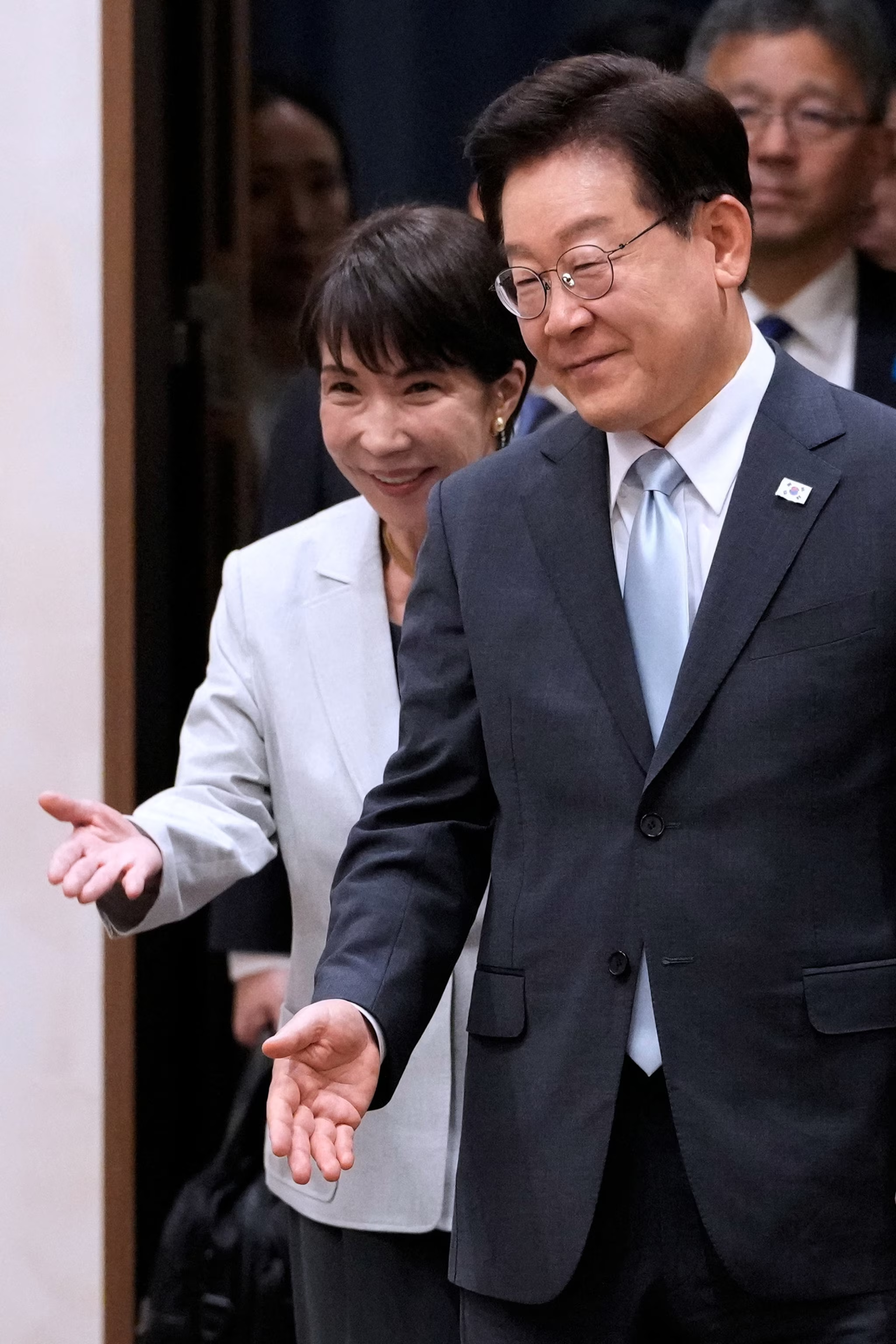
Japanese Prime Minister Sanae Takaichi and South Korean President Lee Jae Myung arrive to hold a joint press conference in Andong, South Korea, Tuesday, May 19, 2026.Ahn Young-joon/via Reuters
An Exceptional Market Performance
The KOSPI benchmark index, which had fallen to near 2,300 in April 2025 following tariffs imposed by President Donald Trump, has since climbed to an unprecedented high exceeding 8,700, far surpassing Lee’s campaign goal of 5,000. This surge has been driven by a global surge in semiconductor production and AI infrastructure, benefiting major corporations such as Samsung Electronics and SK Hynix.
However, the appreciation in stock values has not broadly benefited many households nationwide, and property prices in the vicinity of Seoul are beginning to rise again, posing a challenge to one of Lee’s core campaign commitments.
Navigating Between Global Powers
President Lee’s primary foreign policy strategy has centered on the belief that South Korea can maintain strong relations with both its ally, the United States, and its largest trading partner, China, without being forced to prioritize one over the other. His administration refers to this as "national-interest-centered pragmatism." Within seven months of assuming office, he had engaged in summit meetings with the leaders of the United States, China, and Japan.
"His performance in foreign policy has exceeded expectations," commented Shin Yul, a professor of political science and diplomacy at Myongji University.
Nevertheless, the outcomes have been varied. While Lee successfully improved diplomatic relations with Japan, his state visit to Beijing in January yielded limited results.
His pragmatic approach faced a significant test in February when the conflict between Iran and a coalition involving the U.S. and Israel jeopardized the Strait of Hormuz, a critical transit route for a substantial portion of South Korea’s oil imports.
President Lee’s administration responded by utilizing national reserves, increasing crude oil purchases from the United States, and securing alternative supplies from outside the affected region. A senior presidential aide indicated that this strategic response, coupled with the market’s resilience, contributed to maintaining Lee’s approval ratings throughout the spring.
Contrasting Fates of Two Presidents
In February, a Seoul court sentenced former President Yoon to life imprisonment for his attempt to impose martial law; his former defense minister received a 30-year sentence. For Lee’s supporters, this represented a crucial step towards accountability for an attack on democracy. However, for Yoon’s base, it was perceived as political retaliation.
Yet, President Lee himself faces ongoing legal scrutiny. Upon taking office, he was involved in five criminal proceedings, including accusations of corruption, soliciting perjury, and illicit fund transfers to North Korea, all of which were suspended during his presidency.
His Democratic Party has pursued the establishment of a special counsel that could potentially nullify the charges against him – a move President Lee has neither endorsed nor publicly opposed.
According to Shin, this silence is a calculated political strategy. He suggests that Lee’s camp "will seek to have the charges dismissed," likely leveraging the special counsel "to pursue the cancellation of the cases against him."
This initiative has generated public disapproval, and many observers interpret the results of the local elections as a cautionary message from voters who are apprehensive about a ruling party clearing its leader of charges.
"This could well be President Lee’s vulnerability," stated Park. "I believe he personally feels a significant burden regarding this matter."
For Lee Hyun-woo, the principle is straightforward: "Serving effectively and being remembered as a distinguished president, and facing consequences for past alleged offenses, are entirely separate issues."
ABC News contributor Hakyung Kate Lee also contributed to this report.
Sourse: abcnews.go.com