
STOCK PHOTO/Adobe
The Trump administration reinstated the Presidential Physical Fitness Test this week, with Health and Human Services Secretary Robert F. Kennedy Jr. joining a youth organization for physical activities.
This initiative follows President Donald Trump’s signing of an executive order last year that re-established the President’s Council on Sports, Fitness and Nutrition.
The executive order states, "We must confront the danger to our nation’s vigor and lifespan that is presented by the deterioration of health and physical fitness in America."
Kinesiology specialists informed ABC News that they endorse the administration’s endeavors to promote physical fitness. However, they expressed uncertainty regarding whether a fitness assessment alone would be sufficient to significantly increase physical activity and exercise levels.
"I am a strong proponent of anything that sparks dialogue about children being active, moving, and fit, as it is a positive development," Jackie Goodway, a kinesiology professor at Michigan State University, shared with ABC News. "I believe President Trump highlighting this area is highly beneficial. Nevertheless, in my personal view, the drawbacks of the test overshadow its advantages."
STOCK PHOTO/Adobe
Advantages of Physical Activity
The Presidential Physical Fitness Test has its origins in 1958, when the American Alliance for Health, Physical Education and Recreation (AAHPER) initiated the Youth Fitness Project, which subsequently introduced the inaugural standardized national fitness evaluation in the United States.
The initial evaluation included pull-ups for boys and modified pull-ups for girls, sit-ups, a shuttle run, a standing long jump, a 50-yard dash, and a softball throw for distance. A 600-yard walk-run was later incorporated.
In 1966, President Lyndon B. Johnson established the Presidential Physical Fitness Award Program to recognize young individuals who achieved scores in the top 15% across all seven components of the AAHPER Youth Fitness Test.
Following several adjustments, the test was discontinued in 2012 under the Obama administration. At that time, the President’s Council launched the Presidential Youth Fitness Program, designed as a comprehensive, school-based initiative to foster health and consistent physical activity among American youth.
The Presidential Physical Fitness Test represents just one among numerous physical fitness assessments that students might encounter in their educational settings.
Kinesiology experts communicated to ABC News that physical movement and activity are paramount for children. Research indicates that more active children tend to maintain a healthier weight and may face a reduced likelihood of developing conditions such as type 2 diabetes, cardiovascular disease, or certain types of cancer.
Furthermore, children who are more physically engaged appear to have a lower risk profile for experiencing symptoms of depression and anxiety.
Studies and meta-analyses have also demonstrated that children who are more active tend to achieve better academic results.
"A child’s brain develops through movement, and one of the crucial insights we have is that infants with fewer opportunities for movement do not cultivate executive functions and cognitive development in the same manner as more active children," stated Goodway.
Challenges Associated with the Test
According to Goodway, the Presidential Physical Fitness Test has previously resulted in unfavorable outcomes for some students. She recalled that when she inquired about adults’ recollections of the test, some had fond memories, while others expressed strong dislike.
Goodway pointed out that for students who were less athletically inclined, the test could lead to a degree of public embarrassment.
"When you consider assessments in mathematics and English, the failure is private. If you perform poorly on a test, the teacher and you are aware, but your classmates remain uninformed," Goodway explained. "However, if you finish last in a mile run and everyone is laughing, it constitutes public humiliation."
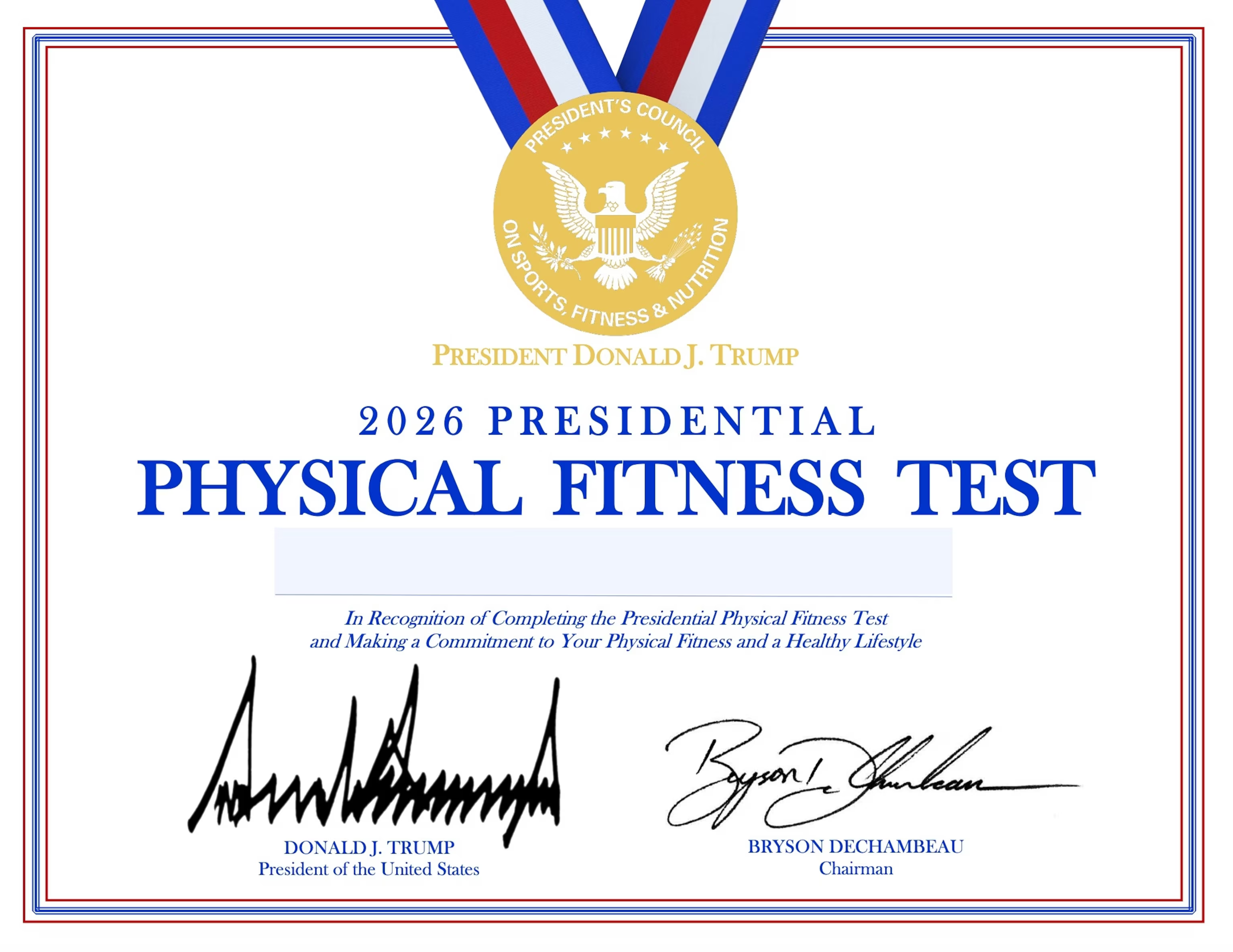
2026 Presidential Physical Fitness Test.The White House
In contrast to other health-related physical fitness assessments that aim to place individuals within a healthy fitness zone, the Presidential Physical Fitness Test involves participants competing against their peers, Goodway noted.
She suggested that children would be more motivated to engage in regular physical activity if they were striving to surpass their own personal bests rather than competing directly against other children.
"Ideally, the objective should be for children to compete against themselves," she stated. "Can I improve my mile run time in the next attempt? Can I achieve a greater jump distance?"
Chad Killian, an assistant professor of kinesiology at the University of New Hampshire, commented that students are not receiving adequate physical education (PE) time in schools each week.
Killian is involved with a group that is surveying PE teachers about the availability of physical activity opportunities within their respective schools.
The National Academies of Sciences, Engineering, and Medicine recommends 150 minutes of PE per week for elementary school students and 225 minutes of PE per week for middle and high school students.
The group’s findings indicate that many children receive significantly less time than the recommended duration, according to Killian.
"When I was an elementary school PE teacher, we had one session per week lasting 30 minutes," he shared with ABC News. "That amounts to 36 sessions in a school year. How can we anticipate children to learn effectively when they lack the necessary time for instruction?"
Killian further elaborated, "If educational institutions are unwilling to allocate sufficient time for children to learn and develop their fitness, then assessing fitness becomes inappropriate."
Both he and Goodway suggested that the effectiveness of the Presidential Physical Fitness Test hinges on its implementation strategy, which should incorporate elements such as consistent practice throughout the year and active teacher involvement.
"During my time as an educator, we conducted it collaboratively," he recalled. "We would engage in it together, offering mutual encouragement. There are indeed effective and ineffective methods for administering fitness assessments."
Sourse: abcnews.go.com