

A supporter of Japan wraps himself under his shirt to shield himself from the sun and heat during the 2026 World Cup football tournament between Japan and the Netherlands, at a watch party in Los Angeles, June 14, 2026.Etienne Laurent/AFP via Getty Images
As the World Cup commences in the United States, public health authorities and researchers are monitoring for indicators of contagious illnesses, sexually transmitted diseases, ailments contracted from food, and other pathogens.
However, health departments in host cities indicate that another factor might pose the most significant health-related danger to teams, players, or spectators: the heat.
Intense heat stands as the most lethal weather-related peril in the U.S., resulting in approximately 2,000 fatalities annually, according to data from the Centers for Disease Control and Prevention (CDC).
"From the outset of our planning, we’ve consistently stated that our primary public health concerns for FIFA events here in Philadelphia revolve around our standard public health issues, including heat and air quality, as these are elements that truly impact everyone," James Garrow, communications director for Philadelphia’s Department of Public Health, informed ABC News.
"There were individuals concerned about conditions like Ebola or hantavirus," he elaborated. "While those are certainly concerning, we assessed the likelihood of their occurrence here as considerably lower."
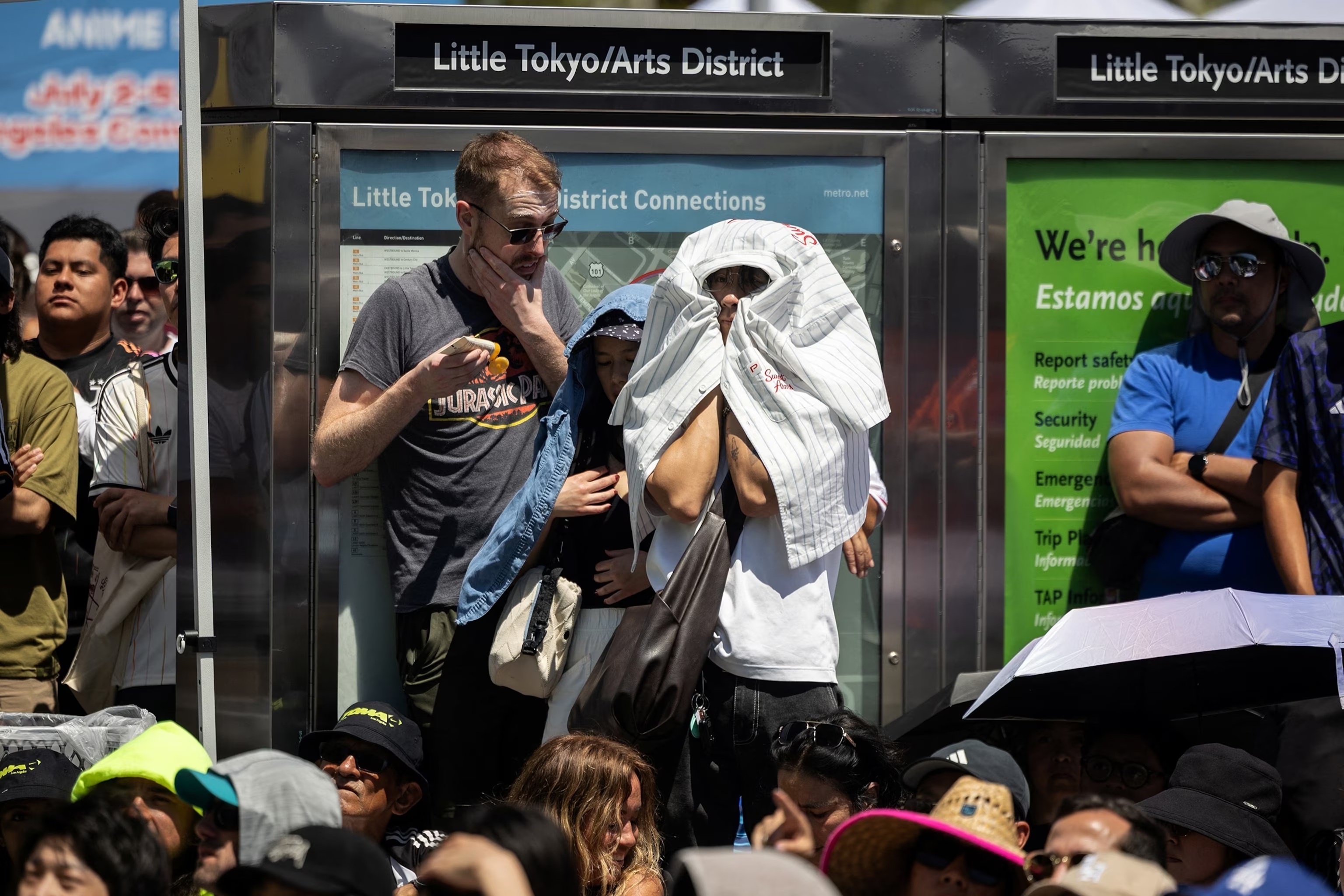
A supporter of Japan wraps himself under his shirt to shield himself from the sun and heat during the 2026 World Cup football tournament between Japan and the Netherlands, at a watch party in Los Angeles, June 14, 2026.Etienne Laurent/AFP via Getty Images
Measures Undertaken by Health Departments for Preparedness
Eleven cities across the U.S. are scheduled to host World Cup matches. Among these is Dallas, which will be the venue for nine games, including a semi-final fixture on July 14.
The National Weather Service has issued a heat advisory for North and Central Texas, encompassing Dallas, effective from 12 p.m. to 9 p.m. CT on Thursday, with heat index values potentially reaching 110 degrees Fahrenheit. According to NWS data, Dallas typically experiences temperatures in the mid-to-high 80s and low 90s during July.
"Heat-related ailments are likely among the most probable issues with a substantial impact on numerous individuals, particularly those arriving from various global locations who may not be accustomed to the Texas heat," Dr. Phil Huang, director of Dallas County Health and Human Services, stated to ABC News.
Dr. Huang mentioned that the department commenced its preparations over eighteen months prior, focusing on safeguarding both players and spectators.
He and other public health department leaders emphasized that communication has been paramount, disseminating crucial advice on maintaining hydration, seeking refuge in air-conditioned environments when feasible, and utilizing protective measures such as hats or sunscreen.
"We are actively disseminating this information, which comprises advisories we issue each season. Therefore, we are striving to convey these messages to everyone, especially those unfamiliar with the Texas heat who might underestimate its potential effects," Huang remarked.
Health departments nationwide are also establishing cooling stations and providing facilities for refilling water bottles.
Dr. Nichole Quick, chief science officer for the Los Angeles County Department of Public Health, informed ABC News that additional cooling centers are activated whenever county-wide heat advisories and alerts are issued.
Garrow reported that nearly 100 cooling centers have been established throughout Philadelphia, and the department has launched a dedicated hotline in collaboration with the Philadelphia Corporation for Aging to address inquiries about the heat or methods for staying cool.

France’s Kylian Mbappe and France’s Michael Olise reacts to the extreme heat during a training session during the FIFA World Cup soccer tournament, at the France base camp in Waltham, Mass., June 12, 2026.Martin Meissner/AP Photo
"Our [FIFA] Fan Festival is situated just outside the city center. However, along the primary route for attendees, we have established five distinct hospitality points offering shade, misting stations, fans, and water bottle refill facilities," he stated. "Furthermore, within the Fan Festival itself, we have erected two substantial tents equipped with fans and misting stations, along with picnic tables strategically positioned in shaded areas."
"Additionally, throughout the rest of the venue, we have deployed more fans, misting stations, and water refill points," he added. "This is all aimed at making it as convenient and accessible as possible not only to access water but also to escape the sun and cool down."
The departments are also collaborating with emergency responders and medical facilities to ensure readiness in treating individuals experiencing heat-related ailments. They have also implemented systems to monitor illnesses in real-time.
Dallas has developed a heat-related illness dashboard that tracks cases of heat exhaustion, heat cramps, heatstroke, and other related conditions, categorized by date, age, and gender.
Los Angeles County has also introduced a heat dashboard that provides weekly data on heat-related emergency room visits and fatalities.
The Physiological Effects of Heat Exposure
Under conditions of extreme heat, characterized by temperatures and humidity exceeding typical levels, the body naturally attempts to regulate its temperature through perspiration.
Failure to adequately replenish fluids can result in dehydration. Subsequently, the body’s core temperature may continue to escalate, potentially leading to other heat-related health issues.
Individuals might experience sunburn, heat rash, or heat cramps, which are typically signaled by muscle discomfort and spasms.
More critical consequences include heat exhaustion or heatstroke, a potentially fatal condition where the body’s temperature surpasses 104 degrees Fahrenheit, and its internal cooling mechanisms cease to function. Symptoms can encompass neurological disturbances such as confusion, impaired speech, loss of consciousness, and seizures.

Croatia fans parade through Dallas, June 16, 2026.Kai Pfaffenbach/Reuters
Research indicates that extreme heat can also adversely affect psychological well-being.
A study conducted in 2021 by the State University of New York at Buffalo and the Yale School of Public Health identified a correlation between brief exposure to extreme heat and an increase in emergency room visits for mental health conditions.
"Heat is indeed one of those weather-related and climate-related phenomena that can affect anyone," stated Quick, from the Los Angeles department of public health. "Even individuals who are generally healthy can be impacted if they are exposed to high temperatures for extended periods, particularly if they are engaging in physical exertion outdoors. Heat poses a risk to everyone. This is precisely why we dedicate significant effort to educating the public and urge everyone to adopt heat preparedness measures whenever weather conditions present a potential heat risk."
Sourse: abcnews.go.com