
-

Ruslan Kyslyak
correspondent
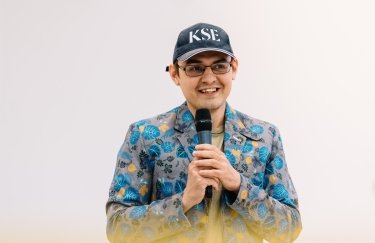
Timofii Brik, sociologist, rector of the Kyiv School of Economics. Photo: facebook.com/tymofii.brik
A well-known Ukrainian sociologist, rector of the Kyiv School of Economics, Timofey Brik, in an interview for Delo.ua, told what the life scenarios of teenagers in Ukraine look like, as well as those of them who went abroad; what is the state of education and science in Ukraine, what is wrong with them and what we have been doing wrong for the last 30 years; how difficult is the process of creating high-quality education, which is in demand by the real economy. He also recommended books that every Ukrainian should read.
The interview took place on the sidelines of the 9th annual research conference of the central banks of Ukraine and Poland .
About education in Ukraine and the prospects of Ukrainians
What do the possible life scenarios of today's Ukrainian teenagers who will soon be entering higher education look like: for those who remain in Ukraine and those who are currently abroad?
— We are dealing with a unique generation — teenagers growing up in times of turbulence, but also with new opportunities. For those who remained in Ukraine, one scenario is to seek quality education here, orient to online formats, focus on flexible skills, and, at the same time, be included in the national reconstruction project.
Our research shows that only a quarter of teenagers want to go abroad. Others want to develop in IT, medicine, trade. A small number, only a third of them, know what profession to choose. In other countries, research shows that this figure is on average 60%. This means that teenagers have a poor idea of their professional future, but they are ready to take risks. It is difficult to work with such a generation, because they are open to changes and risks, but do not know exactly what they want.
For those abroad, there is an opportunity to receive a foreign education, but the dilemma arises: stay or return? And here the state must create incentives for return: in particular, through a transparent labor market, educational programs, and support for young specialists.
What is the current state of the education system in Ukraine, and in particular higher education? What is wrong with it? What have we been doing wrong for the last 30 years?
— There are many problems, but I would like to talk about one that we rarely voice, which is culture. We are used to saying that there is no money, people, political will. But I see that now many people in universities make wrong decisions or behave in a way that makes people not want to be at universities. For example, harassment and sexual harassment. Or the inability to work with foreign grants. Or plagiarism.
This is a situation where people make poor decisions based on their worldview, prejudices, and patterns of behavior that are no longer modern. Where there is a different culture (Ukrainian Catholic University, Mohylyanka, Kyiv School of Economics, American University of Kyiv, and also universities of the Alliance of Ukrainian Universities), there is a different quality result in terms of interaction between students and teachers and scientists. I think that the fight for a quality culture is very important now.
In what directions should modern education in Ukraine develop?
— I would highlight three areas:
- Working on a modern international culture (academic integrity, meritocracy, accountability).
- Close connection with the labor market, very strong attachment to practice (it is necessary to train engineers for the needs of reconstruction, lawyers and economists for European integration, doctors and psychologists for rehabilitation).
- Innovation. Ukraine cannot become strong if it does not have its own original ideas and technologies. That is, education must be connected to science.
How difficult is the process of creating quality education that is in demand by the real economy?
— It's really complicated. I talked about culture because it's something that's been a pain for me, and I try to talk about it with others. But there's also the issue of money and the business model. Who can pay for quality education and how? How can we ensure that talented professionals have high salaries, work on modern campuses, and that students have everything they need to develop?
If during the war the budget is limited, then the state starts talking about the consolidation of universities. But the universities resist. That is, the community itself provides inertia against changes. If we are talking about money from donors, patrons, grants, then the question arises: are all universities capable of working with such money (are they able to receive and use it, is there quality accountability, supervisory boards)?
And at the same time, to maintain a balance in order to train both specialists for the labor market (applied aspect) and innovative scientists (scientific aspect). This is all very difficult and few will be able to win this race with European universities when Ukraine integrates into the EU.
You head KSE. How is it different from other universities in Ukraine?
— First of all, it is not only a university. It is also a large charitable foundation, a large research institute, a business school and a university. These separate areas must somehow be coordinated with each other, so they are managed by the president, and he is accountable to the supervisory board. We have legal entities in the USA and Ukraine, that is, we are accountable and undergo audits in two countries. All this is a guarantee of quality.
The university may receive financial support from the foundation, but for this money they guarantee that they will hire high-quality international professors and teach talented children. The university is also very dynamic and flexible, it is constantly experimenting. This is a special culture where you feel that you can really build something cool from scratch. Most top managers (rector, directors of the foundation and institute) started as junior analysts and assistants who built their careers in 5-8 years. Students here can participate in the selection of teachers and organize the KSE trip to Davos. Most managers do not have offices, planning sessions are held in English, and all employees are very creative and modern people.
Unfortunately, there are few universities in Ukraine with such an atmosphere now. And we are the only university that bought a golf club for the campus to give this place back to the community.
What educational areas do you focus on developing and why?
— We used to focus on economics. Now we say: “Kyiv School of Everything”. That is, we go into any direction that Ukraine needs now for security and development (psychology – to treat trauma, law – to fight for justice and European integration, engineering – to have innovation and security, mathematics – to have fundamental science, urban planning – to rebuild cities). All this is very necessary during and after the war.
What about science in Ukraine? How difficult is it to be a scientist in Ukraine?
— Unfortunately, science in Ukraine is severely underfunded. Modern science in the world is not even done by one university or one country. These are huge alliances and consortia. One university in Ukraine cannot compete against a consortium of EU universities.
We need to understand that we have to scale and unite. Therefore, we need to work in large teams, pool resources. There are many positive changes in Ukraine now (the National Fund for Scientific Research has been established, there are talks about a special tax regime for new science parks, such as Diya.City). But in general, this is a difficult path. Although there is confidence that our military technologies will be very important for the world.
What books would you recommend every Ukrainian to read?
— It would be useful for Ukrainians to read light but thoughtful books about themselves: “The Gate of Europe” by Serhiy Plokhiy or “The Sunrise of the Ukrainian Sun” by Kateryna Zarembo. It is also worth reading the book about economic growth, institutions and culture “The Narrow Corridor” by Nobel laureates Daron Acemoglu and James Robinson. And I advise you to read any books published by “Vikhola”. You can literally choose any book at random.
Read also Timofey Brik's extensive interview for Delo.ua about how to return refugees to Ukraine.