
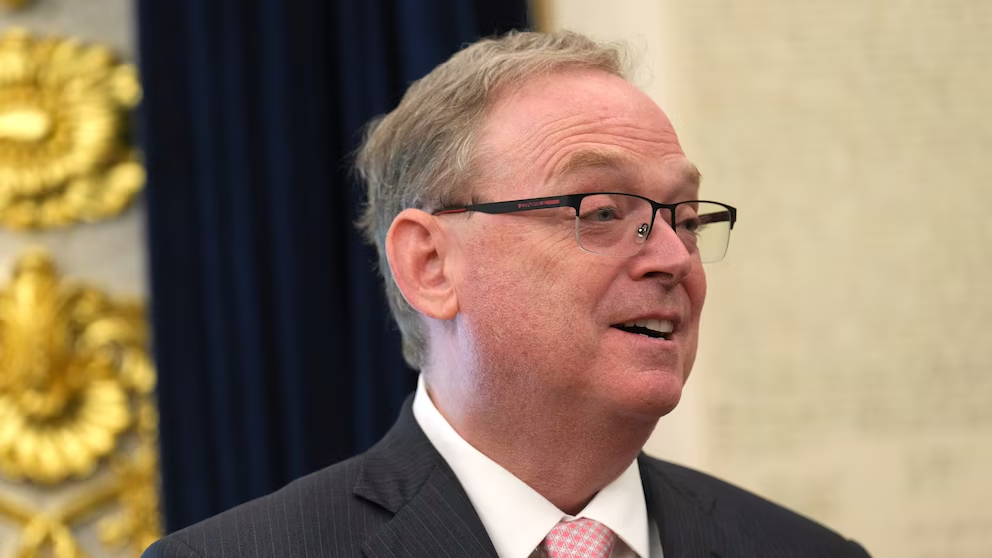
Kevin Hassett, head of the National Economic Council, addresses attendees during an event with President Donald Trump concerning the relaxation of a federal refrigerant regulation, held in the Oval Office at the White House on May 21, 2026, in Washington, D.C. Jacquelyn Martin/AP Photo
Below is a rush transcript of “This Week with George Stephanopoulos” which aired on Sunday, May 31, 2026, on ABC News. This version may not be final, could be subject to revision, and might contain minor errors in transcription. For transcripts from previous broadcasts, please refer to the “This Week” archive.
JONATHAN KARL, ABC “THIS WEEK” CO-ANCHOR: I am now joined by Kevin Hassett, an economic adviser from the Trump White House.
Kevin, we appreciate you being with us.
WHITE HOUSE NATIONAL ECONOMIC COUNCIL DIRECTOR KEVIN HASSETT: Good morning, Jon.
KARL: Are you concerned about the disparity we observed, where the stock market is soaring to new heights almost weekly, while Americans are grappling with elevated gas prices and high inflation?
HASSETT: I believe the report we just heard leaned towards negativity, overlooking considerable positive developments. However, it’s undeniable that gas prices are elevated. While not at their absolute peak under Joe Biden, they are indeed high. Conversely, many other costs are decreasing.
What I’ve noticed here at the White House is a tendency to focus exclusively on any consumer price that appears somewhat disappointing. For instance, during my initial month here, the sole topic of discussion was egg prices, which were high due to avian flu. Egg prices have since dropped by 85 percent.
It’s important to look past short-term fluctuations and examine the trend in real wages. There was actually a factual inaccuracy in the report regarding this; I have the latest real-wage figures with me. Due to increased employment, a robust stock market, and high corporate profits, these benefits are filtering down to employee compensation. For the typical manufacturing worker, real income adjusted for inflation has risen by $2,268. For a manufacturing worker, it’s $3,000, and for a mining worker, it’s $4,500. Therefore, on balance, real incomes and wages are on the rise.
KARL: But are you suggesting that Americans are not experiencing hardship? We are hearing this from numerous economic indicators and, more importantly, from individuals themselves.
HASSETT: Well, actually —
KARL: I mean, people seem anxious and uncertain about the economy, don’t they?
HASSETT: Ultimately, individuals assess their financial situation to make voting decisions. When they examine their budgets and their remaining funds after accounting for price increases, they will find they have more disposable income. Furthermore, the consumer sentiment index that was mentioned is a highly partisan Michigan survey. I discussed this on television last week: when Joe Biden was in office, Democrats surveyed expressed euphoria, with their index exceeding 100 percent during a period of stagflation. Currently, it is at a record low of around 30 percent.
So, when you claim that American consumers are despondent, it reflects the despondency of Democrats. Republicans have consistently remained around 80 percent on that survey. Another metric, consumer confidence, reported by the Conference Board, is near an all-time high. Therefore, when making statements about Americans’ sentiment, we should consult the data accurately and consider the various signals it provides.
KARL: Well, I am simply relaying what I am hearing and what many others are hearing.
But let me inquire about inflation. The Bureau of Economic Analysis released data this week, which is the Federal Reserve’s preferred inflation indicator, showing a rise to 3.8 percent in April. Are you concerned about this? We are observing — and, of course, much will depend on developments in the Middle East. But are you worried about persistent inflation potentially compelling the Fed to raise interest rates?
HASSETT: No. Firstly, you are correct; energy prices are high globally. Gas prices are elevated, which is extremely frustrating, and we are implementing various measures to mitigate disruptions. Hopefully, the situation in the Gulf will be resolved soon, and normalcy will return.
It is accurate that the overall inflation figure, which includes energy costs, is high. However, when examining core inflation, energy price shocks typically do not significantly impact it. This is why the Fed consistently refers to core inflation. As a consumer, however, one is concerned with overall inflation. The reason for the focus on core inflation is that it represents the central tendency of price changes anticipated over the next one to two years.
The Cleveland Fed provides a nowcast for the Consumer Price Index, projecting the upcoming month’s figures. Their forecast for core CPI is 0.23 percent, which I believe is accurate, reflecting our experience that these energy shocks, while difficult at the time, do not significantly influence core inflation.
KARL: So, you are hopeful for an agreement to reopen the Strait, perhaps soon. We’ve heard this for some time, but perhaps it will happen shortly. However, if it does not materialize and the Strait of Hormuz remains closed, preventing tankers from passing, what do you foresee happening to gas and oil prices?
HASSETT: I believe you would agree that oil and gas prices have not escalated as much as many predicted, partly due to people finding alternative solutions. For example, a significant pipeline in Saudi Arabia is now transporting more oil without needing to transit the Gulf.
KARL: Right.
HASSETT: Such adjustments have prevented prices from reaching the $150 or $200 per barrel marks that some had forecast.
My expectation is that once the Straits are reopened—and, in fact, more traffic is already passing through than two weeks ago—the situation will improve. For one of those large tankers, traversing the Straits covers approximately 300 nautical miles per day. Consequently, refineries in Pakistan and India, which are largely idle, will receive their oil.
KARL: Yes.
HASSETT: They will restart operations, leading to a global decrease in refined product prices, which will then propagate. It will likely take a month or two for everything to return to normal for the refineries.
KARL: That assumes the Strait reopens. The International Energy Agency suggests it could take several months for flows to normalize and prices to decrease. However, Neil Chapman, Senior Vice President at ExxonMobil, stated to investors on a conference call this week, “We are approaching unprecedented inventory levels. Truly, remarkably low levels. You can debate whether it will reach those critically low levels in two or three weeks. But once that point is reached, you will see the price surge.”
Therefore, the concern, which I’m sure you share, is that if a resolution is not reached, we could experience a significant increase in not only oil prices but also, consequently, gasoline prices.
HASSETT: Indeed. We monitor inventories daily. We began with billions of barrels in private and government stockpiles, and we still hold billions. Thus, there is ample supply. Additionally, there is considerable pressure on Iran to accept the president’s terms.
Consider the Iranian rial: half a dozen years ago, 4,000 rials would buy one U.S. dollar. Currently, it takes approximately 1.4 million rials to purchase one dollar.
KARL: The Iranian currency.
HASSETT: Yes. Yes.
KARL: Well, their inflation rate is higher than ours.
HASSETT: Yes. This situation also places significant strain on them, particularly on individuals with fixed incomes, who are experiencing considerable hardship.
KARL: Well, Kevin Hassett, you always maintain an optimistic outlook. Thank you for joining us this morning.
HASSETT: It was a pleasure being here, Jon.
KARL: Coming up next, with only five months remaining until the November midterms, which Senate seats are most likely to change hands? The roundtable will discuss this.
We will return shortly.
//
KARL: Alright. Let’s welcome Senator Cory Booker from New Jersey.
Let’s start with the recent rulings against the president. What is your assessment of their significance, and Sarah’s point about congressional oversight being necessary but lacking?
SEN. CORY BOOKER, (D) NEW JERSEY: I concur with her assessment. The Republican-controlled Congress has consistently deferred to this president.
Consider this “slush fund.” It amounts to $1.776 billion, not $2 billion. This figure evokes our nation’s founding principles.
We fought a revolution precisely to prevent such a scenario: a ruler unilaterally directing public funds without any accountability. This president is providing a masterclass in undermining our democracy.
It is unconscionable that a president can allocate funds to himself, usurping Congress’s role, and then disburse them to individuals who assaulted police officers on January 6th.
Therefore, I will continue my efforts over the past few weeks to engage my Republican colleagues. I am currently in constructive discussions regarding bipartisan actions. The Republican Congress has yielded to this president for far too long.
While he invokes historical parallels from 250 years ago, this is precisely why every American should unite to prevent him from degrading our Constitution.
KARL: And just before Congress adjourned for the Memorial Day recess, we did see some Republicans take a stand on this issue, particularly those who will not be returning, largely due to being ostracized by Trump. Cassidy lost his Republican primary in Louisiana. Now, Cornyn is also facing a lame-duck status.
Are you — do you anticipate increased opposition from Republicans? What are the specifics of these discussions you are having?
BOOKER: I absolutely do. And in private conversations, Republicans express their profound dismay and astonishment at the president’s conduct. Consider this: the president has appropriated a revered memorial to an assassinated president and attached his own name to it.
What’s next? The Trump-Lincoln Memorial? May God bless America.
He seeks to emblazon his name on our currency, our passports, and our park passes. When the courts intervene to stop him, he reacts like a petulant child, declaring, “I will take my toys and leave.” This implies he will abandon the institution, which he has already jeopardized through near-bankruptcy by withdrawing initiatives, and allow it to deteriorate.
We must put a stop to this. It is time for Republicans to recognize their oath is to the Constitution, not to Donald Trump.
KARL: Let’s delve into that further. There are two relevant points here. First, the Kennedy Center. It appears he is suggesting, “Okay, I will proceed, and it becomes Congress’s responsibility now.”
What does this signify? Do you have any insight into the current implications for the leadership of the Kennedy Center?
BOOKER: Yes, this is characteristic of Trump’s actions. We witnessed similar behavior in New Jersey, where he has caused the downfall of businesses and casinos. This president’s career is a testament to failure.
He has now impacted an institution that had numerous performances scheduled. After attaching his name to it, it encountered severe financial difficulties. Subsequently, he announced its impending closure, stating his intention to close it regardless and to solicit funds for an alternative.
This is the individual currently leading our nation—someone behaving like an unrestrained child, rather than demonstrating thoughtful, bipartisan, and democratic approaches to governance.
KARL: And —
BOOKER: The reason this is occurring, as you mentioned, is because Congress is permitting it. We possess the authority to hold him accountable, yet we are not exercising it.
KARL: Regarding the 250th anniversary of America, performers have withdrawn their participation in the Mall celebration. President Trump has announced his intention to transform it into a “Make America Great Again” rally, with himself as the featured entertainer.
What guidance are you offering? How should this anniversary—a pivotal moment in our nation’s history—be commemorated? How can we prevent it from becoming a purely partisan event?
BOOKER: This is precisely the issue with Trump; he is the chief divider. My hope is that people are recognizing, beyond his intentions, that this situation serves as a reminder of what American history has always represented: the power of the people triumphing over those in authority. We are not a nation of kings, princes, or rulers, but of Americans who, when witnessing the unjust exercise of power—whether through the labor movement, the abolitionist movement, or the civil rights movement—have risen against authoritarian figures to strengthen our democracy.
This is a moment where we have a leader who, unfortunately, reminds us of the perils facing democracy when a president acts without restraint. The educational takeaway here is that the only way to ultimately stop him is for more individuals to stand up and voice their opposition. This is how our nation was founded.
KARL: So —
BOOKER: This is how we have navigated crises in the past, and it is what is required now.
KARL: So, how crucial is it, in your opinion, for Democrats to regain control of the Senate, and how actively will you participate in this endeavor?
BOOKER: While you mention Democrats, I believe this election presents a broader choice than just left or right; it is about right versus wrong. If Congress fails to check the president, surrenders its war powers and fiscal authority, and if the president publicly targets judges who rule against him and attacks the judiciary, what recourse do we have? We must elect individuals to Congress who will uphold their constitutional duties, including checks and balances, oversight, and accountability.
Therefore, I will dedicate all my efforts. I will be campaigning extensively throughout New Jersey, as I am on the ballot, and across the nation, highlighting the attacks on voting rights and the manipulation of electoral districts mid-decade to secure power for a minority. All these actions represent an assault on the principles our ancestors fought for.
KARL: So —
BOOKER: As I stated, during my visits to Birmingham and Montgomery, our ancestors are observing, questioning what we will do in this critical moral juncture for our country, much as they sacrificed and bled for it.
KARL: One of the prominent Senate races is in Maine, where the presumptive Democratic nominee is Graham Platner. Numerous allegations have surfaced against Platner, including the most recent controversy reported by “The Wall Street Journal,” alleging that his wife, Amy, brought sexually explicit text messages between Platner and several other women to the campaign’s attention during the vetting process. In a video posted on X, his wife Amy stated that they share a deep love, have a strong marriage, and are undergoing counseling.
However, let me ask you, do these accumulating controversies raise concerns that they might jeopardize the Democratic Party’s prospects of securing that Senate seat in Maine?
BOOKER: Yes, I have concerns. That individual has issues that require explanation. That is the purpose of campaigns. However, as I travel across New Jersey and witness hundreds of thousands of residents losing their healthcare and millions more facing increased healthcare costs, and as I hear from families struggling to afford gas for their cars and childcare for their children, I recognize the immense stakes for Democrats in regaining control of the Senate. If we fail to secure the necessary votes to win the House and the Senate, we will continue to have an unchecked president.
Let me be clear: he is a lame-duck president, becoming increasingly dangerous. Observe the overseas conflict, the lives lost, the billions expended, and now his shameful attempt to re-engage, seeking to return us to the pre-war situation. This man poses a significant danger, and it is imperative that we reclaim the Senate. That is my focus.
KARL: All right, Cory Booker of New Jersey, thank you for joining us.
Sourse: abcnews.go.com