
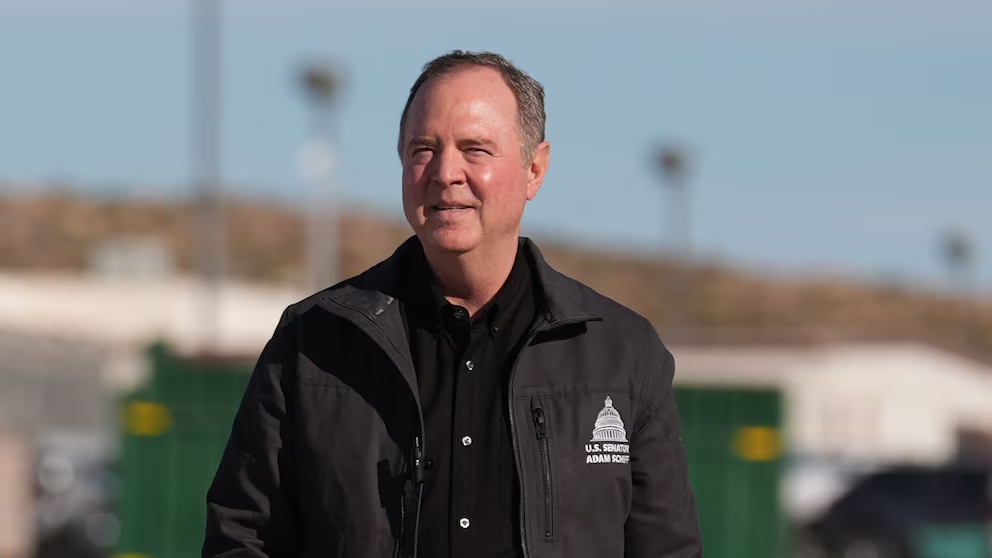
1:10Sen. Adam Schiff is shown during a visit to an immigration detention center in California City, Calif.Marcio Jose Sanchez/AP
A rush transcript of "This Week with George Stephanopoulos" airing on Sunday, February 8, 2026 on ABC News is below. This copy may not be in its final form, may be updated and may contain minor transcription errors. For previous show transcripts, visit the "This Week" transcript archive.
(COMMERCIAL BREAK)
JONATHAN KARL, ABC “THIS WEEK” CO-ANCHOR: It was a wild week, even for the Trump era. The president shared a racist social media post. We learned he tried to leverage $16 billion in federal funding to get Penn Station and Dulles Airport named after himself. And he called on Republicans to, quote, “take over the voting” in elections. "THIS WEEK" starts right now.
(BEGIN VIDEO CLIP)
DONALD TRUMP, PRESIDENT OF THE UNITED STATES: If a state can't run an election, I think the people behind me should do something about it.
KARL: President Trump's calls for Republicans to, quote, “nationalize the voting” sparked bipartisan backlash.
UNIDENTIFIED MALE: I think I’d rather stand on the high ground of states' rights.
SEN. RICHARD BLUMENTHAL (D-CT): He wants totalitarian control over our election.
KARL: And why was the Director of National Intelligence at last week's FBI raid of a Fulton County election office? Democrats sound the alarm.
UNIDENTIFIED MALE: This threat to our election security, the basic premise of our democracy, is forward looking.
KARL: And widespread condemnation.
REP. HAKEEM JEFFRIES (D-NY): This disgusting video posted by the so-called president was done intentionally.
KARL: The president posts, and 12 hours later, deletes an overtly racist video of Barack and Michelle Obama. But he refuses to apologize.
TRUMP: No, I didn't make a mistake. I looked at the beginning of it. It was fine.
KARL: This morning, Democratic Senator Adam Schiff and Republican Congressman Mike Lawler.
And Congress gets a look at un-redacted Epstein files starting tomorrow morning. The roundtable on what to expect.
Plus, desperate search.
SAVANNAH GUTHRIE, NANCY GUTHRIE’S MOTHER: We beg you now to return our mother to us so that we can celebrate with her. This is very valuable to us. And we will pay.
KARL: The family's latest message as the urgent search for Nancy Guthrie enters its eighth day.
(END VIDEO CLIP)
ANNOUNCER: From ABC News, it's "THIS WEEK." Here now, Jonathan Karl.
KARL: Good morning. Welcome to "THIS WEEK."
We’ll get to the news here in Washington in a moment, but we begin with the latest developments in the mysterious disappearance of Nancy Guthrie, the mother of our colleague at NBC, and my good friend, Savannah Guthrie.
It's now eight days since the 84-year-old mother and grandmother was taken from her Tucson, Arizona, home in the middle of the night, with still virtually no clues about her whereabouts as we pray for her safe return. Overnight, Savannah and her siblings released a new message titled “Bring Her Home.” It directly addresses whoever took their mother.
Take a listen.
(BEGIN VIDEO CLIP)
SAVANNAH GUTHRIE, NANCY GUTHRIE’S DAUGHTER: We received your message. And we understand. We beg you now to return our mother to us so that we can celebrate with her. This is the only way we will have peace. This is very valuable to us, and we will pay.
(END VIDEO CLIP)
KARL: For the very latest on the investigation, let's bring in ABC's Aaron Katersky, who joins us live from Tucson.
Aaron, what are your law enforcement sources telling you about this latest video?
AARON KATERSKY, ABC NEWS CHIEF INVESTIGATIVE CORRESPONDENT: When Savannah Guthrie, John, references receiving a message, she's talking about a note that was received from a Tucson television station on Friday evening. And the FBI and the Pima County Sheriff's Department have been analyzing that message from Nancy Guthrie’s supposed kidnapper. As yet, they have not been able to validate its authenticity.
But, Jon, it's clear the Guthrie family is grasping at anything that could bring the 84-year-old in fragile health home to them one way or another. And Savannah's post, just like the family's previous post included carefully calibrated, deliberate language, not to antagonize any captors, but to show a degree of seriousness. They promised to pay to bring their mother home.
KARL: What else have investigators been looking at this week? And have they seen any sort of — has there been any proof of life offered by the supposed abductors here?
KATERSKY: There have — has been no proof of life at all. And we’ve talked to the sheriff here about that, Jon. He says he believes that she is alive, but that is a belief based on hope and on a positivity to keep detectives and investigators engaged and optimistic. The family is clearly frustrated by the lack of developments. We’ve seen the FBI back here at the house this week. They were on the roof inspecting cameras. They towed a car. They were going door to door in the neighborhood. They were tracking a possible vehicle of interest that may have been spotted during a narrow 45-minute window in the wee hours of last Sunday morning when police believe Nancy Guthrie was taken.
But, Jon, there are no suspects. There is no video. And, crucially, no proof that Nancy Guthrie is still alive.
KARL: All right, thank you, Aaron.
Let's bring in former FBI agent and ABC News contributor Brad Garrett.
Brad, you have been involved in many hostage negotiations in your time at the FBI. What is your read, based on these latest developments, about where this stands?
BRAD GARRETT, FORMER FBI AGENT & ABC NEWS CONTRIBUTOR: So, what's interesting, Jon, is that you don't really have some of the same elements in this case that you may in what I would call a traditional kidnapping. Someone’s taken. They contact the folks. They could have money, potentially, and they work that out. There's a give and take and a give and take. This is not even designed or set up to do give and take. Either direction, either from the bad guys or to the Guthrie family. And so, as a result, this is kind of a one-way street in a way of the bad guys basically saying, you need to do x, you need to do y, we’ll give you a little bit of information that we do have your mother, and you’re going to pay us x or there will be consequences, which I assume would be death.
KARL: Do you —
GARRETT: But go ahead.
KARL: Do you think that those messages are actually from the people that took her? And is your read that they think — the FBI thinks they're real?
GARRETT: I think maybe I think is the best answer because I haven't heard — they're not sharing with us, obviously, how they have been able to validate these notes one way or the other.
KARL: Yes.
GARRETT: But you’re talking about IP addresses that maybe they have been able to do something with. If you’re really good at covering that, it could take some time to get to. In other words, who sent the — who sent the message —
KARL: Yes, where did they come from?
GARRETT: Exactly.
KARL: You know, one thing that we’ve heard about the messages is that they set a deadline of sometime tomorrow to get the ransom or consequences will be paid.
GARRETT: Yes.
KARL: You have been in these negotiations. How do you — how do you handle the approaching deadline like this?
GARRETT: Well, you know, ultimately it’s up to the family as to whether the money gets paid or not. And so, as a result, I think — and Svannah said that they’re — you know, they’re willing to pay. So, is that going to happen? Are they ever going to get proof of life? It’s — you know, it’s — you wouldn't want them to pay it until you get proof of life, but I'm not convinced, if these notes are legitimate, that they’ll ever see proof of life. She may pay it and not see her mother.
KARL: How often does that happen in —
GARRETT: It has happened. It has happened where there's — you know — well, it was — you know, the actual kidnappers, they took a person, and then they got the ransom, and then they left.
KARL: (INAUDIBLE).
GARRETT: Yes.
KARL: All right, Brad Garrett, Aaron Katersky, thank you to both of you.
We turn now to President Trump's calls this weekend for Republicans to, quote, take over the voting and to nationalize elections. The latest in Trump's long-running obsession with overturning the election that he lost in 2020 to Joe Biden. But Trump's words this week are raising questions about what he’s planning to do and whether he will try to interfere with the midterm elections coming up this November.
(BEGIN VIDEOTAPE)
KARL (voice over): Donald Trump made it crystal clear this week that he still hasn't gotten over losing the 2020 election. Even at the National Prayer Breakfast, he was talking about it, offering a new reason he cannot accept that he lost.
DONALD TRUMP, PRESIDENT OF THE UNITED STATES: They rigged the second election. I had to win it. Had to win it. I needed it for my own ego. I would have had a bad ego for the rest of my life.
KARL (voice over): In fact, Trump not only lost that election, he lost some 60 times in court attempting to overturn his loss. Now he’s taking extraordinary new actions related to 2020 that have serious implications for the next election. In an interview with his former deputy FBI director this week, he called on Republicans to take over elections in places he had lost.
TRUMP: The Republicans should say, we want to take over. We should take over the voting — the voting in at least many, 15 places. The Republicans ought to nationalize the voting.
KARL (voice over): Nationalize the voting? Republicans in Congress, even the Trump loyal speaker of the House, quickly said they didn't want that to happen. And the White House said that's not really what Trump meant.
And then he said it again.
TRUMP: A state is an agent for the federal government in elections. I don't know why the federal government doesn't do them anyway.
KARL (voice over): So, what's going on here? The Constitution says states control the times, places and manner of holding elections. And that Congress can make changes, but there's no role for the president or the executive branch.
Which brings us to Fulton County, Georgia.
FBI AGENT: Because we —
UNIDENTIFIED MALE: I got you.
FBI AGENT: — one way or the other, the records are coming with us today.
KARL (voice-over): County officials there this week sued the federal government to get their ballots and other records back. They were taken by the FBI in yet another attempt by Trump to challenge his loss there in 2020.
MARVIN ARRINGTON JR., FULTON COUNTY COMMISSIONER: If they believe that Fulton County is a hotbed of fraud, why are they only looking at the 2020 election? Why not look at the 2024 election where he won? Why not look at the 2016 election where he won, right? Because he likes the outcome.
KARL (voice-over): And remember, Georgia's Republican governor, Brian Kemp, has repeatedly said Trump's claims of election rigging are false, writing in 2023, "The 2020 election in Georgia was not stolen. And our elections in Georgia are secure, accessible, and fair."
One of the mysteries about the FBI raid in Fulton County is why Director of National Intelligence Tulsi Gabbard was there. At first, the Department of Justice suggested she just happened to be in town.
REPORTER: Could you please explain Tulsi Gabbard's role in DOJ activity regarding the Fulton County search?
TODD BLANCHE, DEPUTY ATTORNEY GENERAL: What do you mean her role?
REPORTER: It was reported that —
BLANCHE: She was — she happened to be present in Atlanta? I mean, yes, I'm — I saw the same photos you did.
KARL (voice-over): But on Monday, Gabbard told members of Congress her presence was requested by the president.
Two days later, President Trump said he had no idea why she was there.
DONALD TRUMP, PRESIDENT OF THE UNITED STATES: I'm not involved in it, but they are inspecting and checking the ballot.
TOM LLAMAS, NBC ANCHOR: Why is Tulsi Gabbard there?
TRUMP: I don't know.
KARL (voice-over): Very next day, Trump said it was the attorney general who sent her.
TRUMP: She took a lot of heat two days ago because she went in — at Pam's insistence, she went in and she looked at votes.
KARL (voice-over): That came as we learned this week that Gabbard's office oversaw an examination of voting machines in Puerto Rico last year, pursuing a bizarre and debunked claim that the machines were rigged by Venezuelan dictator Hugo Chavez, who died years before the 2020 election. Again, why does it matter? Because most U.S. intelligence agencies by law have no role in domestic law enforcement.
So, what's going on? Democrats claim Trump is really laying the groundwork to undermine upcoming elections.
SEN. MARK WARNER (D-VA), INTELLIGENCE COMMITTEE VICE CHAIR: Here's a guy that was obsessed about losing in 2020, obsessed about losing in Georgia. And I believe they may be intending to interfere in our elections in ‘26 and ‘28.
KARL (voice-over): At least one prominent Trump ally who regularly talks to the president says that's exactly what should happen on his show, “The War Room”.
STEVE BANNON, FORMER TRUMP WHITE HOUSE CHIEF STRATEGIST: And President Trump has to nationalize the election. You got to put not just I think ICE. You got to call up the 82nd and the 101st Airborne on the Insurrection Act. You got to get around every poll.
KARL (voice-over): Bannon's words there echo something Trump's former national security adviser, Michael Flynn, called for in 2020.
MICHAEL FLYNN, FORMER TRUMP NATIONAL SECURITY ADVISER: Within the swing states, if he wanted to, he could take military capabilities and he could place them in those states and basically rerun an election in each of those states.
KARL (voice-over): Trump didn't do it in 2020, and the White House insists the president has no plans to deploy either ICE or the military to polling places in November.
But with the FBI raid in Fulton County, the Trump administration is already taking steps it did not take in 2020. Back then, he wanted his then attorney general, Bill Barr, to seize ballots and voting machines, but Barr refused, saying the election was free and fair.
Now, Trump has an attorney general willing to go along. And he's talking about nationalizing elections with no clear explanation of what that would mean.
(END VIDEOTAPE)
KARL: And I'm joined now by Senator Adam Schiff of California.
Senator, what does he mean? What do you think he means when he says nationalize the elections or specifically that Republicans should take control of the voting?
SEN. ADAM SCHIFF, (D) CALIFORNIA: I think he’ll — intends to try to subvert the elections. He will do everything he can to suppress the vote. And if he loses the vote, and I think the Republicans now expect they'll get a real drubbing in the midterms, he's prepared to try to take some kind of action to overturn the result.
And we really shouldn't question that. We saw him try to the point of insurrection to overturn the 2020 election. We see him now taking these extraordinary steps with an election now years ago.
He's basically telling us he intends to interfere in this coming — upcoming election. He hasn't brought prices down. There's chaos and killing in American streets by ICE agents.
The public has turned against him. In every election we've had since his election, the voters have swung wildly against him. And as you know, he said at that prayer breakfast, his ego cannot stand another loss.
So, we have to prepare for the worst. We have to prepare in every way we can. And frankly, the best preparation we have is not the Congress because Republican senators for the most part are not going to stand up to him.
The courts are useful at the lower levels, but at the Supreme Court, they have left him unrestrained.
The best protection we have is to mobilize the largest voter turnout in U.S. history to so overwhelm the vote and get the kind of margins we saw in Texas in the special election so that there's no way they can cheat.
KARL: But on this idea of, quote, “nationalizing the elections,” obviously the Constitution says the states control the elections. Congress has — could have a role. Congress can change those regulations, the Constitution tells us, but Thune, the Senate leader, Republican Senate leader, and Johnson, the speaker of the House, Republican speaker of the House, have both said they oppose this.
So, given that set of facts, there's nothing that Trump can do legally, is there, to, quote, “nationalize the elections”?
SCHIFF: Well, this depends on a couple things. It depends on whether the Republican leads you just quoted really hold fast to that. And, time after time, we have seen them initially make statements of willingness to stand up to the president and his lawlessness, in this case is a willful defiance of the Constitution. But we’ve seen that melt away.
But also, this is a president more than willing to act lawlessly. More than willing, I think, as we see in Georgia, to deploy the Director of National Intelligence, who has no role in election whatsoever. Her job is to oversee the work of the intelligence agencies outward focusing on foreign threats, not to create a threat to our domestic tranquility by interfering in elections. But that’s what they’re doing.
So, you know, we cannot ignore what they’re telling us they're going to do because time and time again we have seen that they’re willing to go to extraordinary and lawless lengths. The last, best hope for our democracy is not going to be the Congress or the court, it’s going to be the American people.
KARL: SO —
SCHIFF: And the American people are speaking out and they are protesting and they’re going to turn out, I hope, in the most massive numbers in November.
KARL: You — you’re a — been involved in intelligence. You were the chair of the Intelligence Committee in the House. Can you explain why is it concerning that the Director of National Intelligence would not only be present for an FBI raid of this — you know, to get the ballots in Georgia, but also there at a meeting with FBI agents and putting the president of the United States on the phone during that meeting? Explain why this is of concern.
SCHIFF: Well, this is alarming at every level. First of all, why is the FBI conducting a raid five years after the fact when there were three recounts in Georgia? Why are they even there?
And, remember, this is the site of the election in which the president called Brad Raffensperger, the secretary of state, the Republican secretary of state, and demanded he find 11,780 votes that don't exist. So, what are they doing there now? Are they going to manufacture some claim, having seized ballot boxes, that there were, in fact, 11,780 votes? And why is the director of intelligence, who has no role in domestic law enforcement there, what is the president personally doing on the phone with FBI agents during a raid? All of this is unprecedented. I think all of this is intended to send a message, and the message is, we will not tolerate or accept an election that we lose.
And we need to pay attention to this. It's why I think in these budget discussions we need to make sure to insist among other things that we don't have ICE agents at polling places. We're going to make sure that those elections take place and that they’re free and that they’re fair, because this is what’s going to stop this country from sliding into some kind of dictatorship.
KARL: I want to play something that your Republican colleague, Alabama Senator Tommy Tuberville, said this week on "Fox Business."
(BEGIN VIDEO CLIP)
SEN. TOMMY TUBERVILLE (R-AL): President Trump wants same day voting, mail ballots, get rid of these voting machines. There's a half a dozen people, whether it’s the House or Senate, Larry, that are up here as we speak that did not get elected. It was all bogus because we’ve seen the evidence. And if we don't straighten that out, you’re going to see alto more of it this fall.
(END VIDEO CLIP)
KARL: Now, President Trump actually took that clip and posted it on his social media feed. What — how do you respond to those extraordinary and unfounded allegations from Senator Tuberville?
SCHIFF: Well, this is just the latest iteration of the big lie. He is laying the foundation to challenge the results of November if they go against the president and his party. And it’s not just Tommy Tuberville. You cited a moment ago Speaker Mike Johnson as somehow defending our Constitution. Well, Mike Johnson was also saying something very similar to Tommy Tuberville. He said that three House — or three Republicans in California were ahead on election day and lost when the absentee ballots came in in California, and therefore there must be fraud. And he couldn't prove it but he was sure that it took place.
Well, that's the same kind of big lie that you're hearing from Tommy Tuberville, that you heard from Donald Trump, and continue to hear from Donald Trump. This is part of laying the foundation to challenge the result when they lose in the midterms. And we need to call it out. We need to spell it out.
Even as they are saying, people don't trust the elections, they are the reason why people don't trust the elections because they keep telling the American people that somehow American elections are untrustworthy. It is the same thing you see of tin pot dictators anywhere.
KARL: So Republicans are making a push for the so-called SAVE Act, at least some Republicans are. It would require a proof of citizenship to be able to vote. I understand you and other Democrats oppose that. Roughly 20 some — or some million voting age Americans who don't actually have the — the papers that would be required to show, readily available.
But given there's — the Republicans have undermined confidence in elections and the integrity of elections, what about the — what about the idea of voter I.D., a photo I.D. being required to vote? Are you in favor that? Can there be a compromise where Democrats and Republicans put forward photo I.D. as a requirement for voting?
SCHIFF: So, you know, Jonathan, what you've just asked is essentially Republicans have created distrust in the elections by making non-existent — by making claims of non-existent fraud in the elections. And shouldn't we use the distrust they've created in order to enact a voter suppression law, which is the SAVE Act, which would require people to have a birth certificate or passport, documents that millions of Americans don't have, almost half the country doesn't have a passport? And I don't know where many would even find a birth certificate.
So, no, we're not —
(CROSSTALK)
KARL: I was — no, no, no. But I asked you —
SCHIFF: — only fraud claims. Yes.
KARL: But I was asking you a different question. Photo I.D. because, as you know, let's show — there was a recent poll. There's been a lot of polls on this. But in one recent Pew poll, 83 percent of adults support requiring photo I.D. to vote. 71 percent of Democrats favor requiring photo I.D. Is that something that you can support? And if not, why not?
SCHIFF: It's still going to be something, Jon — it's still going to be something that disenfranchises people, that don't have the proper real I.D., driver's license I.D., that don't have the I.D. necessary to vote, even though they are citizens. This is another way to simply try to suppress the vote. And the last thing I think we want to do is discourage more people, more citizens from voting while they are attacking those same elections, while they're trying to do away with absentee ballot voting, while they're trying to do away with being able to register to vote through the DMV or by the mail.
KARL: All right.
SCHIFF: So it's part of the broader disenfranchisement effort. And no, I don't think that's the right direction.
KARL: All right. Senator Schiff, thank you for joining us this morning.
Coming up, he was one of the first Republicans to criticize President Trump's racist social media post. Congressman Mike Lawler joins me next. We're back in two minutes.
(COMMERCIAL BREAK)
KARL: I'm joined now by Republican Congressman Mike Lawler of New York.
Congressman, thank you for joining us.
You were one of the very first Republicans to come out and condemn the president's social media post that had those images of the Obamas as apes.
Here's what you said: “The president's post is wrong and incredibly offensive — whether intentional or a mistake — and should be deleted immediately with an apology offered.”
Now, after you said that, they were still defending it, but it did get deleted eventually after about 12 hours.
Should the president apologize?
REP. MIKE LAWLER, (R) NEW YORK: Look, I think sometimes in our public discourse, it is best to just say “I'm sorry”. You know, I take the White House at their word that this was a mistake, but at the end of the day, given the history of our nation, given the insensitivities with some of the stereotypes that have long been promulgated to attack African-Americans, I think it's imperative to recognize that, and meet the moment.
And you know, I think sometimes it's just best to say “I'm sorry”, and do better. And I think, you know, given the situation, I'm glad they deleted it. But that type of meme or, you know, implication is wrong. And I think, whoever created the original meme, is an idiot. And really, that type of content should not exist in our country. I think everybody should recognize the history and really do better.
KARL: And what do you make of the fact that the White House — about the time you were condemning it — said that people like you were guilty of fake outrage, that this was fake outrage, this was just a — you know, a simple Internet meme? I mean, how do we go from there to and then like many hours afterwards they delete it? But they don't — they don't sort of sure as heck don't seem sorry about it in any way.
LAWLER: Look, I think Tim Scott obviously was one of the first people to speak out. I don't think he was engaged in fake outrage.
I think the vast majority of Americans recognize that that type of imagery and trying to, you know, compare the first Black president to a gorilla or a monkey is insensitive. It's offensive. It's racist. And I think most Americans recognize that. And it was rightly condemned.
And as I said in my statement, whether it was intentional or a mistake, the fact is it's wrong and we should all just be able to acknowledge that and move forward.
KARL: All right. You've been clear on that.
Let me ask you about something else this week. We learned that President Trump told Chuck Schumer, the Senate leader, that he would be willing to unfreeze $16 billion in funding for a major infrastructure project in New York and New Jersey if the president — if Schumer were willing to endorse the idea of renaming Penn Station and, by the way Dulles Airport after Donald Trump. How — how is that okay?
LAWLER: So, a few things here. Number one, this is a critical infrastructure project in the Northeast corridor. It's also critical for my district, you know, representing Rockland County, which is west of Hudson.
We do not have a one seat ride into Manhattan by train. And so, this project is critical towards that. I've been fully in support of it. It's a — you know, multibillion dollar infrastructure project, thousands upon thousands of jobs in my district and across the region relying on it. I have been against freezing the funds.
But how did we get here? Chuck Schumer decided last fall to shut the government down for 43 days. And as a result, this critical infrastructure project was frozen during that shutdown in which the entirety of the federal government was depleted of funds.
I know there have been numerous conversations between the president and Senator Schumer to try and resolve this. Chuck Schumer again shut the government down last week.
Ultimately, this is a negotiation between the two of them that I think can get done. I recall back when I was in New York politics, Andrew Cuomo negotiated the renaming of the Tappan Zee Bridge after his father and the renaming of the Triborough Bridge after his former father-in-law, RFK.
KARL: Yeah.
LAWLER: This is not new. Renaming critical infrastructure projects
KARL: I know, but if I can —
LAWLER: — is not a new concept.
KARL: But if I can say —
LAWLER: Let me just finish, Jon.
KARL: OK, but I mean, he's holding the money hostage for having these things named after him. I mean, this is not like part of a — let's honor somebody. He wants it named after himself and he's saying he'll unfreeze the money if they'll do it.
LAWLER: Jon, at the end of the day, to me, I really could care less what the name of a building is, a critical infrastructure project is. I care that it gets done. And ultimately, from my vantage point, you know, work it out.
These guys have known each other for roughly 50 years. This goes back a long time. From my vantage point, we never should have got here, which is part of the reason why Chuck Schumer never should have shut the government down. And these funds never would have been frozen to begin with.
So, let's get the situation resolved so we can actually get people back to work. I really don't give a hoot what a building is called.
KARL: A judge on Friday temporarily stopped the president from freezing the funds, saying this was obviously money that was appropriated by Congress.
Anyway, before you go, you had an interesting op-ed in "The New York Times" about immigration, saying that not only do we need security on the border, we need reforms to the way ICE is operating. We need a legal pathway forward for people that are here illegally. Tell me why this is important and if you've gotten any traction on this.
LAWLER: Look, this is an issue that I've been focused on for years. For 40 years, we have not solved our immigration crisis. The American people were rightly outraged by what happened under the Biden administration, where you had over 10.5 million migrants cross our border, most of them illegally.
Poorest southern border, needed to be shut down. President Trump did that. The fact is that we have had nine straight months of net zero illegal border crossings. You've had 675,000 people deported, 1.9 million people self-deport.
Many of those folks, criminal aliens or people who have been involved in the criminal justice system, the American people overwhelmingly support that. But what they do believe, if you've been in this country, right or wrong, for five, 10, 15, 20 years, your children and your grandchildren are American citizens. People don't want to see families broken apart.
And so, there's got to be a legal path forward, not a path to citizenship, but a legal path forward for people to come out of the shadows so that they can work legally, that they can pay their taxes, pay any back taxes owed, pay a fine, not collect government benefits, and not commit a crime.
That is the basis of the Dignity Act, so that we can actually start to solve a crisis that has been in effect for 40 years. We have over 25 million people in this country who are undocumented. You're not rounding them all up and kicking them out. It's not realistic.
So, how do you deal with this in a way that is both compassionate, but tough? And I guarantee you, 10 out of 10 would take the deal to forego citizenship to have a legal path forward.
And we have a broad bipartisan coalition that has come together behind that. There's over 30 co-sponsors, Republicans and Democrats. And in my opinion, that is a key component of actually fixing this problem.
It is not amnesty. It is not just letting people stay in this country. The fact is, they would forego citizenship. They would not get the right to vote. They would, however, have a legal path forward.
(CROSSTALK)
KARL: All right, Congressman Lawler. Unfortunately, we're out of time. It's an idea that Republicans and Democrats have supported for some time. We'll see if it goes anywhere. Thank you for joining us this morning. Appreciate it.
LAWLER: Thank you.
KARL: Up next, starting tomorrow, Congress will get access to the unredacted Epstein files.
The roundtable is next.
(COMMERCIAL BREAK)
REP. MIKE JOHNSON (R-LA): You will well and faithfully discharge the duties of the office on which you are about to enter, so help you God.
REP.-ELECT CHRISTIAN D. MENEFEE (D-TX): I do.
JOHNSON: Congratulations. You’re now a member of the 119th (ph) Congress.
We have a one-vote margin now. So, what could go wrong? That’s fine. We're happy for him. And I hope the first vote does not shut the government down. That’s not a good way to start.
(END VIDEO CLIP)
KARL: The newest member of Congress, Christian Menefee, was sworn into office this week after a special election win in Texas. Speaker Johnson's razor-thin Republican majority just got thinner.
I'll be right back with the roundtable.
(COMMERCIAL BREAK)
KARL: And the roundtable's here.
Former DNC chair Donna Brazile, former Republican Congressman Patrick McHenry, SCOTUSBlog editor Sarah Isgur, and former governor of New Jersey, Chris Christie.
Donna, I want to start with that despicable and overtly racist video that ended up on — that was posted on the president's feed. What do you make of all of this?
DONNA BRAZILE, FORMER DNC CHAIR & ABC NEWS CONTRIBUTOR: Well, first of all, I feel more sorrow than rage. Sorrow because the president of the United States clearly understand that this type of — I don't know what he wants to call it. It is just outrageous. It's uncalled for.
We spent 250 years of slavery, 100 years of Jim Crow before we elected our first Black president. Barack Obama remains one of the most popular living presidents, and his Gallup numbers are between 59 and 63.
The president, this was a deliberate act — a deliberate act, I believe that the White House put this out. And for — for whatever reason, the president still believes that he can divide us and detract us.
He's not going to be able to destroy us. You know why? Because this country was founded on principles that people believe in, that we still want to accept, and we're not going to let anyone take us back. And I — I'm sorry that the president of the United States should know better, but unfortunately, he's not going to improve.
KARL: And, Chris, he took it down and they said that it was a staffer that did it. By the way, it was 11:30 at night or whatever when it was posted. And there's — and there's certainly no apology.
I mean, what — and of course, the press secretary condemned the outrage before they condemned — hours before they took the video down.
CHRIS CHRISTIE, (R) FORMER NEW JERSEY GOVERNOR & ABC NEWS CONTRIBUTOR: You know, Jon, with this one, I think Donna has said everything that needs to be said about the video itself. I think it's a bigger issue.
You know, I talk to friends of mine in my party who will say to me all the time, look, he's not a good guy. He's kind of crazy, but I like the issues.
Here's the thing — what they're discovering now is character is the most important issue. And what the posting of that video shows is his absolute lack of character. And now what we're seeing is when you don't have character, you can't get the issues done either, because all these acts of lack of character by Donald Trump are so distracting from issues like the economy, which some people care about, that he's now underwater on the economy. His lack of character allows him to do the things that ICE is doing that is so outraging the country. And now, he's 20 points underwater on immigration which has been a winning issue for Republicans for almost two decades.
So, for all my friends out there who say, “Yeah, no, I know the character is awful, but I care about the issues,” he — you not only now supporting someone with no character, but his lack of character leads to us not being able to accomplish the issues that we care about either.
KARL: Patrick, what did you make of the fact that we saw Republicans come out pretty quickly on this? Tim Scott very forcefully. Several other Republican senators — obviously, we heard from Lawler, but a lot of your former colleagues in the House.
PATRICK MCHENRY, (R) FORMER SPEAKER PRO TEMPORE & NORTH CAROLINA CONGRESSMAN: Well, first, the video is absolutely terrible. Yes.
But what we do know about this president is he controls the memes and the memes are the modern form of communication and they've always danced on the edge, and when you dance on the edge, occasionally you fall off. But what — why this matters and I think what is important to the legislative agenda, to the regulatory agenda is the reaction on Capitol Hill, and the reaction by the White House.
This reaction by the White House looks much more like the first term than this second term. The second term, Susie Wiles has run a tight shop at the White House. The White House is a much tighter operation.
It's been a sloppy response here by the White House.
KARL: You mean, Karoline Leavitt coming out and condemning the outrage —
(CROSSTALK)
MCHENRY: Well, it's like a multi-layer —
KARL: Yeah.
MCHENRY: — set of traditional Washington responses this week, number one. Number two, you have not seen Senate Republicans respond like they have to this meme. The last time they did anything akin to this was 2016, '17, '18.
President Trump has far more control of the Republican Party today than he does then. That is the first break we've seen, president got his cabinet through the Senate, got every nominee through the Senate. He's gotten his legislative agenda through the House and the Senate without any objection of any meaningful sort. This is the first real break from the president.
KARL: And Sarah, I'm going to switch topics, the other big story we've been talking here is what the president is saying about elections and all the Fulton County stuff, and we want Republicans to take over the voting. I mean, Republican — I mean, what is he talking about?
SARAH ISGUR, SCOTUSBLOG EDITOR & ABC NEWS CONTRIBUTOR: Well, once again, we're seeing both parties switch sides that had actually been the Democratic Party that had been in favor of nationalizing voter registration, for instance, and having the federal government play a bigger role in our elections. And it was Republicans who said no, it's actually far more secure to have 50 separate elections. There's all sorts of reasons that states run the election, not the least of which is the Constitution, as you mentioned earlier on the show.
KARL: You know —
(LAUGH)
ISGUR: And so once again, we see both sides switch. Democrats are discovering federalism and why, in fact, when you have a president that you don't like and you don't have control over which president is going to win, you may actually want states to be in control and it is Republicans now who seem to have a very short memory and attention span, who say why don't we nationalize the election for three years and then, definitely, we'll never lose another presidential election again.
MCHENRY: OK, but on this point, Trump is the ultimate magnet of our political discussion. So the Democratic Party had H.R.1 in 2019 and 2021. Biden's first signature legislative item through the House, it was to nationalize elections.
KARL: This is the John Lewis?
MCHENRY: This is the H.R.1 For the People Act.
KARL: OK.
MCHENRY: And this was the one — this was the bill that the Senate was going to — Senate Democrats wanted to break the filibuster rule in order to pass. So, this is not an ancient thing for the Democratic Party. Also part of that, as a kicker, was a mandate, a requirement that states have independent redistricting commissions to avoid gerrymandering. Everything has flipped —
KARL: Everything.
MCHENRY: — because President Trump has picked a different spot. Everything has flipped.
DONNA BRAZILE, FORMER DNC CHAIR & ABC NEWS CONTRIBUTOR: The freedom of vote should be at the center of our democracy and when Democrats push for these issues nationally, it is to ensure that no American is denied the ballot, to ensure that we're not purged because we changed our last name or we didn't vote in the last two elections.
So, I think we're talking about apples and oranges when we talk about what Democrats are doing on this issue of making sure that no one is restricted from their right to vote.
(CROSSTALK)
ISGUR: No, Jon.
CHRIS CHRISTIE, (R) FORMER NEW JERSEY GOVERNOR & ABC NEWS CONTRIBUTOR: No, we are not.
ISGUR: Yeah.
CHRISTIE: No, Jon, we're not. And Donna, we're not, because this is about power. And when the Democrats were in power, they wanted to nationalize the election when they were in charge of the federal government. Now the Republicans are in charge of the federal government, they want to nationalize elections. It's about none of that.
And one other thing the president said this week in the Oval was, he said after all states are just the agents of the federal government, which —
KARL: Madison said that in Federalist — yeah.
(LAUGH)
CHRISTIE: Which as a former governor —
KARL: Yeah.
CHRISTIE: — and I think any former or current governor would loudly object to that. We are not agents of the federal government. And in fact, the reason why the states are in charge is for the very reason that Trump says he wants, which is he wants fair elections.
Well, in my state for instance, we have two Republicans and two Democrats in every county in the room when you're counting votes.
KARL: All right.
CHRISTIE: That's called nonpartisan vote count.
KARL: All right, and just very quickly, the context here is Republicans are fearing a really bad midterm. Am I right? I mean, what are you hearing?
MCHENRY: I think that's an understatement.
KARL: Yeah.
MCHENRY: So, first of all, in the Roman Republic, they would consult and they would reference the auspices. They would look for signs in the sky of how the birds moved, or thunder and lightning, to look for an omen. Well, in Texas, we saw a bad omen for Republicans, a switch of 31 — by 31 points.
KARL: This was a state legislative special election for a state legislature seat.
MCHENRY: Yes, which matters not at all. It is much more psychic than scientific —
KARL: Yeah.
MCHENRY: — that we're getting results from. It's like consulting the sky.
KARL: Because this was a —
(CROSSTALK)
MCHENRY: — and what it said was —
KARL: — a Democratic seat that Republicans just — I mean, a Republican seat that Democrats just took away.
MCHENRY: And it's swung by 31 points.
KARL: 31 points.
BRAZILE: But it is happening all over the country.
MCHENRY: And it says two things —
(CROSSTALK)
BRAZILE: It is not only in Mississippi.
MCHENRY: It says two things.
BRAZILE: It's happening in Georgia, and it happened yesterday in Louisiana. It is happening everywhere.
MCHENRY: It is immigration and it is affordability, the driving force. We also have the special election in New Jersey, where the progressives won over all the money spent for a moderate.
KARL: Yeah.
MCHENRY: And that tells me that the Democratic primaries are going to be through the progressives this year, while Republicans look at a very tough (inaudible).
KARL: OK, I also want to ask you, something is going to happen starting Monday, the Epstein files unredacted and by the way, I've got a few of the files that were released. There were a lot of redactions. So they are — members of Congress are now going to be able to go to a secure room in DOJ and look at these unredacted files.
One of these that I think is probably going to be the first to look at, I want to see if we can put up on the screen. It was sent to Jeffrey Epstein. The name of who sent it is redacted. And the message at 3:00 in the morning on March 3rd, 2014, "Thank you for a fun night. Your little girl was a little — your littlest girl was a little naughty."
Now, why that was redacted is a mystery. But what — I mean, what do you think we're going to see?
ISGUR: What is shocking to me is that we have — Republicans have allowed this to drag on the way that it is. I mean, we've been talking about this now for a year at least about the Epstein files and Trump's promise to his voters. And here we are still talking about it every Sunday. And it does come to the midterm elections. Those special elections that we talked about, they're not telling you that voters are switching from Republican to Democrat.
Those are about turnout. And it's about enthusiasm on the Democratic side. Why are Republicans spending time on this instead of affordability?
CHRISTIE: Well, because Trump is the guy, like the dog who caught the garbage truck. Right? He was chasing this Epstein thing all through his political campaign. And now, oh, damn, now I have to do something about it. And he remembers now, men —
KARL: OK.
CHRISTIE: Friends of mine are all over this thing.
BRAZILE: (INAUDIBLE).
KARL: All right. We'll be right back.
(COMMERCIAL BREAK)
(BEGIN VIDEO CLIP)
SAM DARNOLD, SEATTLE SEAHAWKS QUARTERBACK: I grew up dreaming of this moment. So, you know, I grew up watching, you know, a ton of great football players and a ton of great football teams, get to this moment.
DRAKE MAYE, NEW ENGLAND PATRIOTS QUARTERBACK: I think the age is the thing that makes it, you know, special for me at such a young age, to cherish such a moment of playing this game.
(END VIDEO CLIP)
KARL: The starting quarterbacks for the Seattle Seahawks and the New England Patriots as they get ready for the big game tonight.
ABC's Whit Johnson joins us from Santa Clara on this Super Bowl Sunday. Tough assignment there, Whit.
So let me start with — all eyes are on the two quarterbacks, both starting their first Super Bowl. Tell us a little bit about what you expect, about how they are getting ready for this huge moment.
WHIT JOHNSON, ABC NEWS CORRESPONDENT: Yeah, Jon, and I love this storyline here, these two quarterbacks. Let's start with Sam Darnold. He's really been an NFL journeyman. He was drafted by the Jets in 2018, third pick in the draft. It did not go well. He's played on five teams in eight seasons, finally found his footing at Seattle, has had an incredible year. And really, if he wins today, this could mark one of the best career comebacks in the NFL, in history.
And then on the other side of the ball, you got Drake Maye, who's this young phenom in his second year for the Patriots, of course, operating in the shadow and the legacy of Tom Brady. But he has really helped turn this team around from a losing season last year to now, in the Super Bowl. If he wins today, he will be the youngest quarterback ever to win a Super Bowl.
KARL: And we also have a battle of the coaches that's really interesting here. Tell us about that.
JOHNSON: It sure is. On the Patriots side, Mike Vrabel, who many people know as the linebacker for the Patriots, he won three Super Bowls as a player. And he's just in his first year with the Patriots now. He's totally turned this team around. If he were to win, he'd be the first person ever to win as a player and a head coach.
And then on the other side of the ball, with Seattle, Mike MacDonald, now in his second year. He was a defensive coordinator before this with the Ravens, so he's bringing in this defensive prowess to the Seattle Seahawks, which has really helped them throughout the season. And it could be a difference maker in the game today.
KARL: I was actually at the Super Bowl in 2015 when these two teams faced off. I've got to believe the Seahawks are looking for a little revenge.
JOHNSON: Absolutely, Jon. Everybody has been talking about that. This is the rematch. Seahawks fans and the players absolutely looking for revenge. Of course, that play, you were there. Right on the goal line, the Seahawks, all they had to do was hand it off to Marshawn Lynch.
KARL: Unbelievable.
JOHNSON: Beast mode was his nickname. He was literally known for ramming through players at the goal line. He already had more than 100 yards in that game. Instead, Pete Carroll goes for a trick play. They throw it. It's an interception at the goal line. The Patriots win.
Many people said it was that play, that decision that made the difference, lost the game for the Seahawks. Players have been asked about that. Most of them try not to get into the history of it. They don't want to jinx anything, but no doubt, for the Seahawks and their fans, this game is about revenge.
KARL: All right, Whit Johnson, thank you very much. We'll be right back.
(COMMERCIAL BREAK)
KARL: That is all for us today. Thank you for sharing part of your Super Bowl Sunday with us. Check out "World News Tonight" and have a great day.
(COMMERCIAL BREAK)
Sourse: abcnews.go.com