
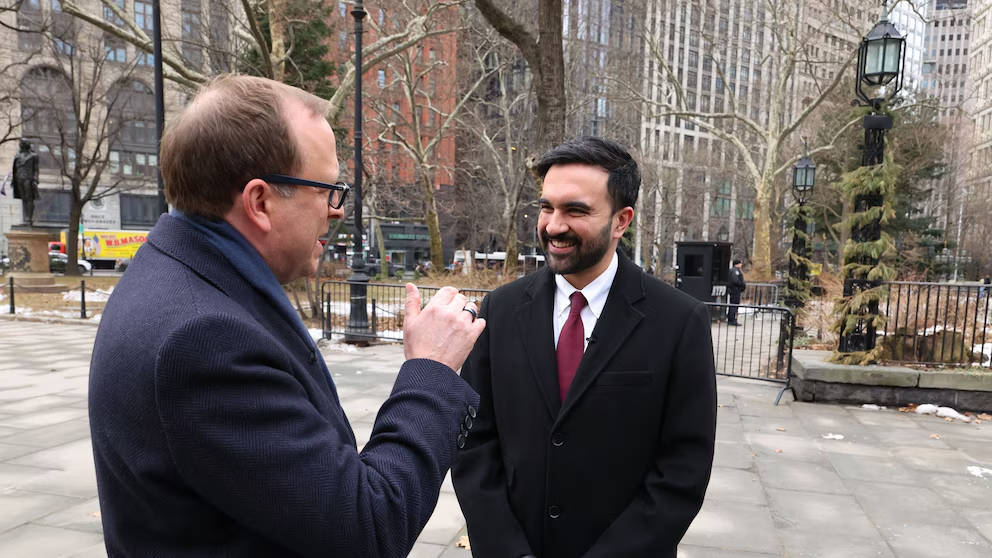
1:51ABC News’ Jonathan Karl interviews New York City Mayor Zohran Mamdani on his agenda.ABC News
A rush transcript of "This Week with George Stephanopoulos" airing on Sunday, January 25, 2022 on ABC News is below. This copy may not be in its final form, may be updated and may contain minor transcription errors. For previous show transcripts, visit the "This Week" transcript archive.
(COMMERCIAL BREAK)
JONATHAN KARL, ABC “THIS WEEK” CO-ANCHOR: Another American citizen has been shot dead by federal agents in Minneapolis. "THIS WEEK" starts right now.
(BEGIN VIDEO CLIP)
CROWD: (INAUDIBLE) our streets (ph). (INAUDIBLE) our streets.
KARL: Backlash in Minnesota after a Border Patrol agent shoots and kills 37-year-old Alex Pretti. The Trump administration is defending the agent's actions.
GOV. TIM WALZ (D-MN): Donald Trump, I call on you once again, remove this force from Minnesota.
KARL: We’ll speak with Senator Amy Klobuchar of Minnesota.
NEW YORK CITY MAYOR ZOHRAN MAMDANI, (D) NEW YORK CITY: The very things that we had been told were impossible or fanciful or unrealistic, they’re the ones we’re already delivering.
KARL: After his first weeks on the job, we speak with New York’s Mayor Zohran Mamdani.
You’re in the city that is seen as the center of global capitalism. Do you want it to remain that way?
We ask him about his texts with Trump, and about ICE in Minneapolis.
Do you worry that Donald Trump tried to do something similar here in New York City? And if he does, what do you do about it?
We’re one-on-one with Mayor Mamdani. A Sunday exclusive.
Head-spinning turnaround.
DONALD TRUMP, PRESIDENT OF THE UNITED STATES: Where we have a concept of a deal.
KARL: President Trump backs off weeks of threats to take Greenland, as Western leaders condemn his approach.
MARK CARNEY, CANADIAN PRIME MINISTER: Let me be direct, we are in the midst of a rupture, not a transition.
EMMANUEL MACRON, FRENCH PRESIDENT: But we do prefer respect to bullies.
KARL: Treasure Secretary Scott Bessent responds. Another “THIS WEEK” exclusive.
KARL: And —
TRUMP: You know they’ll say they sent some troops to Afghanistan or this or that. And they did. They stayed a little back. A little off the front lines.
KEIR STARMER, BRITISH PRIME MINISTER: Well, I consider President Trump's remarks insulting and frankly appalling.
KARL: European fury. America's NATO allies condemn President Trump for downplaying their sacrifice in Afghanistan. The roundtable debates the political fallout.
(END VIDEO CLIP)
ANNOUNCER: From ABC News, it's "THIS WEEK." Here now, Jonathan Karl.
KARL: Good morning. Welcome to "THIS WEEK." We come on the air this morning after another tragedy in Minnesota. Just two weeks after the killing of Renee Good, another person has been shot and killed by federal law enforcement in Minneapolis.
His name, Alex Pretti. He was 37 years old. He was an American citizen. He had no criminal record. He worked as a nurse. His patients were American veterans. He was an avid outdoorsman, a competitive cyclist, and a licensed gun owner. He played football and baseball in high school. He was a Boy Scoutt. His parents say he joined the protests after the killing of Renee Good because he was horrified by what happened and what ICE was doing.
After he was killed yesterday, Alex Pretti’s mother said, quote, “he loved his country but he hated what people were doing to it.”
Here’s Trevor Ault from Minneapolis with what we know so far about what happened.
(BEGIN VIDEOTAPE)
ABC NEWS CORRESPONDENT TREVOR AULT (voice over): Overnight, unrest and anger in Minneapolis after federal agents shot and killed another person. Graphic video from the scene obtained by Drop Site News shows a man in a struggle with agents, resisting being shoved to the ground and hit. One of the agents emerges from the chaos with what appears to be a gun the man was carrying. According to a witness affidavit, at least four agents pointed guns at him. The same witness saying the man shot had at least three bullet wounds in his back.
MAYOR JACOB FREY (D), MINNEAPOLIS: I just saw a video of more than six masked agents pummeling one of our constituents and shooting him to death. How many more residents?
AULT: In court filings, one witness says, “it didn't look like he was trying to resist, just trying to help the woman up. I didn't see him with a gun. They threw him to the ground. Four or five agents had him on the ground and they just started shooting him. They shot him so many times.”
Minneapolis Police have now identified the man shot as 37-year-old Alex Pretti, an American citizen and Minneapolis native who worked as an ICU nurse for the Department of Veterans Affairs. Pretti seen here reading the final salute for a fallen veteran.
ALEX PRETTI: Today, we remember that freedom is not free. We have to work at it, nurture it, protect it, and even sacrifice for it.
AULT: Local authorities say he was a lawful gun owner with a license to carry and no criminal record. Minnesota has an open carry gun law which requires a permit. Video shows Pretti intervene, trying to help a woman the agents had surrounded. He appears to
be holding a phone as he’s pepper-sprayed and wrestled to the ground, which he resists. The video does not appear to show him drawing the gun at any point.
GOV. TIM WALZ (D-MN): Thank God we have video, because according to DHS, these seven heroic guys took an onslaught of a battalion against him or something. It’s nonsense, people. It is nonsense, and it’s lies.
(END VIDEOTAPE)
AULT: And, Jon, of course, it's been very tense here in Minneapolis with demonstrators out through the night in these subzero temperatures. And there is a growing memorial here where the shooting occurred.
We also know a temporary order has been issued at the request of local officials banning the Trump administration from destroying any evidence from this shooting.
Jon.
KARL: Our thanks to Trevor.
And I'm joined now by Minnesota Senator Amy Klobuchar.
Senator Klobuchar, just simply, your reaction to what happened yesterday in Minneapolis.
SEN. AMY KLOBUCHAR, (D) MINNESOTA: Simply horrific. This, as you’ve pointed out, an ICU nurse, in the V.A. hospital in Minneapolis, that has got to be one of the most self-sacrificing jobs than anyone can have. An honorable job. He loved our veterans. He was with them, in many times, in the closing days of their lives. As his mom described him, and dad, he was a kind-hearted soul. And they’ve asked us to tell the truth about him.
And what we saw of how he died should never happen to an American citizen. He was called by the Trump administration officials a domestic terrorist, when all he had in his hand was a cell phone. All he was doing was helping someone, a woman, who’d been pushed over into the snow, into the ice. And then there was this scuffle, and six agents shot at him multiple times. And of course, there have to be a thorough investigation of all of this. And we look at what happened to Renee Good.
So, what I have going in my state right now, Jonathan, is 3,000 ICE agents that outnumber the Minneapolis-St. Paul police, sworn officers, three to one. They actually — it’s more ICE agents and border control than our 10 metro police departments. They are overwhelmed by this federal presence, as are our citizens, grabbing two-year-olds away from their parents, putting them on planes to Texas, and then my office has to go and get them back, or taking an elder Hmong man in his underwear and then realizing they have the wrong guy.
People are afraid. And two of the three, two-thirds of the recorded homicides in Minneapolis right now were committed by federal agents. Two of three. That’s what we’re dealing with. And that is why my message is simple, ICE is making us, not more safe, they’re making us less safe, and they need to get out of our state.
KARL: It’s remarkable to hear what the deputy attorney general said about this. He said that essentially state and local officials — I'm going to read his words exactly, “a federal investigation is ongoing. Make no mistake, this avoidable tragedy is the result of the total failure of Minnesota’s city and state officials.”
He’s blaming this —
KLOBUCHAR: I don’t know how you can say —
KARL: On state and local officials.
KLOBUCHAR: Go ahead.
KARL: How — I mean, what do you make of that?
KLOBUCHAR: You know, I have been with these officials, I have seen them, I think you have too, pleading for peace. And somehow 50,000 peaceful protesters in 10 below weather — I was there with them marching — when they were able to march without any problems. And then the next day, a half a dozen ICE and border control agents couldn’t handle a guy with a cell phone taking video of them and shot him.
So, I think it’s pretty obvious what’s going on here.
KARL: So — so have you —
KLOBUCHAR: And what needs to happen is, they need to leave.
KARL: So, and we’ve seen the secretary of homeland security, almost in mirror images — I mean, she’s — she — two weeks ag,o she calls Renee Good a domestic terrorist. Now she is saying that this was an act of terrorism by Alex Pretti. Have you reached out to the secretary? Have you — and if you haven’t, I mean if you get it, what’s your message to her?
KLOBUCHAR: One of these constituents of mine was a poet, and the other was a nurse. They had no criminal record. So, I would start with that.
And I have reached out to the White House. I've reached out to the Justice Department. I have spoken to high-ranking people in the White House. And I've mostly said to them, if your goal was to go after fraud, that’s a righteous goal, but that’s not what this is. If your goal was to apprehend violent offenders — good. But that’s not what you’re doing anymore when you’re taking five-year-olds and putting them in your car or wrestling down citizens.
Maybe one is Latino and two are white. They pick out the Latino, and they say, “Where are you from?” The guy’s yelling, “I was born here, I was born here,” throw him in the car and, if we’re lucky, they’ll let him out of that car a few blocks later because they get a bounty for picking people up.
There is a reason that the International Association of Police Chiefs, which is a pretty conservative organization, just came out and said that police, federal, local, must follow the law and that they also must follow police procedure.
KARL: Yes. And — and — and —
KLOBUCHAR: Police trust is based on how they interact with the community. So, I just look at this whole thing, and it’s wrong, and it’s completely out of control and out of balance, and they need to leave our state.
KARL: And those police chiefs want a summit, want a meeting with — with federal law enforcement.
Let me ask you about your Republican colleague Bill Cassidy. He put out a statement, a quite stark statement, in reaction to this, saying the event — “The events in Minneapolis are incredibly disturbing. The credibility of ICE and DHS are at stake. There must be a full federal and state investigation. We can trust the American people with the truth.”
But my question is not what Bill Cassidy said. It’s the silence from your other Republican colleagues. We really haven’t heard anything in the wake of this from other Republicans in Congress.
Are you hearing from them privately? Do you expect that they feel the way Bill Cassidy feels?
KLOBUCHAR: We have had a few state legislators now speak out, which I have appreciated. Republican state legislators. And, you’re right. Bill Cassidy is the only one.
I don’t understand this because our colleagues privately have said some things to me. That’s true. But this is actually an assault on the Constitution, and a lot of them care about this, assault on the First Amendment with going after people the way they have and the right to assemble. Assault on the Second Amendment, you’ve had someone actually criticizing Alex for being a lawful gun permit owner, and that’s what he was, he had a permit, and he owned a gun.
KARL: Right.
KLOBUCHAR: You — assault on the Fourth Amendment for search and seizure.
So, they need to speak out because that is one way to get to this Trump administration, but they’re not doing that right now, and it just shocks me because we have a bill in front of us. As you know, I am strongly opposed to more funding for ICE. I was strongly opposed when they tripled their budget this summer, $75 billion more. That money could go to local law enforcement.
And instead, they loosened all the training requirements down from months to 47 days. They are violating the Fourth Amendment that they are ramming in people’s doors without a judicial warrant. They are refusing to have mandatory body cameras. They are — have clearly a leadership that should be removed.
You can just go down the list of all the problems with this right now. And I really do appreciate that Senator Cassidy was brave enough to stand up and say something about it when no one else will.
KARL: Right.
KLOBUCHAR: And at this point, silence is complicity.
KARL: All right, Senator Klobuchar, we appreciate your time this morning.
KLOBUCHAR: Thank you very much, Jonathan.
KARL: Before Saturday's shooting, I traveled to New York City to speak with Zohran Mamdani, his first Sunday show interview since being inaugurated as New York City’s mayor just three weeks ago. It was a wide-ranging conversation touching on his agenda for the city, his relationship with President Trump and his views on what is happening on the streets of Minneapolis and what he plans to do if the Trump administration tries a similar operation in New York.
The interview begins with how he will attempt to win over his critics.
(BEGIN VIDEOTAPE)
KARL: As you took office, you said something I found interesting. You said that there are a lot of people, you acknowledged, who view your administration with distrust and disdain, and the only way you can win them over is with results.
MAYOR ZOHRAN MAMDANI (D), NEW YORK CITY: I think that there's nothing more powerful than the power of example. New Yorkers, they have heard every conceivable set of words in every kind of different sentence. What they are looking for, however, is the work that you do. And so, frankly, it's been 23 days now. Twenty — by the time this airs, 25 days. And in that time, we've been trying to build a city government that moves at the speed of New Yorkers walking down a street.
And so, day one, we went to put a bad landlord on notice, and stand with tenants who are living through the kind of conditions no New Yorker should have to live through. Day six, we fixed a bump on the Williamsburg Bridge. Day eight, we secured more than a billion dollars to deliver universal child care to New Yorkers.
It's a mantra of “there's no problem too small, no issue too big for city government to take on”.
KARL: And you've set sky-high expectations. I mean, you've talked about transforming the city, rebuilding the city. How are you going to measure that? What are the metrics? How are we going to look back and say, he pulled it off or he didn't?
MAMDANI: I think it comes back to what we spoke about every day of the campaign. We spoke about freezing the rent for rent-stabilized tenants, delivering universal child care and making the slowest buses in America fast and free. And so that's why it's so important that our focus in this beginning stage is advancing that agenda.
So, it's not just the more than billion dollars for universal child care, it's also unpausing the bus projects that the prior administration had put on hold, so that you're not traveling at five miles an hour when you're getting on the bus in New York City, you're actually able to get to where you're going.
KARL: It's going to cost a lot of money, and we've seen now that Mayor Adams left you with a deficit, staggering $12.6 billion. How are you going to deal with that?
MAMDANI: Well, I think it's, frankly, in the words of the Jackson 5, it's as easy as A-B-C. This is an Adams budget crisis. What we are inheriting is a scale of gross fiscal mismanagement that leaves us with a debt, the kinds of which we haven't seen since the financial crisis. And what we will not allow, however, is the failures of the last administration to dull the ambitions of our own.
And so, we continue to believe that the way that we meet this challenge, frankly, is by having the wealthiest New Yorkers pay a little bit more in personal income taxes, the most profitable corporations pay a little bit more in their corporate taxes, and then to change the relationship between the city and the state.
And what I mean by that is that here in New York City, we send about 54.5 percent of the state's tax revenues. We receive about 40.5 percent. We want to see a relationship that's more reflective of the city's status as the economic engine of the state. And we know that New Yorkers, working-class New Yorkers, they did not cause this crisis. We cannot let them be the victims of it either.
KARL: But you're going to need Albany. You need the state legislature and the governor to sign off on those tax increases.
MAMDANI: Yes, this is something that will be done in partnership with leaders in Albany, whether it's the governor or the speaker of the state assembly or the majority leader of the state senate.
KARL: But the governor, at least now, is making it clear, she doesn't want to see more taxes, more income taxes. So, can you do what you're talking about — I mean, even without the deficit, can you do all that you want if you don't see taxes go up?
MAMDANI: We will continue to make our case. And I think what we've found already in these 20 odd days of being in office is the very things that we had been told were impossible or fanciful or unrealistic, they're the ones we're already delivering.
KARL: You said also when you took office, you were elected as a Democratic socialist. You're going to govern as a Democratic socialist. You're in the city that is seen as the center of global capitalism. Do you want it to remain that way?
MAMDANI: I want it to continue to be a place that generates prosperity. We should be proud of that legacy. And to ensure that that prosperity reaches every New Yorker. Because as you said, this is not just a symbol of global capital, this is also the wealthiest city in the wealthiest country in the history of the world. And yet it's the same city where one in four New Yorkers are living in poverty. And we have to make this such that New Yorkers know, this isn't just a city where they work in, this also has to be city where they can afford to live in.
KARL: You said — during the campaign, you had a lot of kind of major financial figures in New York say that they would leave the city, predicting that major corporations would leave the city if you got elected. Now, it seems like they're not yet following through on those threats, but is there a concern that if the kind of policies you're talking about, especially the tax increases go into effect, that you will lose those big wealthy corporations?
MAMDANI: We want them to stay in this city. We want this to be a vision of a city, not where we pick and choose who gets to live here, but that we make room for everybody to do so.
I actually spoke to a New Yorker the other day who self-identified herself as one of those millionaires. And she said, you know, is it true you want to raise taxes? I said, yes. She said, you know, but I might leave. I said, but it's only by 2 percent on an income of a million or more. She said, what is that? I said, that's about $20,000. She said oh that's not that much actually to me.
And I think that sometimes we allow ourselves to get carried away by the specter, as opposed to the substance. And the substance of it is, we want to make this a city for everyone, those that we're looking to increase taxes on, those that are currently being priced out of the city, so that they can all afford to live here.
KARL: There was a recent report that found that the city lost 5,000 businesses last spring. This is obviously not on your watch. But do you worry that — and a lot of — sometimes it's regulations that are excited — that are cited, taxes. Do you worry about businesses leaving New York and what will you do to keep them here?
MAMDANI: I worry every day about this not being a city that everyone can not only afford to live in but also build and chase their dreams in. And I think small businesses, especially, are — they are such a critical part of what makes this city so incredible. And so, we want to exhaust every tool at our disposal to make it easier to start a business and keep a business open. Right — right now in New York City —
KARL: So, like what? Like what kind of stuff?
MAMDANI: I'll give you an example.
KARL: Yes.
MAMDANI: You want to open a barbershop. You got to fill out more than 20 forms. You got to go to more than seven agencies. You got to then attend 12 in-person activities. That is not making it easy to open a barbershop. When you see a barbershop in New York City, know that they opened in spite of everything we put them through.
So some of it is the regulatory hurdles. The other side of it is the fines and fees, which you mentioned. We just signed an executive order that would direct every city agency and department to put together every rule, regulation, fine, and fee, and then start to reduce them because we don't want to be any part of what's making it difficult to keep these doors open.
We want this to be a city where you can start your business, grow your business. Not just a city where only the most profitable business can afford to operate.
KARL: Now those ideas, cutting regulations, cutting fines and fees, those sound like ideas that are, I mean, you could see Republicans applauding.
MAMDANI: And I think this is, for every New Yorker that I speak to, they ask me less, how do you describe your politics, and more, does your politics include me in it? And we want to show that a politics that cares about the city, that loves the city. It's a politics that puts working people at the heart of this city. And that's who we want to make it easier to live in the city.
KARL: You had a line in your inaugural speech on New Year's Day that got a lot of attention. You said, we will replace the frigidity of rugged individualism with the warmth of collectivism. What did you mean by that?
MAMDANI: I meant that too often New Yorkers are made to feel as if their struggles are only their own. That the issues they're facing in their life are for them to figure out. And what we want to do is to build a city where we understand that we can build a place where we can understand this as one where we're in this together.
KARL: But let's just take the two parts of that. Rugged individualism, frigidity of rugged individual. A lot of people look at America and they say rugged individualism is kind of what made the country. Are you — do you have a problem with rugged individualism?
MAMDANI: I think I have a problem with how so many are alienated from the city that they live in, the state that they're in, the society that they belong to. They're made to feel not that they can't pursue their own dreams, but that this mountain is only for them to bear. And what I've found time and again is that the most transformative policies that we can have for New Yorkers, they're only possible if we're actually achieving them together and if every New Yorker sees themselves as part of that whole.
KARL: And the warmth of collectivism. I mean, a lot of people associate collectivism with Stalin's Russia, with Mao's China. I mean, it's got a — there is a negative connotation to the historic context.
MAMDANI: That's not at all what's intended.
KARL: I know you don't — I know you don't want, but I mean, when you use that phrase, do you think of that connotation at all or are you worried that people will?
MAMDANI: No, my intention was just to speak about how this isn't a movement of an individual, it's a movement of a collective. And it's through that collective that we've been able to weather the storms. It's through that collective we'll be able to deliver. But it's one of New York City delivering for New Yorkers.
KARL: All right. Let's talk about Donald Trump.
MAMDANI: OK.
KARL: You seem to have charmed him. That meeting in the Oval Office was something. What was it like when you first got there? I mean, just give me something. We saw what happened in front of the cameras. Give me something behind the scenes. What was —
MAMDANI: You know, I think it was, I have, you know, there are a wide variety of ways that meeting could have gone.
KARL: Yes.
MAMDANI: And I was hopeful of a productive meeting. And what I was taken aback by was how quickly it became focused on the intricacies of New York City. Those are intricacies that can range from zoning laws, to municipal policy, to the larger scale issues that people are facing. And I think that, you know, one thing about that conversation is we were both honest and direct with each other about places that we had disagreements, and we also were looking to find the places that we could align to deliver for the same New Yorkers that we both care about.
KARL: And I hear you've been texting with him lately. By the way, how did you get his number? Did he share it with you when you were with him at the White House?
MAMDANI: He gave me his number. I'll say that the conversations between the president and I are private, and I'll keep them there. But they are always back to the question of New Yorkers.
KARL: The conversations are private, but let's just talk about the frequency. I mean, what happens? Do you hear from him? Do you reach out to him? How does this work out? How often? Give me something. I mean, come on.
MAMDANI: I think —
KARL: I text him occasionally.
MAMDANI: I think it's less about the maintenance of a personal relationship, it's more about delivering for the people of the city. And I'll tell you that over the course of the campaign, I said very clearly, where the president is looking to pursue policies that will hurt the city, I'm going to be there on the front lines. And when the president is going to pursue policy to help the city, I'll embrace that opportunity for working together. And I think what we're seeing right now is the need, as the leader of this city, for me to make that case to anyone across this country.
KARL: I know you have been horrified, as many people have, by what's been happening with ICE in Minneapolis.
MAMDANI: Yes.
KARL: Do you worry that Donald Trump would try to do something similar here in New York City? And if he does, what do you do about it?
MAMDANI: I think just to first take a moment about Minneapolis, it is horrific, what we have seen there, and I think that there are too many Americans who are being asked to not believe their own eyes, not believe their own ears, not believe their own realities.
And people want to hear the truth. They want to see the truth. And that's why I described that as a murder because there's no other way to watch that video and come to a different conclusion.
And we know that the fear that so many are living with in Minneapolis, it's a fear that New Yorkers are also living with, a fear of being terrorized. And I will do everything in my power to ensure that we do not see that take place in New York City. And I've also said clearly to the president that these ICE raids, they are cruel, they are inhumane, they do nothing to serve the interests of public safety.
KARL: So it sounds like the first key step is to dissuade him from doing something on the scale that he is doing in Minneapolis. And if he does, do you have the power to stop it?
MAMDANI: We have a number of tools here in New York City, and whether those tools are the utilization of the courts or it's the tools of the bully pulpit or it's the tools our own city policies, we're going to exhaust every option to protect New Yorkers. We want to do everything in our power now to ensure it never gets to that stage.
But our values, our laws, these are not bargaining chips that we will shirk away from at the first sign of a threat. These are things that we will defend. Right now, you have masked agents who are terrorizing people across this country, whether they're in their home, in their car, out on the street. You have the loss of what it means to be an American in your own country, the sense of safety and the sense of self. That's something we should all be fighting.
KARL: What the administration says is that you have hardened criminals who have committed heinous acts, rape, murder, who are undocumented, and that sanctuary cities like New York don't cooperate with the effort to get those criminals. Is that accurate?
MAMDANI: It's not accurate. I've said this directly both to the president, but as well as in public. Our sanctuary city policies allow the city to work with the federal administration if anyone has been convicted of more than 170 serious crimes. What we are talking about is the concern for so many New Yorkers whose only crime seems to be being here in New York City, that they are being targeted in these kinds of ways.
KARL: You've — like many other people — said you want to see ICE abolished. How would you enforce the immigration laws, and where do you think they shouldn't be enforced? I mean, how would you do it without Immigration and Customs Enforcement?
MAMDANI: You do it with a little bit of humanity. You know, immigration existed long before ICE. ICE is a modern creation. It's — I'm older than ICE.
KARL: But you've always had an org — whatever you call it, you've had an organization to enforce those rules.
MAMDANI: I would separate ICE from an organization that looks to enforce these rules. ICE is an organization that cares little for the rules. It's an organization that operates with reckless impunity and seems to revel in the flouting of those kinds of rules.
And that's what gives people a real sense of fear. ICE agents are masked. You oftentimes have no idea. We even have seen instances in this country of people pretending to be ICE agents because they know that there's no identification. That's what we're talking about.
(END VIDEOTAPE)
KARL: Our thanks to Mayor Mamdani.
Look for our extended conversation, and there is a lot more online today at abcnews.com, YouTube, and in the “This Week” podcast feed, including Mamdani's advice for fellow Democrats going into the midterm elections.
Coming up, the roundtable is next. We're back in two minutes.
(COMMERCIAL BREAK)
KARL: The Roundtable is here. We have Former DNC Chair, Donna Brazile; SCOTUSBlog Editor, Sarah Isgur; our Senior Political Correspondent, Rachel Scott; Daily Signal Executive Editor, Robert Bluey.
OK. So Donna, another fatal shooting in Minneapolis. Where is this going?
DONNA BRAZILE, FORMER DNC CHAIR & ABC NEWS CONTRIBUTOR: Well, first of all, I agree with Governor Walz. It's time to de-escalate this violence. I'm glad he did reach out to the White House. I'm glad that calmer, cooler heads might prevail. But look, this is a tragedy. Once again, an American citizen gunned down in the street by federal agents.
Everyone who watched the video, you saw him. You saw him filming. You saw his other arm reach out to help somebody. He was tackled to the ground. This has to stop. There's a way to move forward, but the way moving forward is not with having ICE running around with impunity in residential neighborhoods.
KARL: And Sarah, this is the second time in just over two weeks where we've seen somebody killed by federal law enforcement in Minneapolis, and we have seen the head of the Department of Homeland Security go out and say the victim was a terrorist and describe a series of events that are not seen on video. What is this doing to the credibility of the federal government?
SARAH ISGUR, EDITOR AT SCOTUSBLOG & ABC NEWS CONTRIBUTOR: Yeah, I mean, you even see it with ourselves, right? Like we no longer even take it at face value that there might be some truth to what they're saying. You know, we've seen pushback now from the National Rifle Association, from Gun Owners of America, basically saying you should be able to exercise your First and Second Amendment rights without being shot by federal law enforcement officers.
At the same time, you are still hearing Republicans say they want these immigration laws enforced. If you have them on the books, someone needs to enforce them. And there are a lot of them are blaming the protesters for putting themselves into these situations that are clearly going to be very dangerous.
KARL: So — and Rachel, you heard Senator Klobuchar —
RACHEL SCOTT, ABC NEWS SENIOR POLITICAL CORRESPONDENT: Yeah.
KARL: I mean, she's going to oppose this funding bill in Congress. What — how are Democrats able to respond here?
SCOTT: So look, Democrats right now are carefully trying to figure out a way, like they have been for everything that the Trump administration has been doing, to protest, to put up a stand. And so right now, we are easing into potentially another partial government shutdown. Democrats are saying they're going to potentially block this Homeland Security bill.
But even top Democrats in the House, Rosa DeLauro, have said that this is going to hurt other agencies. It's going to hurt FEMA. It's going to hurt TSA agencies, because a lot of the funding for ICE has already been allocated. So right now, Senate Democrats are going to have to decide whether or not this is worth it.
Last time we saw them, you know, drag this out, but they didn't get their demand overall.
KARL: Rob, something's going wrong, right? I mean, if we have a situation where, again, another American citizen with no criminal record is gunned down in the streets of Minneapolis, something is not working.
ROBERT BLUEY, PRESIDENT AND EXECUTIVE EDITOR OF THE DAILY SIGNAL: Clearly a tragedy, Jon. And I'll say that, you know, as you've heard from President Trump and Vice President Vance, they pin the blame on Governor Walz and Mayor Frey, because they say —
(CROSSTALK)
KARL: (Inaudible).
BLUEY — why not — why won't they cooperate with federal officials? And in many cases, they looked at examples of our history when people like Jefferson Davis or George Wallace resisted the federal government in things that they were doing. President Trump was elected with the promise that he would ramp up immigration enforcement in this country.
Elections have consequences, and I think that's what the administration keeps coming back to. And they say, let's cool those temperatures, Donna, but let's also do so in a way that we can cooperate between federal and local officials.
BRAZILE: Rob, let me just say this. These agents are barely trained. They're supposedly getting trained for 47 days because they wanted to have 47 after the president. That's crazy.
Number two, they're not identified. I mean, they're walking around like they're hooded thugs. Why don't they identify themselves? Why don't they work with the local officials? The Minneapolis Police Department said, we want to work.
These cities are saying, like they did under Obama, like they did under Bush, work with the city officials.
BLUEY: But Minnesota is a sanctuary state. How — I mean, how, when you have policies in place like this, are they —
(CROSSTALK)
BRAZILE: Because those policies existed in previous administrations, and yet you can work with the state and local government.
But when you go into schools and rip children apart, use children as bait. When you go into churches — churches, and you — and you — and your — it is un-American. that’s what it is, is un-American.
ISGUR: This is why more Americans today — more Americans identify as an independent than a Republican or a Democrat for the first time in American history. And this is why, because no one actually believes that either side believes what they’re saying.
Look, honestly, if Barack Obama’s federal officers had killed a member of the Tea Party, who had shown up who had a concealed carry permit, who was disarmed before he was shot, that would not be what the right is saying. And, frankly, the left was all for big executive power, as long as it was Joe Biden. They’re not “no kings.” They just don't like this king. If you actually want to do something about the problems, both sides need to actually say, presidents shouldn't have this power. The federal government shouldn't have this power. But like Rob said, this is the federal government versus the states. And we have already agreed, I guess, on that balance. And here we are. And this shooting looks very different than the last one. Very different legally as well.
KARL: I want to get to that in a second. First, let's take a look at the video. This is video obtained by Drop Site News showing the struggle and the shooting. And first of all, we get — that initial push of a woman.
BRAZILE: That's what —
KARL: I mean, really. And that’s what you see, Alex Pretti going to like her aid. And if you watch, we’ve done a frame-by-frame analysis of this video. It looks like Alex Pretti, there’s no evidence that he ever reached for his gun. It looks like he was disarmed before he was shot.
BRAZILE: Disarmed before he was shot. He was an ICU nurse. He’s going to — you know, and, of course, the administration runs up. He’s a terrorist. No, he’s an American citizen trying, with his First Amendment right, he was filming these ICE agents. And by the way, Border Patrol should not be in our cities. They should be at the border. They don't know what the hell they're doing in our cities. They should work with local officials. But he was trying to help somebody who was taken to the ground. And for that, he was executed.
KARL: Let me — let me — OK, let’s get to where you were going on this, Sarah. Our understanding has been that a federal officer on the job cannot be criminally prosecuted in state courts. But there's a possible exception.
ISGUR: That is true. And in the Good case, what I said was, there was really no chance that Minnesota authorities were going to be able to charge the officers involved in that. The exception is, if something is so egregious, so outside reasonable conduct by an officer that it would be outside of their official duties. Here, where you have an unarmed man with a concealed carry permit, and they shoot him ten times, mostly in the back, we are now in that area where Minnesota authorities actually could be on more solid ground to charge this.
KARL: Rachel, I want to show you what the assistant U.S. attorney, one of the U.S. attorneys in California, Trump appointed assistant U.S. attorney had to say about this. We have this on the screen. “If you approach law enforcement with a gun, there is a high likelihood they will be legally justified in shooting you. Don't do it.”
What did the NRA have to say about that?
SCOTT: Yes, well, they — the NRA came out and said that that was dangerous and wrong. And I want to read to our viewers just what they said. “Responsible public voices should be awaiting a full investigation, not making generalizations and demonizing law-abiding citizens.”
I mean, that is pretty strong. That's as strong as it gets coming from the NRA, criticizing basically what the Republican message is. And when we’re talking about the politics of this, yes, absolutely, you have Trump voters who supported the president and this effort. But when it comes to independent investigations, that is getting people upset on both sides.
KARL: I mean, Rob, Second Amendment?
BLUEY: Sure. I mean as Sarah indicated earlier, I mean you had the gun rights come out very strongly yesterday, defending the right of individuals to have concealed carry permits. And so I think that that will certainly play a factor into this. But ultimately it comes back, Jon, at the end of the day, will Governor Walz decide to lower the temperature or will he (INAUDIBLE)?
KARL: All right, we’ll be back.
Up next, Treasury Secretary Scott Bessent, a "THIS WEEK" exclusive.
We're back in just a minute.
(COMMERCIAL BREAK)
(BEGIN VIDEO CLIP)
MARK CARNEY, CANADIAN PRIME MINISTER: We are in the midst of a rupture, not a transition.
Over the past two decades, a series of crises in finance, health, energy and geopolitics have laid bare the risks of extreme global integration. But more recently, great powers have begun using economic integration as weapons, tariffs as leverage, financial infrastructure as coercion, supply chains as vulnerabilities to be exploited.
(END VIDEO CLIP)
KARL: That was Canadian Prime Minister Mark Carney this week in Davos.
Treasury Secretary Scott Bessent is here to respond, when we come back.
(COMMERCIAL BREAK)
KARL: I'm joined now exclusively by Treasury Secretary Scott Bessent, who is just back from Davos and joins us here in the studio.
Thank you for being here, Mr. Secretary. Let me start with the threat that the president made just yesterday to Canada. He said, if Canada makes a deal with China, it will immediately be hit with a one hundred percent tariffs against all Canadian goods. Why is Donald Trump threatening Canada again with another trade war?
SCOTT BESSENT, (R) UNITED STATES TREASURY SECRETARY: Well, Jonathan, good to be with you. And look, Prime Minister Carney went to — went to China, came back, dropped some industry specific tariffs on Chinese goods, and we have a highly integrated market with Canada, sometimes in autos, which he dropped the E.V. tariff, I believe, from a hundred percent to six percent.
The goods can cross across the border during the manufacturing process six times. And we can't let Canada become an opening that the Chinese pour their cheap goods into the U.S. We have a USMCA agreement, but based on — based on that, which is going to be renegotiated this summer, and I'm not sure what Prime Minister Carney is doing here, other than trying to virtue-signal to his globalist friends at Davos.
I don't think he's doing the best job for the Canadian people.
KARL: But there's confusion from President Trump on this. I mean, we heard from him just — I think it was nine days ago, eight or nine days ago. He had this to say about Canada negotiating with China.
(BEGIN VIDEO CLIP)
REPORTER: How do you see the deals — Canada and China just signed trade deals between the two partners?
DONALD TRUMP, PRESIDENT OF THE UNITED STATES: Well, that's OK. That's what he should be doing. I mean, it's a good thing for him to sign a trade deal. If you can get a deal with China, he should do that.
(END VIDEO CLIP)
KARL: OK. So, he gives a green light to a deal with China just after they do it. And then nine days later, he's saying that's it, hundred percent tariffs.
BESSENT: Well, no, there's possibility of hundred percent tariffs if they do a free trade deal. So, what —
KARL: So, it's not now? It's — this is if they go further than what's already happening?
BESSENT: Well, it's — if they go further, if we see that the Canadians are allowing the Chinese to dump goods. And Jonathan, just to be clear that the Canadians, a few months ago, joined the U.S. in putting high steel tariffs on China because the Chinese are dumping. The Europeans also have done the same thing. And it looks like that Prime Minister Carney may have done some kind of about-face.
KARL: You've got tariffs that have been in place since April. And the idea is to bring back manufacturing jobs, but in fact, every month, according to the data from the Fed, every month since April, we've actually had a decline in manufacturing jobs in the country.
BESSENT: Well, that — those are the manufacturing jobs. What we're seeing is a burst in construction jobs because we're seeing record number of factories construction. I was just in my home state of South Carolina a couple of months ago. There's a rare earth magnets factory, 800 construction jobs. It could morph into 3,000 factory jobs.
I was just at the Boeing plant in Charleston. Thanks to President Trump's constant push during the trade deals to sell more aircraft, Boeing is expanding their capacity there by fifty percent. So those will be construction jobs that morph into factory jobs. So, I could not be more upbeat about the prospects for manufacturing, for the economy in 2026.
KARL: And how do you explain what happened with Greenland? I mean, the president goes into Davos, not ruling out military force, talking about imposing tariffs on the Europeans who oppose us retaking Greenland. And now, suddenly, he's OK with essentially, it seems like the same agreement that's been in place since the '50s.
BESSENT: Well, I think you haven't seen the full agreement. Secretary General, Mark Rutte was a very good interlocutor between the Europeans and between President Trump. But look, a lot — a lot of things have changed up in Greenland. Jonathan, do you know what the Istanbul Bridge is?
KARL: Tell me.
BESSENT: A Chinese freight ship that, for the first time in October, came across the Arctic into the U.K. They are shortening their travel time. So, the Arctic is changing. Very important strategically for the U.S. to help control that.
KARL: OK. But again, it seems like we're going to basically have the — I mean, Greenland's not going to become part of the United States. We're going to have the same access that we've had.
(CROSSTALK)
BESSENT: I promise you, the deal is not what we had before.
KARL: OK.
BESSENT: It is much more fulsome for the United States. And again, Jon, just to be clear, for 150 years, American presidents have had their eye on Greenland. We administered Greenland during World War II after the Danish were invaded by the Nazis.
KARL: Let me — let me ask you. Let me show you a photo that was posted by the French Defense Ministry yesterday showing coffins of French soldiers who died fighting alongside Americans in Afghanistan. And we also heard from the Italian prime minister, a good supporter of Donald Trump, Prime Minister Meloni, reacted to what the president had to say about European troops serving in Afghanistan, saying that she was astonished, and noted that 53 Italian service members were killed, more than 700 were wounded.
Does the president regret what he said about our NATO allies and their service in Afghanistan?
BESSENT: Jon, I was traveling. I haven't seen any of that, but I can tell you that the president values NATO, and since his first term, he has worked hard to make sure that our NATO allies are pulling their fair share.
Just to be clear, since 1980, since 1980, the U.S. has spent $22 trillion more on defense than NATO. And now by President Trump getting our NATO allies, including Canada, who was very deficient in the funding, NATO is going to be stronger than ever.
KARL: But this is about sacrifice. Let's play President Trump's words so you understand exactly what they were talking about, what I'm talking about.
(BEGIN VIDEO CLIP)
DONALD TRUMP, PRESIDENT OF THE UNITED STATES: We've never needed them. We have never really asked anything of them. You know, they'll say they sent some troops to Afghanistan or this or that, and they did. They stayed a little back little off the front lines.
(END VIDEO CLIP)
KARL: I mean, do you understand why our European allies, the ones you're negotiating with, are insulted by that?
BESSENT: Again, I think President Trump is laser-focused on the strongest NATO possible, that he has worked to negotiate a settlement on Russia-Ukraine. The U.S. has made much bigger sacrifices than the European has — Europeans have. We have put 25 percent tariffs on India for buying Russian oil. Guess what happened last week? The Europeans signed a trade deal with India.
They — and just to be clear again, the Russian oil goes into India. The refined products come out, and the Europeans buy the refined products. They are financing the war against themselves. So, President Trump's leadership, we will eventually end this Ukraine-Russia war.
KARL: And before you go, I know this is not your lane, but I got to ask you about what's happened in Minneapolis. As a member of the — of the Trump cabinet, are you concerned to see another American citizen ends up dead, shot by federal law enforcement?
BESSENT: Jonathan, it's a tragedy when anyone dies, but I can tell you the situation on the ground there is being stirred up by Governor Walz. I was out there two weeks ago. Governor Walz declined to provide a security detail for me to go into the Minnesota capital with the state police. So, he is fomenting the — he is fomenting chaos because there is substantial waste, fraud and abuse.
My job as Treasury secretary is to investigate that, and I think that, you know, this chaos that's going on out there, and again, I am sorry that this gentleman is dead, but he did bring a nine-millimeter semi-automatic weapon with two cartridges to what was supposed to be a peaceful protest. I think that there are a lot of paid agitators who are ginning things up, and the governor has not done a good job of tamping this down.
KARL: Yes. I mean, as you know, he was an ICU nurse, worked for the Veterans Administration, and there's no evidence that he brandished the gun whatsoever. In fact, it appears that —
BESSENT: He brought a gun.
(CROSSTALK)
KARL: He'd been disarmed before he was —
(CROSSTALK)
BESSENT: He brought a gun. Have you ever gone to a protest, Jonathan?
KARL: I mean, we do have a Second Amendment in this country that —
BESSENT: Jonathan, have you ever gone to a protest?
KARL: I mean —
BESSENT: Have you gone to a protest?
KARL: I mean, I've — no, actually, as a reporter covering it.
BESSENT: OK. I've been to a protest.
KARL: Yes.
BESSENT: Guess what? I didn't bring a gun. I brought a billboard.
KARL: OK. Secretary Bessent, thank you for joining us.
Coming up, we'll have the latest on the massive winter storm sweeping the country. We're back in a moment.
(COMMERCIAL BREAK)
KARL: Snow is coming down pretty hard this morning here in Washington and across much of the country. Take a look at the radar as the storm moves from the southeast up the East Coast today.
You can stay tuned to ABC News Live for the latest, and we will be right back.
(COMMERCIAL BREAK)
KARL: Thank you for sharing part of this chilly Sunday with us. Check out "World News Tonight." Have a great day.
(COMMERCIAL BREAK)
Sourse: abcnews.go.com