
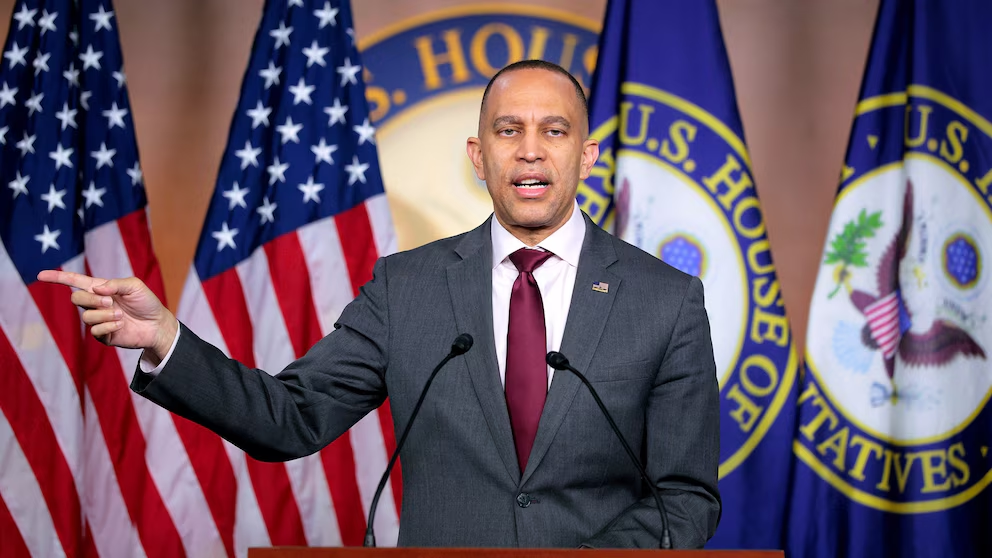
The House Minority Leader, Hakeem Jeffries, conducts a press briefing at the U.S. Capitol Visitors Center on March 19, 2026, located in Washington, D.C. Chip Somodevilla/Getty Images
Below is an expedited record of "This Week with George Stephanopoulos," which was broadcasted on ABC News on Sunday, April 5, 2026. Please note that the following text may not reflect its definitive iteration, is subject to future updates, and might include slight inaccuracies in its transcription. Past transcriptions of the show can be accessed through the "This Week" transcript directory.
(COMMERCIAL BREAK)
ANNOUNCER: “THIS WEEK,” hosted by George Stephanopoulos, is commencing now.
(BEGIN VIDEO CLIP)
GEORGE STEPHANOPOULOS, ABC “THIS WEEK” ANCHOR: A sudden development overnight: pilots are saved. Martha Raddatz offers comprehensive details regarding the daring special ops executed to retrieve the airmen of the F-15 fighter plane taken down in Iran, coinciding with the President issuing both a fresh ultimatum and further warnings.
DONALD TRUMP, PRESIDENT OF THE UNITED STATES: Over the coming two to three weeks, we plan to impose significantly harsher measures. We intend to revert them to the Stone Age, where they rightfully belong.
STEPHANOPOULOS: Following five weeks of ongoing conflict, are any de-escalation avenues visible? How might Iran respond? Additionally, what impact will the political and monetary consequences have domestically?
Furthermore, a change in the cabinet. Trump dismisses Attorney General Pam Bondi; the president’s previous private counsel will now serve as the temporary A.G. Will this individual amplify Trump’s agenda of retribution?
A revision to the voting process.
TRUMP: I am convinced that it is secure and might be assessed or might not be.
STEPHANOPOULOS: The president approves an executive action aimed at curbing voting through postal services, leading to several legal objections. Will the order be upheld? What implications will it carry for the midterm elections?
UNIDENTIFIED MALE: His political faction risks being soundly defeated, leading him to resort to altering the electorate’s composition, as previously stated.
STEPHANOPOULOS: Additionally.
UNIDENTIFIED FEMALE: My family and I are entitled to ascertain the circumstances surrounding my father’s demise.
STEPHANOPOULOS: Matt Rivers delivers a report on the increasing instances of fatalities within ICE detention sites.
(END VIDEO CLIP)
ANNOUNCER: From ABC News, it’s “THIS WEEK.” Back to you, George Stephanopoulos.
STEPHANOPOULOS: Greetings, and thank you for joining us on “THIS WEEK.”
We proceed directly to the current urgent information; a subsequent American aviator has been freed in Iran. This perilous endeavor saw the deployment of hundreds of special operations forces well into a mountainous location. Martha Raddatz, our lead global affairs reporter, has maintained constant surveillance of the mission through the night. She will commence our briefing.
Welcome, Martha.
MARTHA RADDATZ, ABC “THE WEEK” CO-ANCHOR: Greetings, George.
The task proved to be extraordinarily intricate and hazardous for both the rescuers and the absent Air Force pilot, who had been hiding beyond enemy lines for multiple days. Nevertheless, the conclusion provided relief as the second crew member has successfully departed Iran, with reported serious injuries, according to the President, while remaining secure.
(BEGIN VIDEOTAPE)
RADDATZ (voice over): Suddenly overnight, the news broke that the second Air Force pilot from the stricken U.S. warplane in Iran had been saved by U.S. elite forces and returned safely to U.S. control. President Trump stated on social media, “In the past hours, the United States military executed a remarkably bold operation of finding and saving our valued officer. This brave fighter was trapped within enemy boundaries amid Iran’s challenging terrains, with our enemies diligently closing in as time ran short.”
This Air Force colonel served as the weapon systems officer, otherwise known as WSO, positioned in the aircraft’s rear. Securing the colonel’s safety was an uphill struggle and his ability to stay undetected for almost two days after the F-15 pilot’s rescue post-crash Friday was no minor feat. A high-level official informed ABC News that, “before pinpointing the WSO, the War Department launched a decoy operation in Iran, making it appear that the U.S. troops had already located him and were moving him overland for extraction.” Commander John Hiltz (Ret.), a Navy FA-18 Super Hornet pilot with engagement experience in Afghanistan, Iraq, and Syria, fulfilled roles as both rescue mission commander and forward air controller, equipped to manage operations such as these.
CMDR. JOHN HILTZ, U.S. NAVY (RET.): The risk level of this scenario is critically high. First, you need to find the individuals, verify their identities, evaluate their mobility, and check their health. Are they in peril or is there some threat nearby? Several factors like these must be accounted for.
RADDATZ (voice over): President Trump indicated that the rescued officer sustained injuries but will recover. This injury likely resulted during the ejection.
HILTZ: Getting catapulted from a warplane inflicts major physical trauma. Upon landing, the impact may lead to further bodily harm.
RADDATZ (voice over): As the pair were launched milliseconds apart, it is plausible that the airmen landed in the same general region, despite a separation of several miles.
HILTZ: As one makes landfall, gauging one’s situation, surroundings, and initiating survival measures such as evading, resisting, and escaping become paramount.
RADDATZ (voice over): We recognize, as per official accounts, that the pilot’s inaugural rescue was challenged by acute enemy fire post the F-15 shoot-down. The engagement led to damages on two Black Hawks and an attack jet, perhaps explaining the delay in extracting the second crew member.
HILTZ: Under hostile fire, as reports and Iranian visuals appear to confirm, it could be best to withdraw, reassess, and adopt a more sound strategy. Perhaps acting under the cover of night, or once you’ve neutralized possible dangers identified initially.
RADDATZ (voice over): Even more alarming details on the operation last night. Officials say that two C-130 aircraft became stranded in Iran, leading U.S. troops to demolish them to avoid them falling into Iranian hands. New aircraft were deployed to assure safe evacuation of the American forces. The destruction of this F-15 signifies the first instance in this war where Iran succeeded in downing a U.S. operated airplane, causing doubt on Iran’s diminishing military prowess as asserted repeatedly by President Trump, stating that Iran had forfeited the ability to take down U.S. warplanes.
DONALD TRUMP, PRESIDENT OF THE UNITED STATES: Their arsenal of anti-aircraft weaponry is virtually nonexistent. Their radar infrastructure has been utterly dismantled. As a military, our forces cannot be stopped.
(END VIDEOTAPE)
RADDATZ (on camera): Yes, the combat rescue personnel undeniably pressed forward, however, George, it is evident that Iran retains the capacity to neutralize U.S. aircraft.
STEPHANOPOULOS: True, a compelling endeavor and a tremendous relief, though their defensive capabilities are clearly not fully neutralized.
RADDATZ: Precisely, George, the extraction was exceptional. These missions all carry considerable danger. Not only was the F-15 downed over Iranian terrain, but the Iranians also struck the A-10, which was participating in the original rescue effort. Although the pilot safely flew the aircraft as far as Kuwait before having to eject prior to a crash, the pilot was later rescued.
The two Black Hawk helicopters also came under fire. In addition to the two C-130s, which support special operations, our personnel intentionally destroyed during last night’s operation were reported to have had mechanical failures, thus becoming immobilized within Iran. Despite these losses in air defenses and guided missiles, Iran persists as a substantial threat during this war.
George.
GEORGE STEPHANOPOULOS, ABC “THIS WEEK” ANCHOR: Martha Raddatz, we appreciate your report.
Now, let us hear from Britt Clennett in Jerusalem.
Britt, even while this rescue is underway, the United States has been reported to be heightening its attacks.
BRITT CLENNETT, ABC NEWS FOREIGN CORRESPONDENT: Yes, George, truthfully, this armed conflict gives every impression of intensifying, as each side ramps up its aggressive fire on a continuous basis. Iran and the United States have pledged mutual destruction while also threatening further strikes on vital infrastructures. On Saturday, President Trump posted video footage revealing extensive damage from bombing within Iran with thick plumes of smoke from a petrochemical complex in Iran’s southwest region. Israel claimed accountability, stating this facility produces vital parts for missile assembly. Iranian state media reports five deaths resulting from that assault.
Currently, HRANA, a U.S.-based human rights organization, puts Iran’s death toll at 3,540. Iran has reported an attack by U.S. and Israeli forces near its Bushehr nuclear facility, which resulted in the loss of a security officer’s life and damage to a neighboring structure. The International Atomic Energy Agency has expressed deep apprehensiveness, although elevated radiation counts have not been verified. Separately, the WHO cautioned that such attacks could precipitate a nuclear event, impacting generations to come, George.
STEPHANOPOULOS: Iran’s retaliation is focused on energy sites in the gulf area.
CLENNETT: Yes, it’s been noted that Iran is aggressively striking throughout Israel as evidenced by frequent missile and drone assaults aimed at Gulf nations. Kuwait and Bahrain have reported attacks on their energy and petrochemical facilities. Bahrain’s Bapco Energy has verified that one of their tank storage units caught fire due to Iranian drone strikes but affirmed the situation is under control with no personnel injuries.
In Lebanon, reports indicate an Israeli offensive killed seven individuals, inclusive of a four-year-old female, in southern Lebanon’s Cafa Eta (ph). As Israel endeavors to expand their military operations and create a safety zone against Hezbollah, backed by Iran, Lebanon’s death toll rises to 1,422.
Meantime, the U.N. Security Council is projected to vote on a proposition in the following week to secure commercial vessels passage in the Strait of Hormuz. However, consensus with other global influencers regarding how to deal with Iran’s blockade on that key channel, responsible for approximately 20% of global oil distribution, remains elusive for the U.S., George.
GEORGE STEPHANOPOULOS, ABC “THIS WEEK” ANCHOR: There seems to be no communication presently between the United States and Iran. Have there been any diplomatic advancements?
CLENNETT: Though both Iran and the U.S. broadcast their willingness towards discussions, accounts differ regarding the status and success of these probable talks.
Iran’s foreign representative, Abbas Araghchi, indicated that U.S. media sources misreport Iran’s position, as they have not officially declined engaging discussions in Islamabad.
Pakistan asserts that its efforts to mediate negotiations between the U.S. and Iran are advancing positively.
However, realistically, substantive headway does not seem likely in the near term, George.
STEPHANOPOULOS: Britt Clennett, thank you for sharing your insights.
I now want to transition to Hakeem Jeffries, the House of Representatives’ Democratic leader.
Congressman, we appreciate your presence this morning.
What are your thoughts on the developing situation overnight?
MINORITY LEADER REP. HAKEEM JEFFRIES, (D) NEW YORK: I am thankful for the Special Forces’ gallant saving of another U.S. airman. We continue praying for the health, welfare, and safety of all our uniformed men and women within this conflict zone.
Donald Trump’s impulsive decision has embroiled us in this unnecessary war, absent a plan, strategic objectives, and an exit pathway. Conversely, huge daily expenditure occurs in the form of bombs falling throughout the Middle East, and Donald Trump, as a candidate, promised to avoid these very engagements.
STEPHANOPOULOS: Having affirmed your opposition to this war, can you suggest a potential exiting strategy presently?
JEFFRIES: The issue is Donald Trump’s reckless initiation of an elective war without explicitly defining its strategic purposes, plans, or methods to improve life for Americans. Instead, Americans face the opposite, specifically, heightened gas prices, during this ongoing affordability problem throughout America.
A few days ago, Donald Trump promised to deliver an enlightening discussion for the American people, a promise he failed to deliver on.
STEPHANOPOULOS: He is threatening further action this morning. He is suggesting the Iranians will “live in hell” should they not permit the Strait of Hormuz’s opening by Tuesday.
Is resolution achievable without the introduction of ground troops?
JEFFRIES: American ground troops should not be dispatched into the Middle East under any circumstance. Popular disfavor surrounds this conflict as there’s no evidence implying the war enhances our national security interests.
Our resources are diverted towards fueling an ongoing war with over a dozen participant countries, funded with tax-payer revenue, and the administration is unwilling to invest one cent towards providing Americans financial relief.
STEPHANOPOULOS: The President is also pursuing $200 billion in additional funds for the Department of Defense. It is fairly clear Democrats will obstruct the request.
Are you apprehensive this might jeopardize the war’s effectiveness?
JEFFRIES: The Defense Department’s budget exceeded a trillion dollars this past year. Resources should be abundant enough to carry out necessary actions.
The Congress should also responsibly oversee tax-payer funds. The country’s living cost is soaring. Donald Trump vowed affordable relief during his first day in office.
The opposite occurred. Expenses have increased due to decisions enacted by Donald Trump and his Republican supporters in Congress. The Trump tariffs contribute to thousands of dollars of annual spending for average Americans, smaller business owners, and farmers nationwide.
Republican reluctance to extend credits via The Affordable Care Act has impacted millions of Americans by causing increases in health insurance rates.
This elective war has now escalated living expenses for everyday Americans and its impact spreads through gasoline, followed by food commodities all across the country.
STEPHANOPOULOS: This week, the president said the United States is mulling over exiting NATO, an idea echoed by Secretary of State Marco Rubio.
Do you feel confident that Congress will keep the United States as a NATO member?
JEFFRIES: Hopefully, a bipartisan movement will convince this administration regarding the recklessness associated with exiting NATO. We need more allies instead of foes.
We mustn’t compromise the alliance that secured America and the world as well as possible since World War II.
The President needs to halt threats aimed at friendly countries while accommodating Vladimir Putin and Russia, which remains America’s sworn adversary. His priorities are misaligned regarding who is friend and foe.
Sourse: abcnews.go.com