
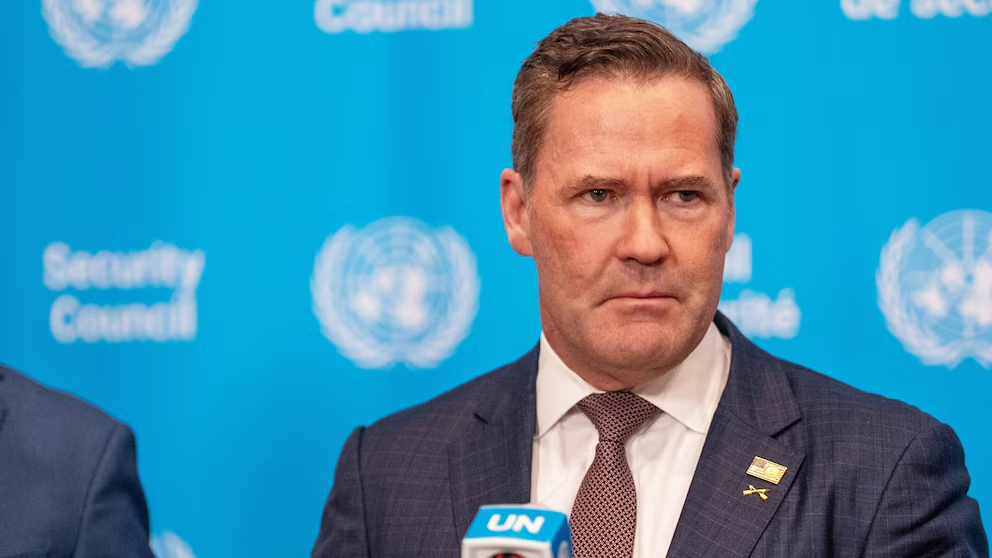
United States representative to the global organization Mike Waltz addresses the press regarding a proposed measure for the Hormuz Waterway, at the U.N. building in the Big Apple, May 7th, 2026. David Dee Delgado/Reuters
A rough copy of "This Week with George Stephanopoulos" that is going to be broadcasted on the air on the date of Sunday, May 10 in the year 2026, via ABC News, is presented here. This rendition might not be the finalized one, and it is subjected to revisions as well as the possibility of having slight inaccuracies in its transcription. If you would like to find past transcriptions of the show, you may check out the archive of "This Week" transcripts.
(COMMERCIAL BREAK)
MARTHA RADDATZ, ABC “THIS WEEK” CO-HOST: In the face of growing worries about the hantavirus, the vessel which is at the epicenter of the catastrophic eruption has now entered the vicinity of the Isles of Canary just moments ago.
“THIS WEEK” will now commence immediately.
(BEGIN VIDEO CLIP)
RADDATZ: Emergency containment strategies.
UNIDENTIFIED FEMALE: The potential risk to those in the general populace is remaining at a minimum level, but our team is currently monitoring the situation and regularly reevaluating.
RADDATZ: The urgent mission to restrict hantavirus as governing bodies surveil contaminations worldwide.
DONALD TRUMP, PRESIDENT OF THE UNITED STATES: There are countless talented and highly skilled individuals dedicated to researching this subject. We anticipate things to turn out favorably. We keep our fingers crossed.
RADDATZ: Just how concerned should a person be? What level of threat does the germ have? Here with us today is a renowned expert of infectious ailments to address these very serious issues.
Uncertain ceasefire.
TRUMP: There were shenanigans going on today. We took them down swiftly.
UNIDENTIFIED MALE: An understanding is not in sight. President Trump continues to assert that we are.
TRUMP: The U.S. and Iran involved in exchange of fire in the Hormuz Channel, can they come to a solution? The U.S. ambassador to the U.N., Mike Waltz is with us this morning. What does the admiral who is no longer in service think of the conflict coming to conclusion?
Main battleground.
This particular community is the center of focus and attention.
UNIDENTIFIED MALE: We have everyone with eyes on the town of Allentown.
RADDATZ: A journey to the state of Pennsylvania, where we gained insight from its voters, after an intense 10 weeks of combat.
UNIDENTIFIED MALE: It is terrifying to imagine Iran having a nuclear weapon.
UNIDENTIFIED MALE: The president’s expedition into the land of Iran is a total disaster.
RADDATZ: On top of that, a discussion on the repercussions of the intensifying battle of district lines.
And is it an unidentified flying object? Sensational imagery and footage from archived UFO materials recently shared by the Pentagon.
(END VIDEO CLIP)
ANNOUNCER: Broadcasting via ABC News, here is “THIS WEEK.” Introducing Martha Raddatz.
RADDATZ: Hello and greetings to "This Week."
As we commence our show on this day, the cruise ship that is related to the hantavirus outbreak has already made its way to the Canary Islands. The people onboard are now able to exit the boat. Several groups were seen in protective outfits leaving earlier today. The plan is for many of them to return to their native lands later today.
Many people might have recollections of the terrible COVID pandemic from the year 2020 when an epidemic is mentioned. Yet, the World Health Organization is advocating composure during this day. The director general is sharing a public message to the people of Tenerife, where the ship made its destination, composing, “I have full awareness that you might be disturbed. The thought of a ship heading to your coast might invoke terrible memories of the pandemic that are unforgettable. Be clear on this, however. It is not comparable to COVID. Currently, the hazard to public health from the hantavirus is at a minimum.”
He proceeded with the statement, “The greatest assurance any of us has is togetherness.” Spain has already taken action by accepting the cruise ship containing about 150 individuals hailing from approximately 23 nations, like 17 from America who will return to the U.S. via a specially hired aircraft. None of those disembarking the ship exhibited symptoms.
According to the WHO, they have verified six confirmed and a pair of suspected hantavirus instances connected to the vessel up until this point. Among those eight, three are confirmed to have died, and there is no medical treatment for the virus. President Trump had stated, “It is likely that things are under management.”
Worries continue to exist. Our team will have a discussion with a prominent specialist in infectious diseases here in the studio. Before that, Maggie Rulli will be situated live in Tenerife, the location where the cruise ship has recently entered.
Good morning, Maggie.
MAGGIE RULLI, ABC NEWS FOREIGN CORRESPONDENT: Hello, Martha, greetings.
Present before you is the Dutch cruise ship, the MV Hondius. It was docked at approximately 5:30 a.m. in local time.
As you examine the scene behind me, Martha, there are members of the press coming from all parts of the globe. They are keeping an eye on the several dozens of nationalities from across the world while they are being discharged from the boat on a per-country basis. One medical professional told me that they were only permitted to carry travel bags along with them. All of the baggage will be remaining on the ship and will be purified.
(BEGIN VIDEOTAPE)
RULLI (voice over): The cruise ship that is linked to the lethal hantavirus eruption is anchored at Tenerife in the Canary Islands. The last of the travelers are now allowed to come ashore once again.
RULLI: Here with us, there is a collection of individuals who have gained permission to exit the ship. We can see a small selection present here. These individuals are dressed in full blue outfits of protective gear. I was present to see some of them waving to the crowd behind.
They are transported to the harbor at the current moment.
RULLI (voice over): The Spanish authorities are asserting that tourists are not to have any contact with anyone in the territory, and officials keep advocating for level-headedness.
BORIS PAVLIN, WHO EMERGENCIES PROGRAMME TEAM LEAD FOR FIELD AND HUMANITARIAN EPIDEMIOLOGY: An ordinary citizen is not under any significant concern, because the Andes form of the hantavirus has had little to no spread among people. These are people that have not been showing symptoms. They are being monitored by professional medical staff, purely as a safety precaution.
RULLI (voice over): A WHO physician on the ship has sent us this footage of the extraction. The evacuated travelers are en route to their homelands as others linger behind. Of the total of 150 tourists on the ship, the CDC has reported that seventeen are citizens of the United States. It is stated that these individuals are not required to take part in quarantine once they touch down on U.S. soil.
DEB HOURY, FORMER CDC OFFICIAL: Not necessitating any quarantine is the logical decision, given the data on hand. Hantavirus is passed on by symptomatic individuals. It is important to understand that asymptomatic individuals carry no threat based on information to this point.
RULLI: U.S. personnel are monitoring at least nine Americans who span six states. Authorities are looking into the eight hantavirus cases linked to the ship, including its origins, after three travelers passed away from the sickness. Despite alarm for the virus, those on the vessel insisted that the setting had remained encouraging.
Dr. Stephen Kornfeld, a medical professional specializing in tumors from Oregon, is standing in after the main medical professional on the ship became sick. Stephen has informed ABC that the ship has been symptom-free for more than seven days.
DR. STEPHEN KORNFELD, MV HONDIUS PASSENGER: There is too much blame and scorn. I have been there and back again, and I am a medical professional. With the benefit of hindsight, I do not believe that any red flags were missed. My compliments and accolades go out to all of the people who were onboard this ship.
(END VIDEOTAPE)
RADDATZ: How are U.S. personnel managing the arrival of these U.S. citizens?
RULLI (on camera): The officials have reported that the American citizens are to be evacuated last on this day. The Department of State has reported that there is a specialized aircraft assigned to returning the individuals back to U.S. soil. The CDC is on standby to assist the group once they land. From there, the group will be accompanied to the National Quarantine facility found in Omaha, Nebraska.
This will be the same quarantine center that was implemented to help manage the crisis of COVID-19 in its early days.
I managed to ask a Ministry of Health spokesperson about the lack of requirement for a mandatory quarantine, and he responded by stating that such a process is not technically or scientifically sound.
Martha.
RADDATZ: Thank you, Maggie.
We will speak with Dr. Michael Osterholm from the U. Minnesota, who is a prominent expert of infectious ailments in the nation.
It is a pleasure to see you.
DR. MICHAEL OSTERHOLM, DIRECTOR, UNIVERSITY OF MINNESOTA CENTER FOR INFECTIOUS DISEASE RESEARCH & POLICY: It is my pleasure to be here.
RADDATZ: Several Americans may not be familiar with the hantavirus. It is sensible for a person to be apprehensive. It has been iterated that this is unlike the event of COVID-19. It has been said that this should not be a cause for concern. Are you in agreement with those people?
OSTERHOLM: Correct. Allow me to wish you a joyous occasion for Mother’s Day.
RADDATZ: Thank you.
OSTERHOLM: It is fortunate for the fact that we are dealing with hantavirus and not an instance of the coronavirus. Person-to-person transmission of the germ is limited, and it does not usually occur. There is no doubt in our minds that the situation is coming to its conclusion. There is a chance that there may be no additional occurrences from this point forward.
RADDATZ: Typically, infection stems from rodent excrement. About how many instances are there in a typical year?
OSTERHOLM: Thirty occurrences take place each year in the U.S. Most occurrences are located to the west of the Mississippi, or approximately 96%. These occurrences are based on the existence of the deer mouse that carries the virus.
The South American Andes strain is responsible for boat-related transmission. Transmission between people has rarely happened as a result.
RADDATZ: The incubation period should be discussed. The timeframe is more extensive compared to COVID, which involves an exposure of thirty minutes.
OSTERHOLM: Precisely. As it comes to the likelihood of transferring to someone else, only a small number of people can do so. Examples of people contracting the virus from rodent residue in Argentina have not resulted in person to person transmission. It is not very common.
For a limited exposure period, it should be understood that the super-spreader is the person who transfers the germ.
RADDATZ: Is it true that there is no transmission unless someone is symptomatic?
OSTERHOLM: Correct. The individuals should be watched for a fever and checked for any symptoms two times per day.
It is possible to limit the germ by wearing a N95 mask if someone is identified with the ailment.
This is why containment facilities are not necessary. A normal monitoring process will suffice.
RADDATZ: What about staying home?
The American citizens are going to be sent to Nebraska. There will be medical checkups, and they will be free to leave.
Is it safe to assume this will be fine? Do you agree with this assessment?
OSTERHOLM: It is more than just being trusting. I am referring to the ability of the people to participate in this process as it relates to their own welfare as well as others.
I am referring to our involvement with Ebola. We monitored the returning health-care staff returning from Africa twice per day. It worked out in the best manner.
I have full faith that everything will work out. I believe the situation will disappear from the news cycle.
RADDATZ: The citizens who have been released from the ship earlier in the month of April are now returning to the U.S. Is there any cause for worry?
OSTERHOLM: Now that the citizens are being monitored, there is no need for concern. Until now, nobody has had an infection. The same can be said about the citizens disembarking the boat today. There is no evidence of illness.
The cases can be traced back to the original person who entered the ship. It can be attributed to one person and not multiple.
RADDATZ: I appreciate you being on the show.
OSTERHOLM: My pleasure.
RADDATZ: It is reassuring to hear the analysis.
OSTERHOLM: My pleasure.
RADDATZ: Mike Waltz is here to represent the U.S. at the U.N.
I thank you for your attendance, sir.
I would like to discuss Iran soon. First, there are some hantavirus questions to answer.
I would like to know more about the organization with other countries to get the American citizens out of there. As you know, the president has removed himself from the World Health Organization.
Are there any issues to take into account with this change?
MIKE WALTZ, U.S. AMBASSADOR TO THE UNITED NATIONS: Things are playing out just as they would when we were involved or not involved.
It is important to understand that WHO and this issue are not linked. Our European associates have been coordinating closely with us, and the CDC is taking the lead, and I will trust in them and the National Institutes of Health. From what I can understand, our teams are deployed. They are caring for the American citizens from the ship. They will be able to take repatriation flights and return to the national quarantine center of Nebraska.
I am no doctor. I do not want to dive deep into this issue. It is my understanding that the sickness does not involve the respiratory system, and transmission through breathing is virtually impossible. I am confident that the CDC and NIH are in control of the situation.
RADDATZ: President Trump spoke about the virus being under control. The fear from COVID persists. President Trump had no worries during the beginning of COVID and that the situation will be under control. This sentiment was shared in a CNBC interview.
The concerns are understandable. What is your response to them?
WALTZ: This is why the situation needs to be addressed with clarity. Transmission between humans is rare and transmission through respiratory means is nearly impossible.
It is to be taken very seriously, and the citizens will be addressed in a proper manner as they are brought back to the quarantine center. I would suggest that the individuals will be monitored and cleared after a month before they are free to go back to their communities.
There are diplomatic missions from the State Department overseas so that they can work together with local authorities in areas such as the Canary Islands near the Spanish coast. All of the collaborations will be handled through the inner agency, State Department, and CDC.
RADDATZ: I appreciate your help, sir.
Let’s turn to Iran.
Can you provide an update on the status of negotiations? We have heard Secretary of State Marco Rubio say that a response is expected from Iran on the proposal. Can you explain the delays?
WALTZ: The country has dealt with severe issues when it comes to leadership. One example is Mojtaba, the son of the previous ayatollah, has had injuries and must remain in hiding. He has become a difficult person to deal with, but the IRGC is still respectful in some capacity. The result is that negotiations are taking more time than desired. Diplomacy is ongoing, however.
We will have to see what comes about as a result. President Trump has been clear about the aggressive regime of Iran and how they cannot have their hands on a nuclear weapon. This sentiment has been going on for decades, even before his time in office.
As the U.N. ambassador, I can share that it is not only the position of the U.S. We have had countless resolutions for the past twenty years agreeing that the Iranian regime cannot be in control of a nuclear weapon. They are subject to inspections and they should not disregard their obligations. This point has been echoed throughout the world.
The world has remained strong with the U.S. when it comes to imposing sanctions. The Iranian government has not met its obligations when it comes to non-proliferation.
RADDATZ: President Trump has given a warning to Iran 50 days ago to open up the strait. The Strait has not been opened.
WALTZ: We are dealing with a problem that has spanned 50 years in 50 days. This is not the first time that Iran has threatened such an action. It is important to remember the tanker wars. One of our ships was struck with a mine in the 1980s. Reagan removed half of the Iranian Navy at the time.
This is why we are pushing for a U.N. resolution that will not allow Iran to take these actions. No country is permitted to take actions in international waterways in the same way as Iran.
We cannot have a conflict between two countries based on resources or a nuclear program in which another is held hostage through the use of sea mines in international waterways. Imagine a similar situation in the Strait of Gibraltar.
RADDATZ: Can you respond to these points, sir?
WALTZ: The state TV of Iran has suggested that they will take control of the undersea cables in the waterway. These cables move financial and stock exchange information.
RADDATZ: Sir?
WALTZ: Data can be placed into the cloud with data centers. It must not be permitted. There are 60 other countries standing together to isolate Iran and ensure that it never repeats its actions.
RADDATZ: The exchange of fire from today is notable. The drones were going over Kuwait and the UAE. Is this a violation of the ceasefire? How is the exchange of fire not a violation?
WALTZ: I must respond to your point. There was a blockade established by President Trump and the U.S. Navy that stopped shipping. Iran has been experiencing a freefall of its economy. Its currency is down over 100% and its currency reserves have been used. The New York Times has run an article about the layoffs in its manufacturing sector. The regime is under tremendous pressure.
I would not expect the regime to willingly give up on a nuclear weapon. The pressure will be needed. This point on the ceasefire will be handled by President Trump, the commander in chief. He will determine what is a violation and whether we should go back to military action or to continue with diplomacy. The mediators of Pakistan have asked for another negotiation. It is an appropriate choice for the President to make. He is giving diplomacy an opportunity before going back to hostilities. The President is prepared to take military action as well.
RADDATZ: Thank you for your presence this morning, sir.
WALTZ: You are welcome.
RADDATZ: The retired Admiral William McRaven is here. He was the commander that eliminated Osama bin Laden, and he authored the book, “Duty, Honor, Country, and Life.”
It is great to have you on the show this morning, sir. We spoke with Ambassador Waltz. You are laughing already. How do you describe the state of the ceasefire?
ADM. WILLIAM MCRAVEN, FORMER U.S. SPECIAL OPERATIONS COMMANDER: The ceasefire has been broken. The exchange of fire is not a part of the ceasefire. I understand Ambassador Waltz’s perspective. It is important to reach an agreement with Iran. The exchange of fire needs to be downplayed.
The ceasefire is no longer in place in technical terms. Shooting at each other is the antithesis of the ceasefire.
RADDATZ: What is the Iranian perspective in this situation?
MCRAVEN: The situation is interesting right now. The President should look towards his strategic objectives. The goals are to reopen the Strait and to ensure that a uranium agreement is in place. The Iranians must be brought to the table.
Leverage can come from the blockade. The blockade has been successful. The Iranians can be approached with an offer to lift the blockade, if they come to the negotiating table. By doing so, the president can reinstate the blockade if they do not come to the table.
Discussions about serious issues will not take place unless the Iranians come to the table.
Sourse: abcnews.go.com