
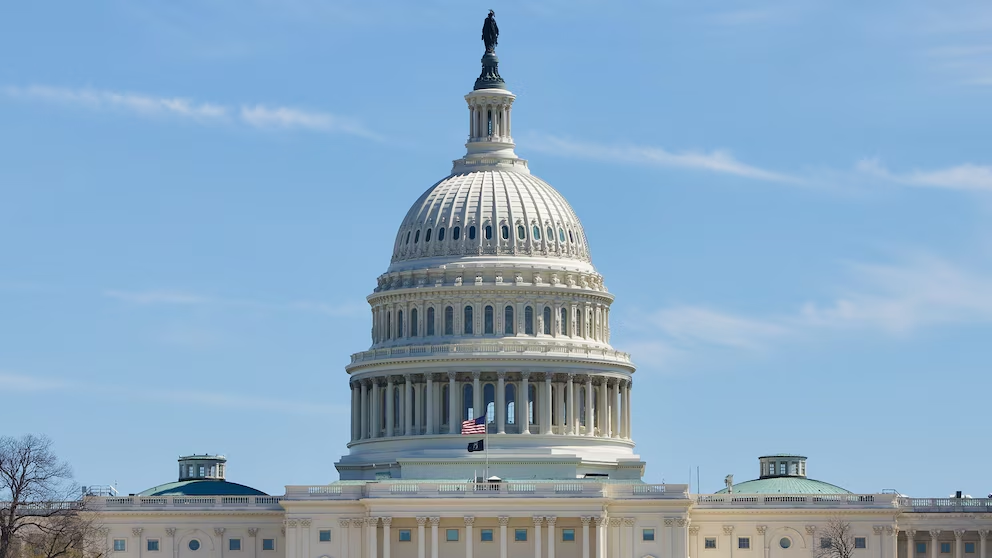
The United States Capitol building is pictured in Washington, March 29, 2026.Amid Farahi/AFP via Getty Images
Speaker of the House Mike Johnson and Senate Majority Leader John Thune revealed that the Republican-led Congress will, “in the approaching days,” finance the Department of Homeland Security through both the budgetary process and the reconciliation route; however, the path they are taking suggests it could potentially extend beyond the timeframe desired by President Donald Trump.
It appears that House Republicans have conceded to their Senate counterparts, who preferred to finance DHS excluding immigration enforcement, which was backed by Democrats.
To address that trickier matter, the initial cause of the standstill, Republicans assert they will utilize the reconciliation method, which bypasses the Senate filibuster. Yet, pursuing this path would necessitate relying on their exceptionally narrow advantages in both legislative bodies.
"By adopting this dual-track strategy, the Republican Congress will completely reopen the Department, ensure all federal personnel are compensated, and specifically provide funds for immigration enforcement and border protection for the subsequent three years, enabling these law-enforcement operations to proceed unimpeded," the leading Republicans declared in a statement released on Wednesday.
June 1 target
The declaration occurred shortly after Trump publicly urged Republicans to employ reconciliation — a mechanism that avoids the filibuster in the Senate — to deliver a bill to him by June 1 that would provide resources for Immigration and Customs Enforcement and Customs and Border Protection.
"We will strive as swiftly, and as diligently, as we can to restock funding for our Border and ICE Agents, and the Radical Left Democrats will be powerless to impede us," Trump expressed in a post on his social media platform on Wednesday.

President Donald Trump speaks during the signing ceremony for an execituve order on mail ballots, in the Oval Office of the White House in Washington, March 31, 2026.Evan Vucci/Reuters
Legislators departed from the Capitol on Friday for a two-week break after failing to secure an agreement to finance DHS. Following the fatal shooting of two U.S. citizens by federal officers in Minneapolis earlier this year during the administration’s crackdown on immigration, Democrats called for revisions to ICE and CBP.
The partial closure, which commenced on Feb. 14, is currently the lengthiest in U.S. history.
Last week, the Senate unanimously approved legislation to finance all of DHS, excluding ICE and CBP, aiming to subsequently fund these agencies via reconciliation, but the House turned down the Senate’s proposal.
Instead, House Republicans advanced a temporary measure to finance the entire department for eight weeks at existing levels, which Senate Minority Leader Chuck Schumer labeled as “doomed” in the Senate.
Senate strategy to fund all but immigration enforcement
It remains uncertain how this situation will unfold over the next few days, but House Republicans might attempt to approve the Senate bill during brief sessions held during the recess.

The US Capitol building is seen in Washington, March 28, 2026.Heather Diehl/Getty Images
ABC News has inquired with Johnson’s office regarding how the House plans to address the Senate’s DHS funding bill.
"While we had hoped they would endorse the 60-day [continuing resolution] to finance the Department entirely, thereby permitting bipartisan negotiations to proceed, it is now abundantly evident that Democrats prioritize allegiance to their radical left-leaning base above all other considerations — including their own spending authority — which equates to open borders and safeguarding criminal undocumented immigrants,” Johnson and Thune remarked.
"That is unacceptable to Republicans in Congress, nor is it acceptable to the American populace. We can no longer permit Democrats to jeopardize the safety of the American public through their open border initiatives; therefore, we are removing that possibility from consideration," they asserted.
Funding frontier security
Moreover, Johnson and Thune stated that Republicans will proceed to allocate funding for border security and immigration enforcement for a three-year period through budget reconciliation – a legislative device that furnishes Congress with a streamlined approach to advance specific spending and tax measures.
A primary advantage of this method is that reconciliation legislation is immune to filibusters, signifying it can be adopted with a straightforward majority vote in the Senate, instead of requiring 60 votes.
However, with such slim Republican majorities in both legislative bodies, the passage of a bill via this avenue would necessitate almost unanimous endorsement from every congressional Republican. Securing such backing is not guaranteed and could prove rather protracted, potentially rendering Trump’s June 1 deadline quite optimistic.
Trump appealed for cohesion in his social media posting on Wednesday, imploring Republicans to take action.
"Through simple agreement, Republicans can achieve this independent of the Democrats!" his post stated.
Sourse: abcnews.go.com