

In this Aug. 8, 2020, archived image, an oceanic crude drilling platform is pictured in the Gulf of Mexico.UIG via Getty Images, FILE
A US panel, consisting of high-ranking officials from the previous administration, voted in agreement to approve a waiver under the Endangered Species Act for petroleum and natural gas activities in the Gulf, pointing to national security matters.
Conservation organizations denounced the ruling, cautioning that it could seriously endanger the protection of numerous imperiled and threatened species in the area, such as cetaceans, marine turtles, whooping cranes and manatees.
The Endangered Species Committee convened Tuesday after Secretary of Defense Pete Hegseth submitted a finding concerning national security that set off the waiver procedure.
According to the Endangered Species Act, the Endangered Species Committee is able to issue infrequent exceptions when a federal action possesses national or regional value and the advantages of proceeding clearly outweigh the advantages of options that would safeguard the species. Financial, security and other public-interest elements can be taken into consideration alongside conservation obligations, although waivers are hardly ever utilized.
“Responding to the Department of War’s request, the Endangered Species Committee assembled today to deliberate a national security exception under the Endangered Species Act regarding petroleum and gas operations in the Gulf of America,” the National Oceanic and Atmospheric Administration (NOAA) expressed in a declaration to ABC News.
“The Committee cast their votes in favor of the national security exception, acknowledging the major risks associated with restricting petroleum and gas operations in the Gulf of America, while also recognizing that the action encompassed protective measures for endangered species.”
Authorities underlined that consistent petroleum and natural gas output in the area is vital to U.S. national security and economic stability, and cautioned that essential power activities should not be put at risk by the possibility of upsetting legal action.

In this Aug. 8, 2020, archived image, an oceanic crude drilling platform is pictured in the Gulf of Mexico.UIG via Getty Images, FILE
The committee, established in 1978, rarely assembles due to the strict, restricted criteria for its application. It has not been in session for more than 30 years, and this is the first instance where a national security reason has been utilized to convene the committee.
The Endangered Species Committee, comprising of the Secretary of the Interior, the Secretary of Agriculture, the Secretary of the Army, the chair of the Council of Economic Advisers, the administrator of the Environmental Protection Agency and the administrator of the National Oceanic and Atmospheric Administration, was fully represented and voted in unison to approve the waiver.
“This meeting made it evident that energy currents in the Gulf of America must not be disturbed or held at the mercy of pending litigation,” said Secretary Burgum. “Energy manufacturing in the Gulf of America is necessary for our nation’s strength, protecting our power autonomy and stopping reliance on foreign adversaries. Substantial expansion in the Gulf keeps our economy resilient, stabilizes expenses for American families and secures the U.S. as a global leader for years into the future.”
On March 13, Secretary of Defense Pete Hegseth informed Interior Secretary Doug Burgum, chair of the Endangered Species Committee, that a national security exception under Section 7(j) of the Endangered Species Act, was required, resulting in Secretary Burgum issuing a notice of the meeting in the Federal Register.
The meeting commenced with the defense secretary addressing the committee, emphasizing the significance of a constant, affordable domestic power resource, which is presently under pressure. He showed his gratitude to the committee members for assembling to explore what he termed “a matter of critical national security.”
“This extends beyond gas prices; it concerns our capability to power our military and defend our nation. That crucial energy resource is currently at risk,” Hegseth stated. “In January, considerably before Operation Epic Fury, the Department of the Interior informed the Department of War regarding ongoing Endangered Species Act legal action that threatened to cease petroleum and gas output in the Gulf of America.”
According to Hegseth, the legal action seeks to halt Gulf petroleum and gas activities as opposed to permitting them to advance in conjunction with accountable endangered species protections.
“These judicial conflicts misuse vital government assets and make it impossible for energy businesses to strategize and put money into new initiatives. When expansion in the Gulf is suppressed, we are hindered from producing the energy we require as a nation and as a department,” Hegseth continued. “The Strait of Hormuz is the busiest oil route on Earth and recent hostile actions by the Iranian terror regime emphasize yet again why resilient domestic petroleum production is a national security necessity.”
Nevertheless, conservation organizations contend this is not what the originators of this significant law envisioned.
The Center for Biological Diversity brought a suit against Secretary Burgum on March 18, seeking to prevent the committee meeting, claiming the government overlooked legal stipulations, including submission deadlines, providing sufficient public awareness, and having an administrative law judge preside. Following the committee’s determination, the group announced it will modify its existing lawsuit to dispute the defense secretary’s national security assessment and the waiver.
“Americans broadly disapprove of sacrificing endangered whales and other marine organisms so the fossil fuel industry can accumulate more wealth. This is unrelated to national security and is entirely about Trump and his cronies giving in to Big Oil,” Brett Hartl, government affairs director at the Center for Biological Diversity, remarked in a declaration.
Conservation organizations are particularly anxious about the Rice’s whale, which, according to NOAA, is one of the rarest and most imperiled whales globally and is exclusively found in the Gulf.
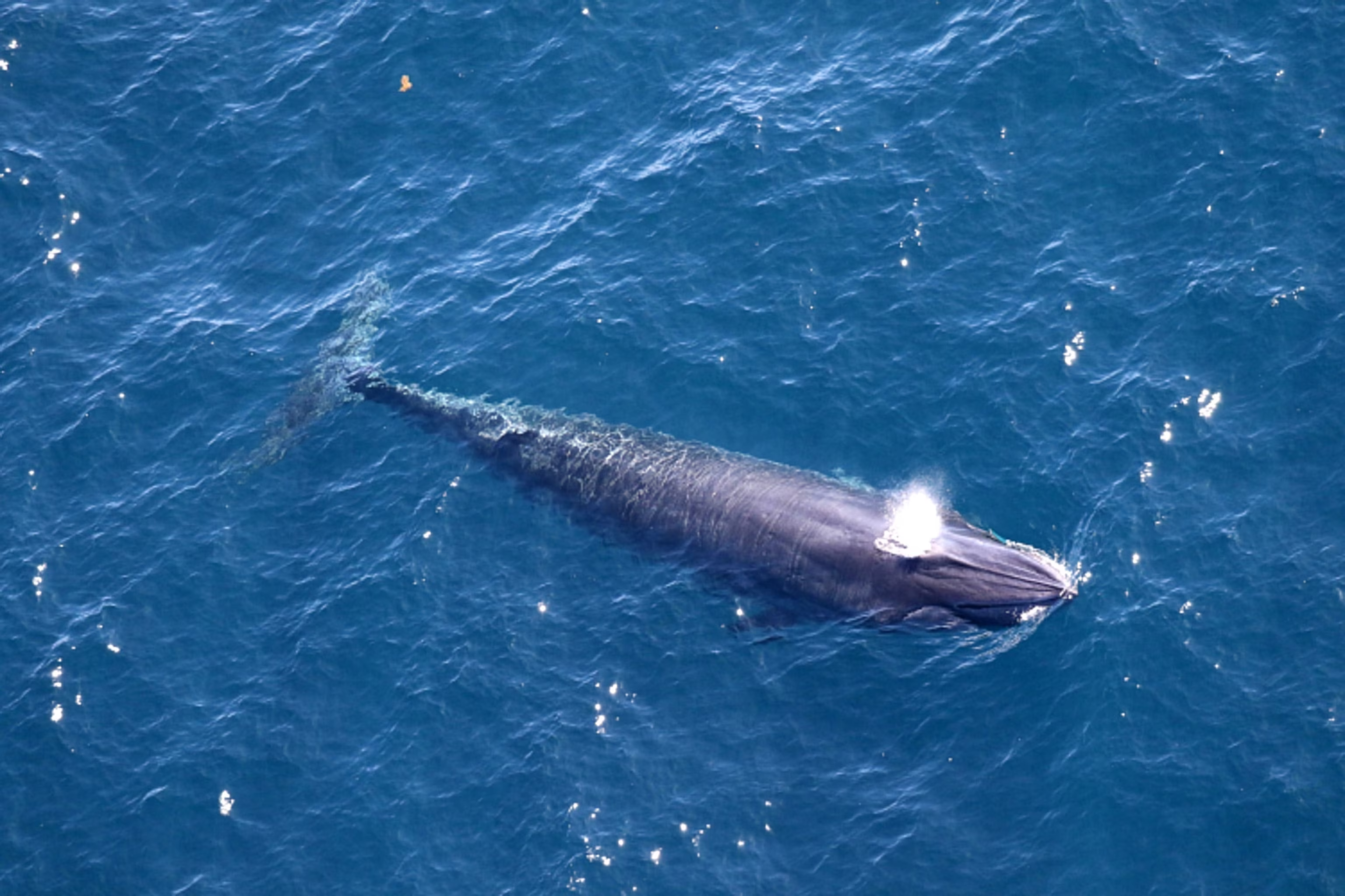
In this 2024 image furnished by NOAA Fisheries, a Rice’s whale can be seen from aboard the NOAA Twin Otter aircraft off the shore of Texas in the Gulf of Mexico.Paul Nagelkirk/NOAA Fisheries via AP
NOAA Fisheries, which oversees protections for marine species under the Endangered Species Act, registered the Gulf of Mexico Bryde’s whale as endangered in 2019 and, in 2021, revised its designation to Rice’s whale to mirror the newly recognized scientific taxonomy and nomenclature of the species.
According to the Marine Mammal Commission, the most recent population estimates indicate there are only 51 Rice’s whales remaining.
The Rice’s whale’s minimal population, restricted habitat and minimal genetic variety make it highly susceptible to risks such as vessel collisions and petroleum leaks. NOAA states the 2010 Deepwater Horizon spill affected approximately 48 percent of its habitat in the eastern Gulf, potentially causing a population reduction of up to 22 percent and leading to enduring impacts on reproduction and growth.
The committee’s determination will not have any instant consequences, and legal challenges to the action could delay its execution further. It may take several years before any future additional petroleum output linked to the determination is accomplished.
“The action could make it simpler for applications to be approved for additional petroleum and gas exploration and growth in the Gulf; yet it requires several years between the filing of an application and the manufacturing of the first unit of petroleum,” said Michael Gerrard, a professor at Columbia Law School and the faculty director of the Sabin Center for Climate Change Law. ”No court has commanded petroleum and gas output to be halted in the Gulf, and such a command seems very improbable.”
Sourse: abcnews.go.com