

President Donald Trump addresses the nation regarding the Iran conflict from the White House in Washington, April 1, 2026.Alex Brandon/Pool/AFP via Getty Images
The Executive Office, in its financial plan submission for the 2027 accounting period, is petitioning Congress to sanction about $1.5 trillion for national defense — an unprecedented armed forces budget request while the U.S. continues in its fifth week of conflict with Iran.
That represents a $445 billion, or a 42% expansion from the total figure in 2026, according to the Executive Office. Non-defense spending would subsequently be diminished by $73 billion, or 10%, according to the budget made public by the Executive Office on Friday.
Key objectives of the suggested spending reductions are environmental initiatives across numerous federal departments, including rescinding in excess of $15 billion in Department of Energy allotments tied to environmentally friendly energy.
The Executive Office budget likewise carries on the Department of Education's "course to elimination," proposes curtailments to agricultural spending by 19% and proposes cutting the Internal Revenue Service's fiscal plan by $1.4 billion.
"The 2027 Fiscal Plan expands upon the President’s perspective by persistently restricting non-defense expenditures and reforming the Federal Government," Office of Budget and Management Director Russ Vought communicated in the application to Congress.
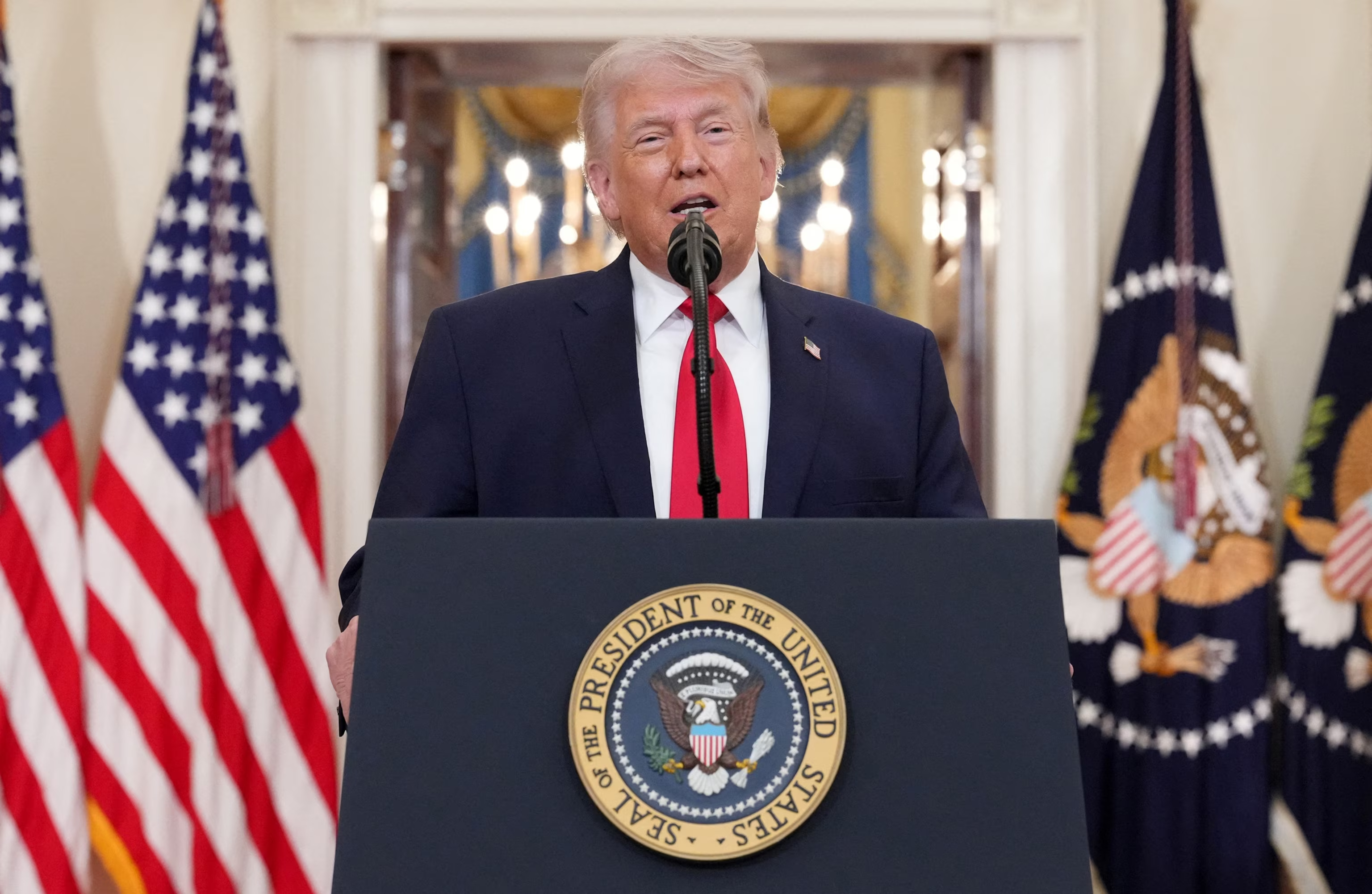
President Donald Trump delivers an address to the nation about the Iran war at the White House in Washington, April 1, 2026.Alex Brandon/Pool/AFP via Getty Images
President Donald Trump's fiscal plan submission, which is predominantly a desired list given to Congress to denote the administration's focal points, includes "reducing fierce crime and safeguarding national security" in conjunction with "defending the homeland and removing perilous unlawful immigrants" as the other two spending focal points for the approaching year.
The fiscal plan proposes more than $19 billion for federal law enforcement — a 15% upswing from 2026. The fiscal plan upholds "vital funding" for Immigration and Customs Enforcement next year, equivalent to the 2026 level, encompassing $2.2 billion to maintain 41,500 immigration holding facilities.
The Executive Office communicated that an investment in defense and Department of Homeland Security would be, to some extent, accomplished through fiscal plan reconciliation.
The reconciliation procedure presents a crucial advantage of not being exposed to a filibuster. This signifies legislation can be enacted with a straightforward majority vote in the Senate and that Republicans wouldn't essentially require Democratic backing, implying an endeavor from the Executive Office to circumvent Democratic stipulations for non-defense augmentations.
"Reconciliation appropriations in 2027 will empower DHS to thoroughly execute the President’s immigration enforcement endeavors, finalize construction of the border barrier on the Southwest border, secure cutting-edge border safeguarding technology, and sustain the largest recapitalization investment in the chronicles of the U.S. Coast Guard,” according to the Executive Office.
Presently, DHS appropriations are entrapped in impasse on Capitol Hill, culminating in the lengthiest partial government cessation in recorded history.
Sourse: abcnews.go.com