
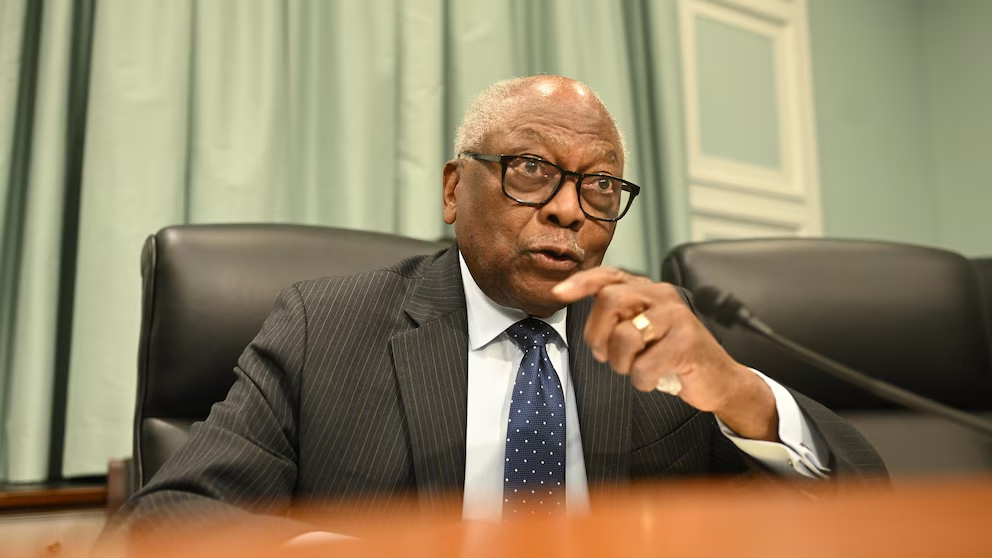
Rep. James Clyburn, D-S.C., questions Secretary of Housing and Urban Development Scott Turner during a House Committee on Appropriations Subcommittee on Transportation, and Housing and Urban Development, and Related Agencies budget hearing on Tuesday, May 12, 2026.Mattie Neretin/Sipa USA via AP
Representative James Clyburn, the veteran African American congressman from South Carolina whose position might be vulnerable due to congressional redistricting later this decade, expressed to ABC News that he views the redrawing of congressional districts held by Black representatives as part of a broader history involving bias and the suppression of voting rights against African Americans.
"I struggle to understand why it’s so difficult for people to grasp this. The nation is pursuing what I’m calling ‘Jim Crow 2.0.’ It really is that straightforward," Clyburn stated.
Several experts informed ABC News that the redistricting process in the South might eliminate as many as a third of the Congressional seats currently occupied by African American lawmakers, and Black congressmen have been voicing comparable worries ever since the mid-decade redistricting endeavors by Republicans commenced the previous year.
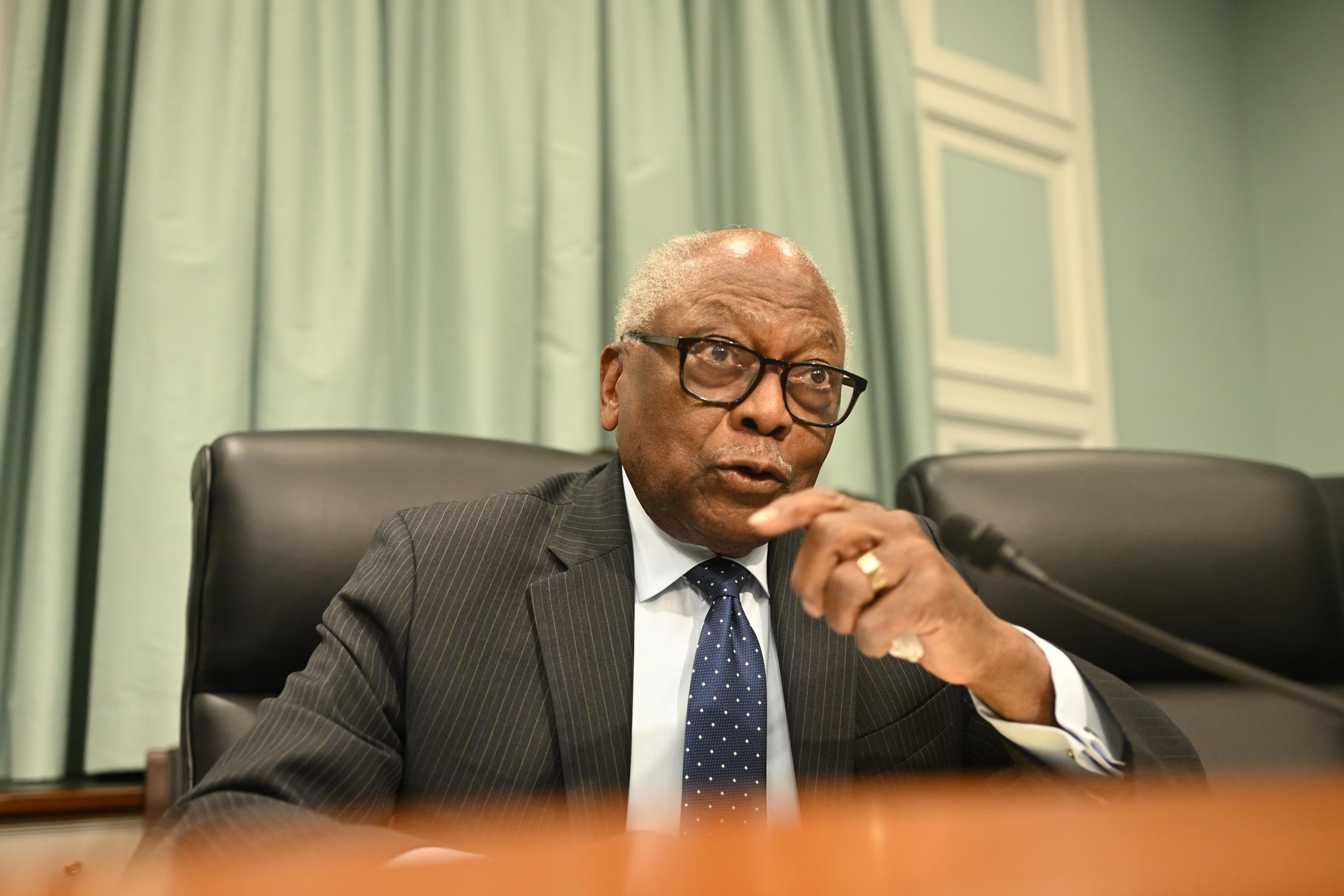
Rep. James Clyburn, D-S.C., questions Secretary of Housing and Urban Development Scott Turner during a House Committee on Appropriations Subcommittee on Transportation, and Housing and Urban Development, and Related Agencies budget hearing on Tuesday, May 12, 2026.Mattie Neretin/Sipa USA via AP
Republicans have maintained that they are revising the congressional maps to abide by Supreme Court rulings or to rectify districts that were unfairly created, and to ensure that the districts that might be altered could still vote in Black representatives to Congress.
However, Clyburn informed ABC News that focusing exclusively on redistricting obscures a more significant issue.
“When I put out the book ["The First Eight"], and that's what my book was centered on. I believe many individuals assumed I was just being facetious. But no,this is genuine. It’s as authentic as possible. And we need to confront that. So it's not solely about congressional districts. It's also regarding affirmative action, closing colleges and universities that historically served Blacks, it's about the challenges we face in obtaining jobs in the federal and state governments,” Clyburn noted.
“They are aiming to eliminate federal positions within the federal government, removing that safeguard … getting rid of diversity and inclusion initiatives. So this is a broad, sweeping action.”
Clyburn was initially chosen to represent his district in the House of Representatives in 1992, becoming the first African American member of Congress from South Carolina in a century. His background includes teaching high school history and extensive engagement in political activism.
He had a discussion with ABC News mere hours before South Carolina Gov. Henry McMaster made a statement Thursday evening in an official decree indicating his intention to convene the state legislature for a special session to deliberate mid-decade redistricting.
McMaster’s announcement followed other states redrawing maps after the Supreme Court’s recent decision against Louisiana’s congressional map. It also followed only two days after, despite pressure from President Donald Trump, the state Senate rejected a key bill that would have allowed the legislature to consider mid-decade redistricting even after formally adjourning.
However, that particular, specialized bill needed a two-thirds majority to pass. During the special session, a bill that would redraw the congressional map would need only a simple majority.
In a statement celebrating McMaster’s announcement, South Carolina Republican Party Chair Drew McKissick stated, “Thanks to the Supreme Court ruling, Republicans have an opportunity to get this completed, and we should capitalize on it. This is the time for lawmakers to side with President Trump, defend the Constitution, and complete the task.”
Clyburn, speaking prior to the special session being formally declared, shared with ABC News that he considered the Supreme Court’s decision in Louisiana vs. Callais, which invalidated Louisiana’s congressional map, as the continuation of a series of additional Supreme Court rulings he deems detrimental – including the Citizens United v FEC ruling that unleashed billions of dollars from corporations, labor unions and other groups into American campaigns as a protected form of free speech; as well as the Dred Scott decision, which in 1857 held that Black Americans could never be considered citizens.
The Fourteenth Amendment, ratified 11 years following Dred Scott, was designed to refute that decision and to avert the creation of a hereditary class of noncitizens within the United States.
“I’ve been saying this for around five or six years. Back when the Supreme Court made a ruling … many individuals regarded me as if I were some intoxicated sailor," Clyburn recounted. "I mentioned, when the Supreme Court issued its ruling in the so-called Citizens United case, which is when they established anonymous funding. And I said at that point in time, this Supreme Court decision will be remembered alongside — will rival Dred Scott as one of the worst decisions ever rendered by the Supreme Court."
“Now, people couldn’t comprehend my meaning back then, but I’ve studied history my entire life. And upon observing that [Citizens United] decision, I recognized that the groundwork was being set to seize control of this nation,’’ Clyburn explained.
Despite all of that, Clyburn communicated to ABC News that he does maintain optimism for the country’s prospects.
"I'm from South Carolina. Are you aware of our state’s saying? 'While I breathe, I hope.' I'm a genuine South Carolinian. Breathing and maintaining hope," he said.
ABC News' Devin Dwyer and ABC News legal contributor James Sample lent their expertise to this article.
Sourse: abcnews.go.com