
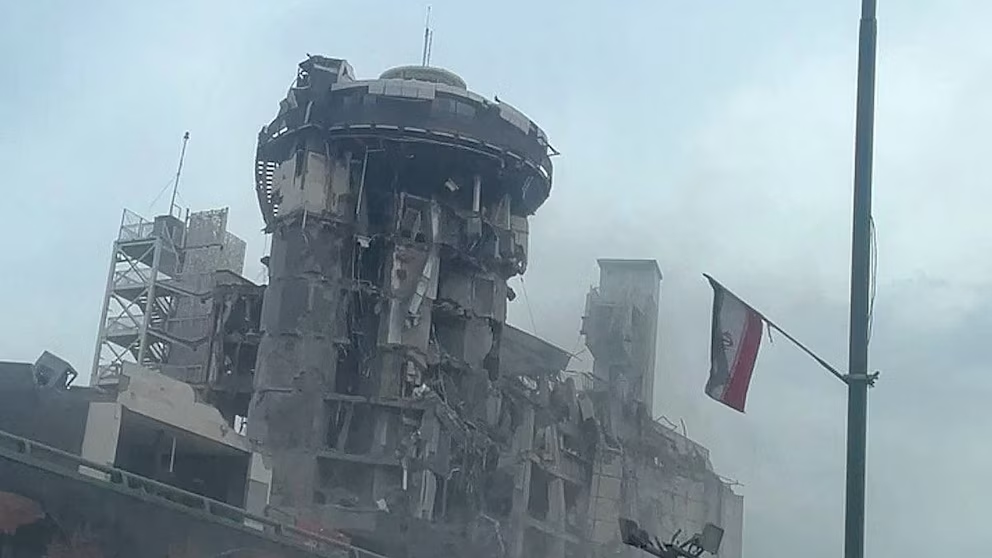
Damage to the Isfahan Optics Industries complex, along with the nearby area, in Isfahan, Iran, on March 24, 2026. Social Media via Reuters
The specter of potential U.S. strikes on Iranian electrical facilities is still present amidst the Middle Eastern tensions, even after Trump postponed a self-defined deadline for the second instance.
In a social media communication on Thursday, Trump stated he was "suspending the Energy Plant destruction timeline" until April 6.
Should such an assault occur, Iran has stated that it would execute retaliatory attacks on energy-related infrastructure in adjacent nations, as per Iran's Fars News Agency, a state-run media source.
This menacing escalation carries the risk of a humanitarian disaster for potentially tens of millions in the region, possibly restricting their admittance to fundamental necessities such as power, sustenance, hydration, and medical assistance, as per several analysts speaking with ABC News.
Hardship could extend to nations outside the Gulf zone if harsh circumstances compel people to escape across boundaries, and if infrastructure impairment intensifies a worldwide oil predicament, the analysts suggested.
“This will prove detrimental to all parties,” Mushfiq Mobarak, an economics professor from Yale University, explained to ABC News. “The most harmful outcomes — the gravest welfare repercussions — will burden Iranian residents.”
On March 21, Trump pledged to “demolish” Iranian power plants within a 48-hour span if the nation didn’t relax its blockade of the Hormuz Strait. Before this ultimatum concluded on Monday evening in Washington, D.C., Trump conveyed through social media that he was deferring the deadline for five days, alleging “fruitful discussions” had transpired between the U.S. and Iran.
On Thursday — a day prior to the revised deadline’s arrival — Trump indicated he would delay the deadline by an additional ten days.
Discussions between the U.S. and Iran are "in progress," Trump asserted. Iranian figures have refuted that the nation is engaged in discourse with the U.S.
Concurrently, Iran has vowed to retaliate against civilian infrastructure in neighboring states should its energy locations be attacked.
"Immediately following the targeting of our country’s power plants and infrastructure, essential infrastructure, energy infrastructure, and petroleum installations throughout the region will be deemed legitimate targets," declared Mohammad Bagher Qalibaf, Iran’s parliamentary speaker, in an X post on Sunday.
Natural gas powers approximately 79% of Iran’s electricity consumption, as reported by the International Energy Administration, an international energy policy body located in Paris, France.
South Pars, the world’s most expansive natural gas field, provides the bulk of the nation’s natural gas. Last week, an Israeli offensive on South Pars signaled a severe impact for Iran and neighboring Gulf countries, analysts previously communicated to ABC News.
Potential U.S. offensives on energy facilities could impede power access for a significant portion of Iran’s 92 million population, while concurrently interrupting energy provision to vital institutions like hospitals, Mobarak stated.
“If hospitals suffer power outages, that is very dangerous,” Mobarak emphasized.
The health-related fallout could surface as certain regional hospitals face perilous conditions, according to the World Health Organization (WHO). As of March 5, health installations underwent a total of 13 attacks, according to the WHO, expressing concern regarding “regional health systems and at-risk lives.”

Iranian citizens walk through Tajrish Bazaar amidst the U.S.-Israeli conflict involving Iran, in Tehran, Iran, on March 24, 2026. Majid Asgaripour/West Asia News Agency via Reuters
Attacks targeting civilian amenities in Iran could additionally exacerbate food deficits and escalating prices, Michael Werz, a senior fellow at the Council on Foreign Relations, conveyed to ABC News. Iran’s annual food inflation stood at 72% in December, before the war’s onset, The Wall Street Journal noted.
Werz specified that any additional degradation in food accessibility could produce a “substantial impact.”
Potential Iranian reprisals against civilian locations represent a menace of desperate circumstances for millions residing in surrounding nations like Oman, Qatar, Kuwait, Saudi Arabia, the United Arab Emirates (UAE), Iraq, and Israel, some analysts conveyed.
These nations depend significantly on water desalination plants for potable water due to the region’s arid climates, positioning these facilities as a major vulnerability, Ginger Matchett, the assistant director with the GeoStrategy Initiative at the Atlantic Council’s Scowcroft Center for Strategy and Security, articulated in a blog post.
Desalinated drinking water constitutes at least 90% of the supply in Kuwait, Bahrain, and Qatar, while Israel and Oman each depend on these plants for 80% of their drinking water, Matchett specified.
“Should Iran successfully decimate the Gulf’s desalination network, the outcomes could be cataclysmic,” Matchett added.
In early March, desalination facilities in both Iran and Bahrain were targeted during combat, and missile-related harm has been documented at locations in Kuwait and the UAE.
Potential retaliatory actions aimed at oil and gas locations in the region could likewise intensify and prolong a global oil predicament, escalating fuel expenditures and driving up prices for fundamental commodities worldwide, analysts suggested.
Worldwide oil costs have increased significantly in recent weeks since the conflict spurred a closure of the Hormuz Strait, a crucial waterway for global oil and natural gas transfer. Consumers have been anticipating a reopening of the strait and a reasonably swift recovery, yet facility repairs could stretch on for months, curbing fuel accessibility in the interim.
Qatari officials disclosed last week that Iranian ballistic missile attacks instigated fires and "extensive damage" at the Ras Laffan terminal, which transports approximately one-fifth of the world’s liquid natural gas provision. An Iranian missile assault impacted oil refineries in Haifa, Israel, last week, where fire departments subdued a blaze that erupted at the site, per Israel Fire and Rescue.
The Philippines has declared a nationwide energy emergency in response to the U.S.-Israeli war against Iran, while South Korea has urged inhabitants to utilize bicycles for short excursions and shorten their shower durations. Thailand and Vietnam have similarly implored citizens to embrace strategies for lessening energy consumption.
Roughly 80% of the oil traditionally channeled through the strait is destined for Asian markets, as per the IEA. Still, the oil predicament will inflate gas prices globally, given that energy is exchanged on a worldwide marketplace, Mobarak clarified.
“This will impart effects on gas users across the planet,” he concluded.
Sourse: abcnews.go.com