

Elon Musk is photographed at Space X in Brownsville, Texas, May 27, 2025.Marvin Joseph/The Washington Post via Getty Images
The rocket and artificial intelligence enterprise led by Elon Musk, SpaceX, is set to commence trading on public exchanges this Friday, presenting the opportunity for ordinary investors to acquire a stake in the company.
SpaceX is aiming for a valuation of $1.75 trillion, which would signify the largest initial public offering (IPO) in history. Should this target be met, SpaceX would instantly rank among the top 10 corporations globally based on market capitalization.
A successful IPO could also elevate Musk to trillionaire status, further widening the gap between the world’s wealthiest individual and other financial magnates. The second-richest person, Google’s co-founder Larry Page, possesses a net worth of $291 billion, according to Forbes.
Here’s essential information regarding the SpaceX IPO.
What is the motivation behind SpaceX pursuing an IPO?
The IPO is intended to inject much-needed capital into the Texas-based firm, which spearheads Musk’s endeavors in the rapidly expanding yet capital-intensive AI sector. The company intends to secure up to $75 billion through its public offering.
Established in 2002, SpaceX designs and operates spacecraft, including a vast network of satellites deployed for its Starlink satellite internet service.
In February, the company integrated with xAI, an AI venture also under Musk’s direction, offering a chatbot that competes with offerings from OpenAI’s ChatGPT and Anthropic’s Claude. Both OpenAI and Anthropic have recently submitted documentation to become publicly traded entities.
SpaceX highlighted the merger with xAI as a crucial stride in its strategy to launch a constellation of “orbital data centers”—satellites engineered to provide computational power akin to their ground-based counterparts.
The company’s revenue saw a significant increase to $18.7 billion in 2025, marking a 33% surge from the preceding year, as indicated by financial disclosures. Approximately a quarter of this revenue originated from Starlink, which boasted millions of subscribers. Nevertheless, SpaceX did not achieve profitability, reporting a deficit of $4.9 billion last year.
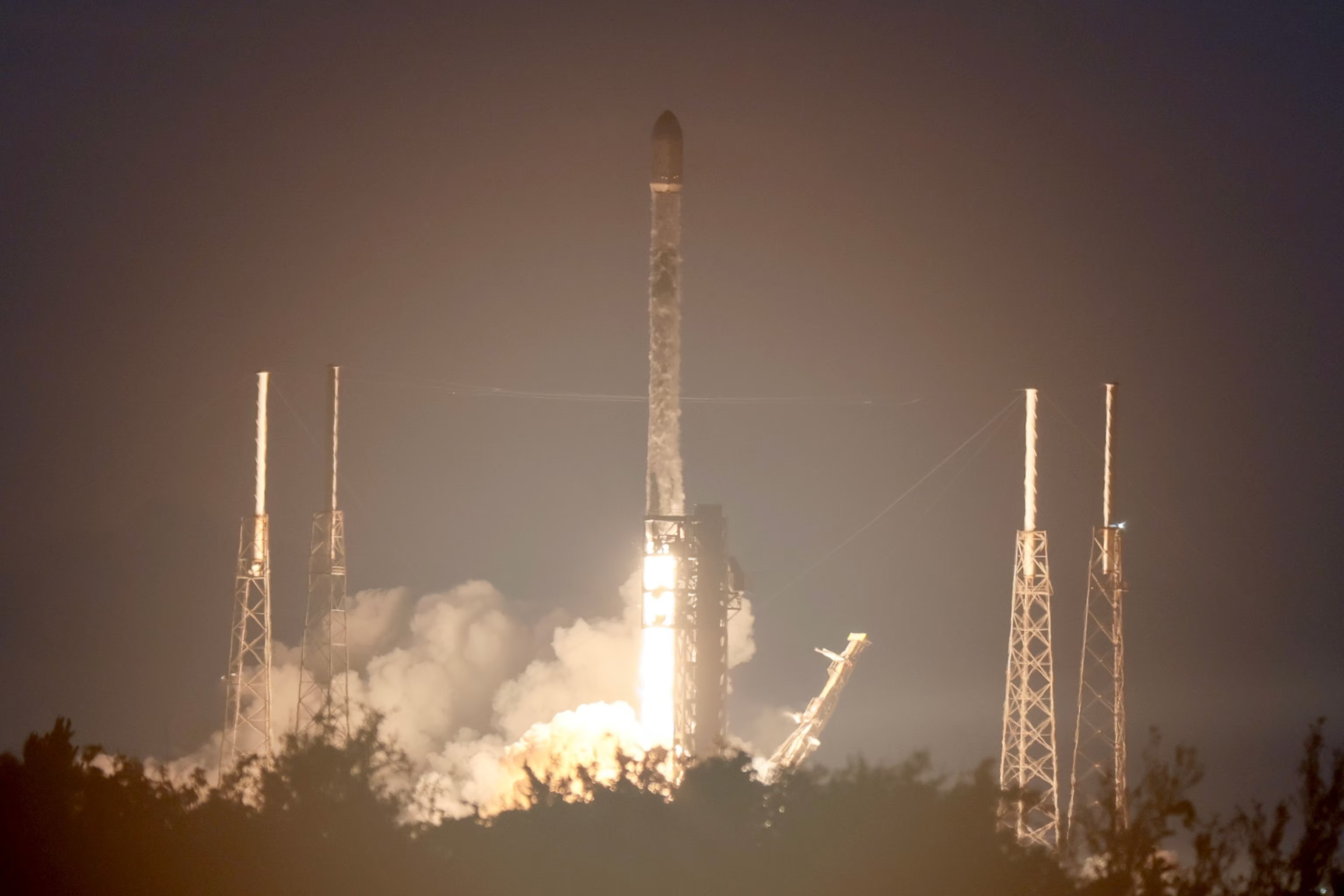
A Spacex Flacon 9 rocket lifts off from Space Launch Complex 40, June 8, 2026, in Cape Canaveral Space Force Station, Fla.Joe Raedle/Getty Images
Will the SpaceX IPO elevate Elon Musk to trillionaire status?
The world’s most affluent individual is poised for an even greater accumulation of wealth.
Musk’s net worth is estimated at approximately $780 billion, according to Forbes. The SpaceX IPO has the potential to propel Musk’s wealth substantially beyond the $1 trillion mark.
The founder and CEO of the company is expected to hold about 42% of SpaceX’s shares post-IPO. If SpaceX realizes its target valuation of $1.75 trillion, Musk would gain hundreds of millions of dollars in new wealth, at least on paper.
However, financial filings indicate that Musk is restricted from selling any of his SpaceX shares for a year following the IPO.
Nevertheless, Musk could soon hold a significant ownership in two of the world’s ten largest corporations. Last year, Tesla shareholders approved a compensation plan for Musk that could yield him over $1 trillion in the coming years, suggesting he might eventually approach a net worth of $2 trillion.
Will SpaceX shares be accessible in your 401(k)?
It is highly probable that SpaceX stock will soon be included in individual 401(k) portfolios. These retirement accounts frequently contain index funds, which are benchmarked against major indices such as the S&P 500 and Nasdaq.
Until recently, newly listed companies faced a substantial waiting period before being eligible for inclusion in major indices. However, the Nasdaq revised its regulations last month to permit “fast entry” into the Nasdaq-100 for certain significant IPOs. In the subsequent weeks, other prominent exchanges also adjusted their rules.
Consequently, it will not be long before SpaceX becomes a component of 401(k) investments.
What are the perspectives of analysts on the stock?
The SpaceX IPO has prompted divergent opinions among stock analysts. Some highlight its potential for profitability within the lucrative aerospace and AI sectors, while others express reservations regarding what they perceive as ambitious, perhaps unrealistic, initiatives like space-based data centers.
Dan Ives, managing director of equity research at Wedbush, described the SpaceX IPO as a “pivotal moment” for the technology industry, marking a significant advancement in the “AI Revolution and the role of data.”
Individuals seeking evidence of potential shareholder returns can draw parallels with Musk’s other company, Tesla. Over the last five years, Tesla’s stock price has surged by 90%, outperforming the S&P 500’s 71% increase during the same period. Electric vehicles constitute the predominant source of Tesla’s revenue. Similarly, Starlink subscriptions and government contracts currently form the main revenue streams for SpaceX.
However, Tesla’s stock performance has also been bolstered by speculative ventures such as autonomous ride-sharing services and humanoid robotics. In principle, these initiatives bear resemblance to Musk’s projects at SpaceX, such as the orbital data centers.
“Ultimately, Musk embodies SpaceX and SpaceX embodies Musk,” Ives stated in a client advisory this week.
Certain analysts who are cautious about the SpaceX IPO have pointed to the ambiguity surrounding its objectives in the AI domain.
“We recognize the company possesses genuine strengths, particularly with Starlink, but given the numerous unproven technologies underpinning a significant portion of its valuation, especially within its AI division, we consider the valuation to be highly speculative,” stated Michael Field, chief equity strategist at Morningstar, in a communication to ABC News.
“Investors would be well-advised to abstain from this offering and await a more favorable opportunity at a later stage,” Field advised.
Sourse: abcnews.go.com