
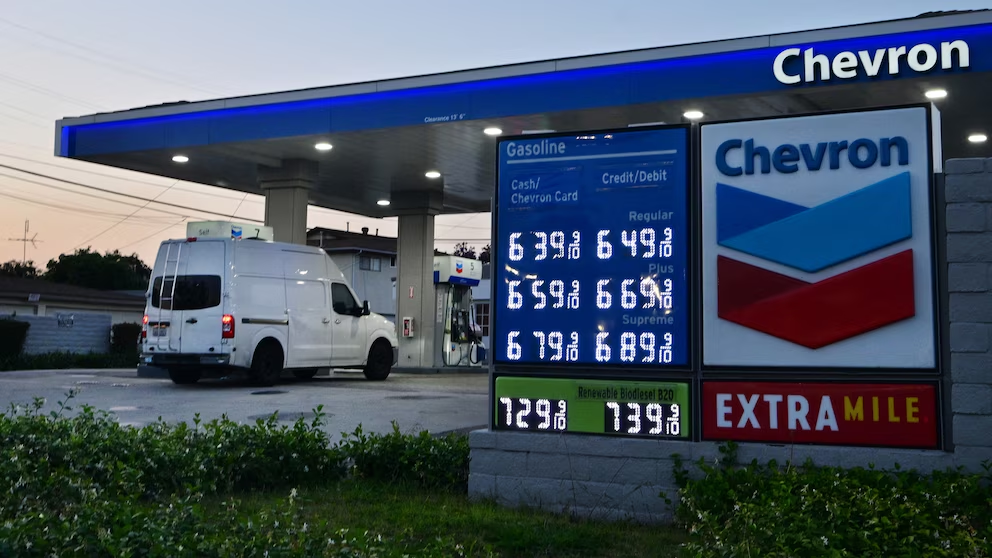
Gasoline costs exceeding $6 per gallon are shown at a Chevron station in Monterey Park, California, on April 30, 2026.Frederic J. Brown/AFP via Getty Images
A Chevron fueling station in Los Angeles garnered significant attention recently for its staggering $8.71 per gallon price, symbolizing the surge in gasoline expenses triggered by the Iran conflict.
Soaring gasoline expenses across the nation stem mainly from a notable crude oil crisis subsequent to Iran’s de facto closing of the Strait of Hormuz. Nonetheless, a less recognized element contributes to the heightened costs, specifically at certain branded stations that market fuel from companies such as Chevron, Shell, and ExxonMobil.
Branded stations, comprising almost half of all fueling stations nationally, typically impose approximately 6 cents more per gallon compared to their unbranded counterparts, based on information from the Oil Price Information Service (OPIS), a Dow Jones entity, for the week concluding on May 2. This pricing difference mirrors the pre-conflict levels, according to OPIS data.
In at least one state, this price variation is markedly more significant. Fuel at a Chevron station in California averages 48 cents more per gallon than the price at an independent station, as discovered by the California Energy Commission (CEC) in 2024. Following Chevron, the highest average fuel expenses in California were observed at Shell, 76, and Arco-branded locations, the CEC indicated.
According to some experts, the elevated cost of branded fuel results from added expenditures, for example, exclusive additives in the gasoline, along with the producer’s promotional budget and payments made by stations for assured access to the fuel—costs ultimately borne by patrons.
Conversely, other experts, including a California state watchdog, have suggested that the pricing disparity may originate from the market influence held by a limited number of entities, enabling them to elevate retail prices.
This examination arises as several major oil firms, such as British Petroleum, Valero, and Marathon Petroleum, report considerable earnings amidst the Iran conflict, although Chevron and Exxon experienced profit downturns partially attributable to one-time accounting losses derived from financial hedges created to defend against potential price declines.
The average price for a gallon of fuel is currently $4.52, a $1.54 escalation per gallon since the conflict began on Feb. 28, as revealed by AAA data. This represents an approximate 52% surge in roughly two and a half months.
Patrick Penfield, a Syracuse University professor specializing in supply chain practices, indicated that the recent price escalation might trigger a renewed evaluation of the embedded costs within the price at the pump, including the surcharge for branded gasoline.
“When you notice such substantial gasoline price increases, every aspect warrants examination,” Penfield stated.
Chevron did not directly address a request for comment from ABC News. Nevertheless, Jim Stanley, media relations director at the Western States Petroleum Association, an industry advocacy organization, communicated with ABC News at Chevron’s behest.
Drivers opt for branded stations based on individual preferences centered on factors such as lighting, restroom cleanliness, or location, Stanley explained.
"Any trademarked item – be it pharmaceutical products, food products, or attire – will typically command a higher price than a generic equivalent," he added.
Stanley further clarified that approximately 95% of branded fueling stations function as franchises, indicating they establish agreements with prominent companies yet maintain their independent ownership.
"Branded gas stations may adhere to brand standards that they enforce upon their franchisees: a more stringent standard compared to an independently operated establishment," Stanley elaborated.
Kelly Davila, an Exxon spokesperson, conveyed that the company does not “own or manage our retail stations.”
Shell opted not to respond to ABC News’ request for comment.
Phillips 66, the parent corporation of 76, did not address ABC News’ request for comment. Likewise, Marathon Petroleum, the parent entity of Arco, did not respond.
Branded stations constitute about 45% of all stations nationally, retailing gasoline under the identity of a major fuel enterprise, according to OPIS data. Each brand promotes a distinctive combination of additives that they claim enhances the gasoline and mitigates its effect on vehicle engines. These supplementary components exceed the minimum regulations mandated by federal and certain state authorities, Denton Cinquegrana, chief oil analyst at Dow Jones Energy, informed ABC News.
“Fundamentally, all gasoline must adhere to a federal benchmark,” Cinquegrana stated. “The branded gasoline surpasses this minimum threshold.”
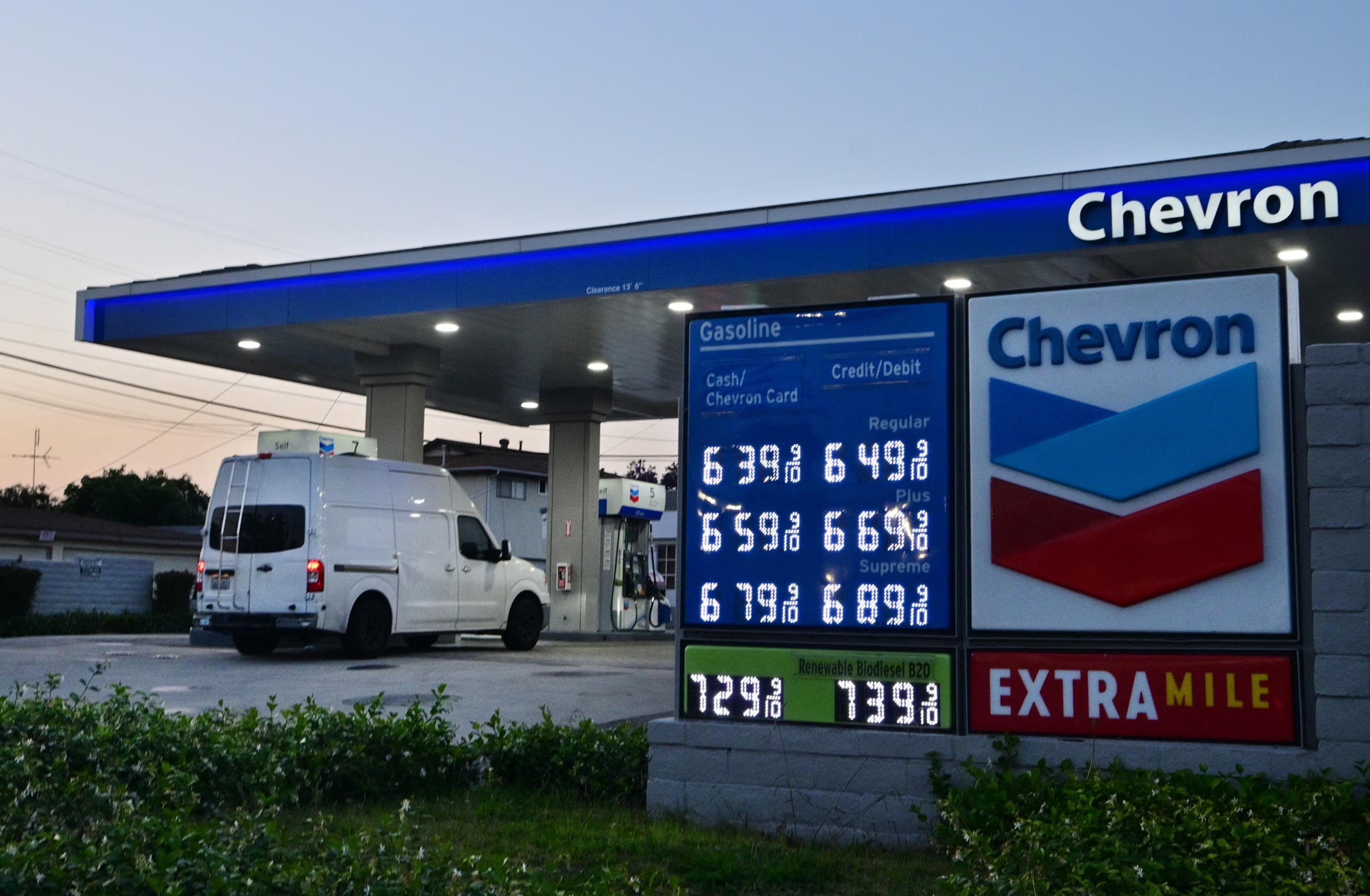
Gas prices above $6 per gallon are displayed at s Chevron station in Monterey Park, California, on April 30, 2026.Frederic J. Brown/AFP via Getty Images
Increased rates at well-known stations – an occurrence with a lengthy history – can be partially attributed to the expenditures on research and production related to additives, Cinquegrana added: "They’re attempting to regain a portion of their investment.”
Certain analysts, conversely, suggest that it is still unclear whether the incorporated components substantially augment the product.
“Regardless of each company’s assertion, there is no definitive proof substantiating that additives indeed improve gasoline quality, at least to the degree perceived by consumers,” a study published by the non-profit RAND corporation concluded in 2010.
The California Division of Petroleum Market Oversight (DPMO), a state regulatory agency, stated last year that it was “unable to independently corroborate claims that branded gasoline is superior to unbranded gasoline.”
When questioned about studies that challenge the advantages of additives, Stanley, representing the Western States Petroleum Association, declined to offer a comment.
The higher prices of branded gasoline also reflect the marketing outlays assumed by major companies, as well as increased expenditures incurred by retailers as part of agreements with the brands that ensure their priority access during supply deficits, as highlighted in a study by the U.S. Government Accountability Office on this topic in 2005.
“Gas stations allocate greater funds for a branded gasoline contract due to the supply guarantee. Plus, they benefit from the support of a significant global brand,” Cinquegrana remarked.
Some analysts and a California regulator contested these justifications. Instead, they proposed that the elevated prices could signify the market dominance enjoyed by large corporations, granting them the freedom to elevate prices without fear of competition.
“My personal understanding of the data suggests that branded companies exploit the absence of a competitive market, behaving akin to an oligopoly,” Paasha Mahdavi, a professor of energy governance and political economy at the University of California, Santa Barbara, conveyed to ABC News, employing terminology to describe an industry governed by a handful of firms.
Mahdavi emphasized the considerable price variance in California between branded and unbranded gasoline, which has expanded in recent years.
In 2019, branded gasoline from companies such as ExxonMobil, Arco, Valero, and Chevron averaged 20 cents more per gallon in California; within five years, this price differential increased to 31 cents, according to a DPMO study issued last year. During that same period, the profitability of oil refineries in California has amplified, DPMO indicated.
The surge in refinery profitability may be related to the “exercise of market influence by gasoline providers,” DPMO stated, specifying that 90% of in-state refining capacity is managed by four entities. Consequently, elevated wholesale costs may propagate along the supply route, DPMO added.
The largest companies appear to wield “not only substantial leverage over upstream resources such as oil and gas, but also control of the gas stations that consumers favor based on location,” Mahdavi stated. “They possess the capability to charge a greater premium.”
Valero did not acknowledge ABC News’ inquiry for comment.
Stanley, representing the Western States Petroleum Association, expressed uncertainty as to why California exhibits a more significant price divide between branded and unbranded gasoline than other states. One aspect, he suggested, could be the relatively sparse number of gas stations in the state.
"Rivalry lowers costs. If a retailer does not perceive that level of competition, you may observe that reflected in inflated prices."
Stanley attributed elevated overall gas prices to environmental policies in California.
"Whether branded or unbranded, gasoline in California is the costliest in the nation. This is attributable to supply limitations stemming from state regulations."
Mahdavi further suggested that the placement of branded gas stations may incur increased expenditures due to heightened rental fees, accounting for a portion of the price discrepancy.
The increase in prices amid the Iran conflict offers a chance to reexamine the dynamics that contribute to prices at the pump, according to Mahdavi.
“We have the opportunity to shed greater light on the factors driving these inflated costs," he concluded.
Sourse: abcnews.go.com