
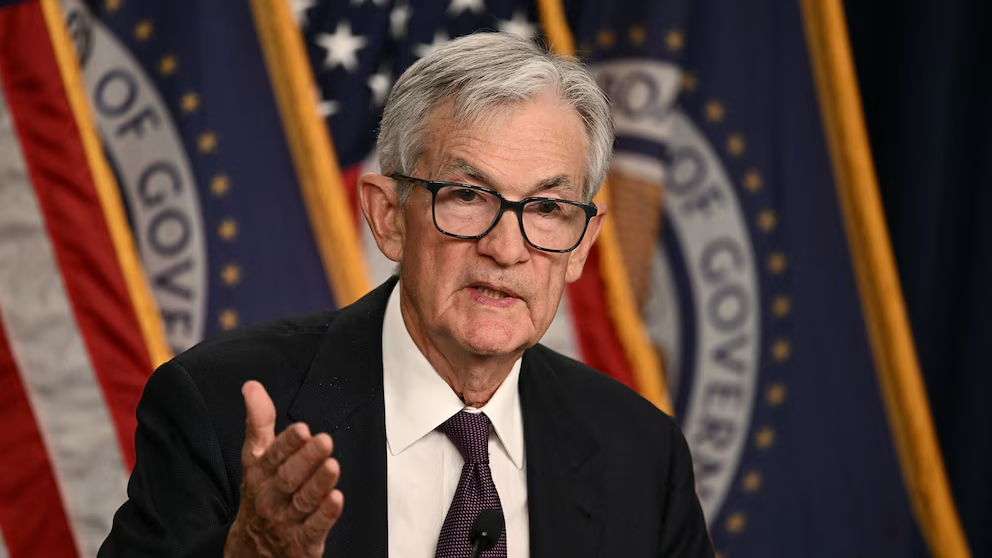
In this archived photograph from March 18, 2026, Federal Reserve Chairman Jerome Powell delivers remarks at a press conference after the Federal Open Market Committee meeting at the Federal Reserve Board Building in Washington, D.C.Brendan Smialowski/AFP via Getty Images, FILE
A worldwide pandemic that displaced millions of American workers in a matter of days. The steepest price increases in forty years. An extraordinary federal criminal inquiry.
Fed Chair Jerome Powell encountered a series of difficulties during his 8-year term leading the central bank, which concludes on Friday. Powell’s choices along the way involved consequences as practical as the financial plans of ordinary citizens and as significant as the political autonomy of a vital institution.
President Donald Trump’s choice for Fed Chair, Kevin Warsh, is poised to assume the position, inheriting an economy considered robust by some standards, despite grappling with a resurgence of inflation.
Powell stated last month that he would take the unusual step of remaining on the central bank's 12-member board of governors after his term concludes. The action provides Powell with a role in interest-rate policy that could extend until 2028, although he indicates he will resign once a Fed inspector general's investigation into a refurbishment of the central bank headquarters is finished.
The handoff presents an opportunity to reflect on Powell’s time in office, which encompassed two presidents, three Treasury secretaries, and 66 decisions on interest rates.
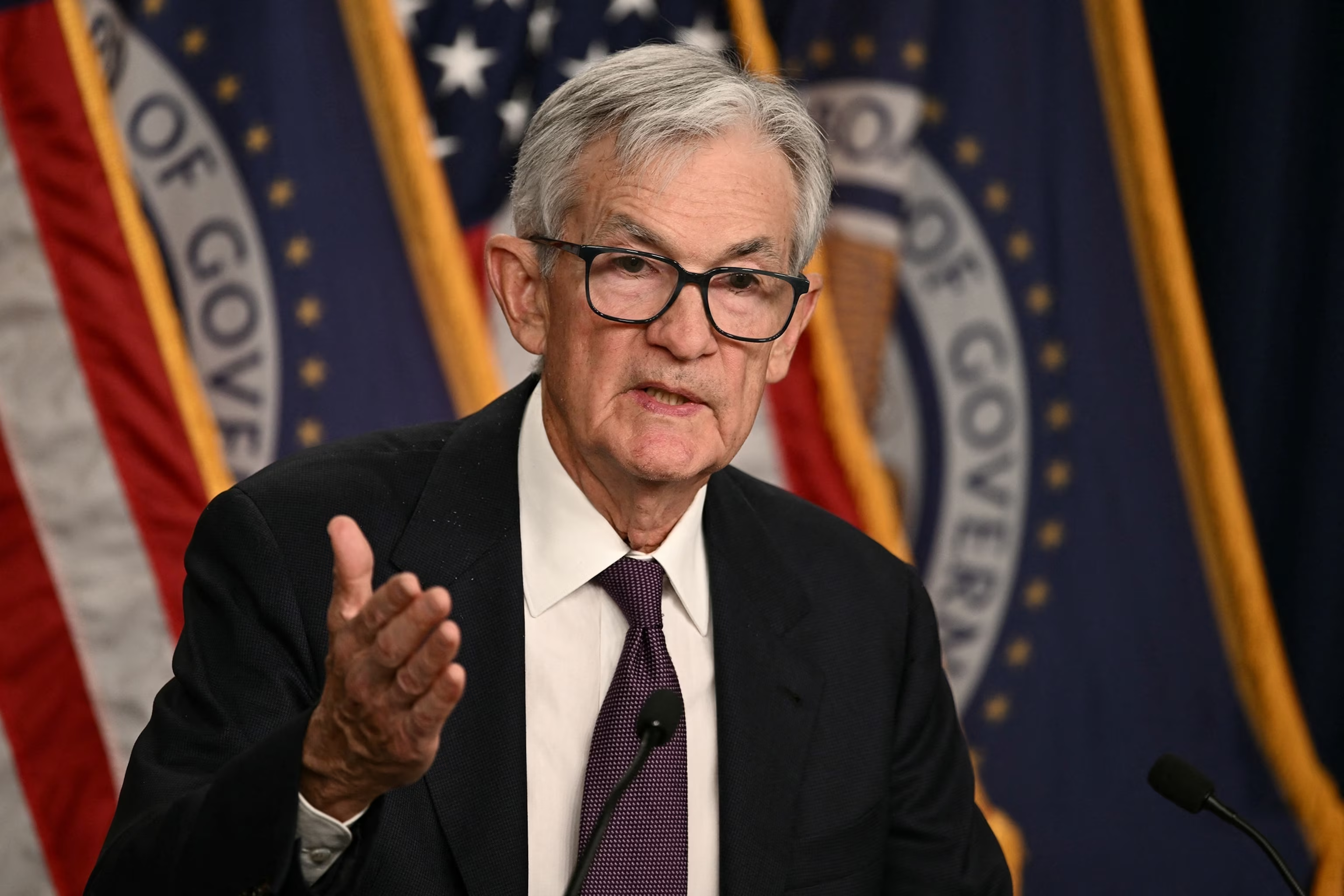
In this archived photograph from March 18, 2026, Federal Reserve Chairman Jerome Powell delivers remarks at a press conference after the Federal Open Market Committee meeting at the Federal Reserve Board Building in Washington, D.C.Brendan Smialowski/AFP via Getty Images, FILE
"You can't select the challenges you face, but you can select your response," Claudia Sahm, chief economist at New Century Advisors and a former Fed staffer, remarked to ABC News. "Ultimately, Powell's legacy will be determined by those results."
When Trump tapped Powell to become Fed chair, Trump characterized him as a "consensus builder" who "understands what is needed for our economy to expand."
Powell, a former investment banker and Treasury official under President George H.W. Bush, took on the role in 2018. At that point, the economy was thriving, the unemployment rate registered at a historically minimal level, and inflation was just marginally above the Fed’s target rate of 2%.
Powell increased interest rates four times during his opening year, putting pressure on the stock market but positioning the Fed to stimulate the economy with rate reductions if a slowdown occurred. Policymakers wouldn’t have to wait for very long.
In the initial months of 2020, the COVID-19 pandemic placed tens of millions of Americans under lockdown, bringing business to a standstill across sectors like restaurants and hospitality, while displacing a significant portion of the workforce.
At an emergency session in March 2020, Powell sharply lowered interest rates to levels near zero in an attempt to invigorate a struggling economy.
“Families, businesses, schools, organizations, and governments at all levels are taking steps to protect people’s health. These measures, which are essential for containing the outbreak, will nonetheless understandably take a toll on economic activity in the near term,” Powell communicated to journalists at that time.
The unemployment rate surged from 4.4% in March to 14.7% in April, data from the U.S. Bureau of Labor Statistics revealed.
To accelerate the recovery, Trump and President Joe Biden enacted economic stimulus intended to support individuals who had lost their jobs or encountered other challenges. In conjunction with low interest rates, that expenditure contributed to a rapid economic recovery from the downturn.
The COVID-19 recession lasted only a couple of months, making it the shortest in U.S. history, according to the National Bureau of Economic Research.
The rapid recovery justified the Fed's decision to lower interest rates, even though it hadn’t been a particularly tough choice, Alan Blinder, an economics professor at Princeton University and former vice chairman of the Federal Reserve, told ABC News.
“The reduction of rates to the floor was both essential and suitable, and in a real sense, self-evident,” Blinder said.
A period of intense inflation soon took hold, however, arising as a consequence of a supply scarcity resulting from the COVID-19 pandemic and heightened by the Russia-Ukraine conflict. Powell initially minimized the price increases, referring to them as “transitory.” It became a significant error — and Powell would later acknowledge his mistake.
Annual inflation reached a peak of 9.1%, a 40-year high, in June 2022. By that time, Powell had started to steadily increase interest rates, and it would continue throughout the following year. The forceful sequence of rate increases placed the central bank’s benchmark rate at its highest point since 2001. The decision caused mortgage and credit card rates to escalate quickly.
By June 2023, annual inflation had sharply dropped to 3%, but Americans broadly remained discontented with price increases long after that. Numerous economists anticipated a recession and the associated job losses it usually entails. Fortunately, the downturn never materialized.
"Inflation remained elevated for too long, but once it decreased, it decreased very quickly. It decreased without generating undue hardship in the labor market," Wendy Edelberg, director of the Hamilton Project and senior fellow in economic studies at the Brookings Institution, commented to ABC News.
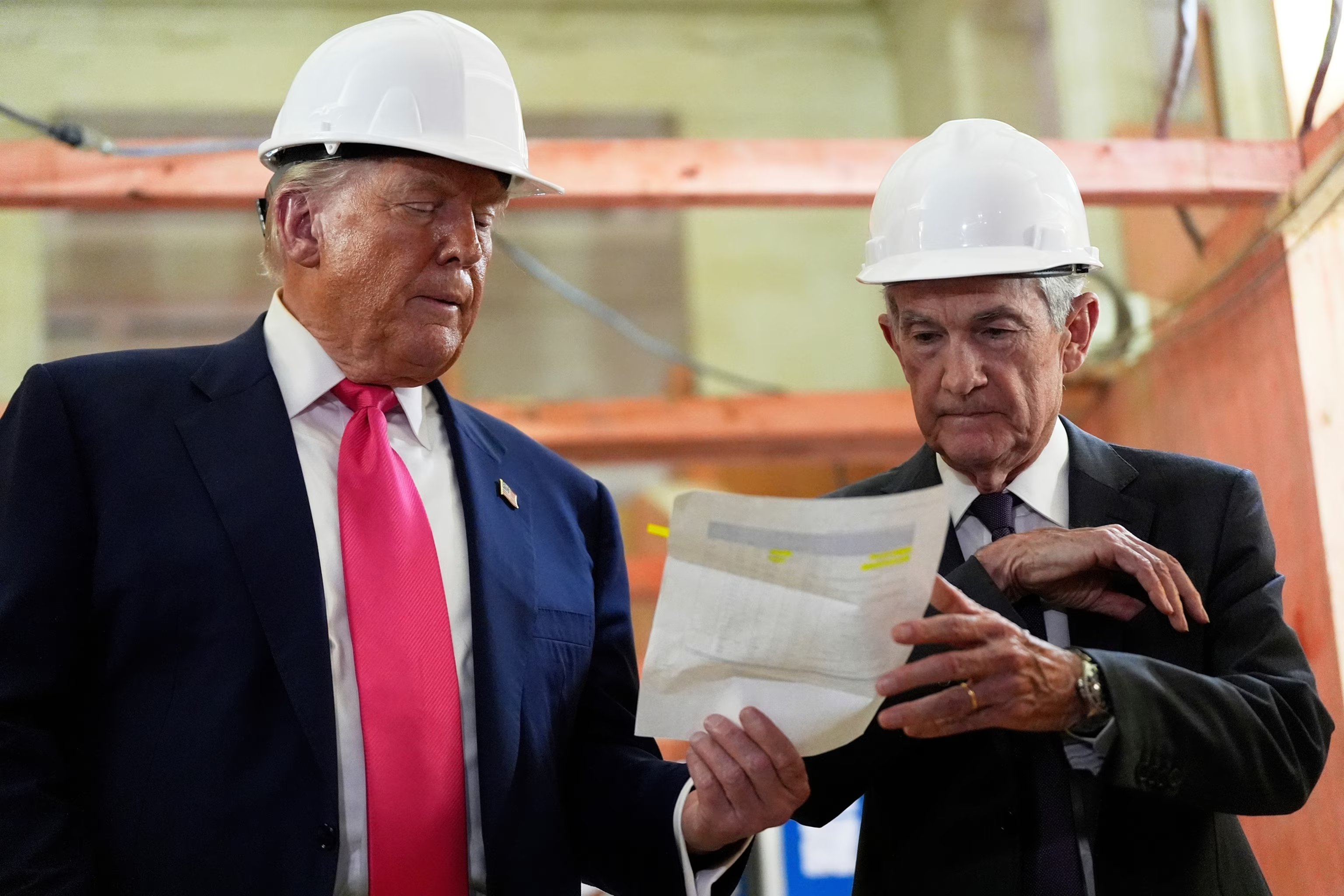
In this archived photograph from July 24, 2025, President Donald Trump speaks with Federal Reserve Chairman Jerome Powell during a visit to the Federal Reserve, in Washington, D.C.Julia Demaree Nikhinson/AP, FILE
In September 2024, less than a couple of months before the presidential election, the Fed lowered interest rates by 0.5%. The decision sparked disapproval from allies of Trump, who regarded the action as a possible boost for the economy that would benefit incumbent Democrats. Trump eventually won the election.
Within weeks of his return to the White House, in early 2025, Trump openly voiced criticism of Powell, encouraging him to reduce interest rates. The attacks amplified criticism of Powell that had begun during Trump’s initial term.
Over the following months, Trump started to denounce Powell for expenses exceeding estimates in a renovation project at the Fed’s headquarters in Washington, D.C. Last July, Trump made the initial official visit to the Fed by a sitting president in nearly 20 years, wearing protective headgear as he toured the renovation with Powell.
The Fed attributed excessive spending to unexpected cost escalations, stating that its building renovation would ultimately "lower expenses over time by enabling the Board to consolidate the majority of its operations," according to the central bank's website.
By January, the Department of Justice had initiated a criminal inquiry into Powell, intensifying an unusual clash between the White House and the Fed. It was the first criminal investigation of a Fed chair in the 113-year history of the central bank.
The inquiry focused on Powell’s testimony to Congress last year regarding the excessive costs. Powell issued an uncommon video message condemning the investigation as a politically influenced endeavor to sway the Fed's interest rate policy.
"No individual — certainly not the chair of the Federal Reserve — is above the law," Powell stated. "But this unparalleled action should be interpreted within the broader context of the administration's threats and sustained pressure."
Trump had previously denied any involvement in the criminal investigation. The DOJ took action to drop its criminal investigation into Powell last month. Washington U.S. Attorney Jeaninne Pirro stated that the investigation into the office refurbishment would be handled by the Fed’s inspector general.
“The assault on the Fed chair was shocking,” Rebel Cole, a professor of finance at Florida Atlantic University who formerly worked at the Federal Reserve, told ABC News. “Powell resisted it.”
Warsh, a former Fed official, will serve a 4-year term as chair. He is prepared to guide the Fed during a challenging period for central bank policymakers.
Inflation increased for a second straight month as the U.S.-Israeli war with Iran continued to propel gasoline prices upward in April, government figures released on Tuesday revealed. Annual inflation climbed to its highest mark in three years, according to the U.S. Bureau of Labor Statistics.
Regardless of the turmoil, some measures of economic strength have shown resilience.
The unemployment rate remained stable at a historically low level of 4.3% in April, leaving it largely unchanged from when Powell began his term in 2018.
"The economy is reasonably sound but far from ideal," Blinder stated, criticizing Powell in part for elevated inflation, while attributing much of the blame to the Iran war. Simultaneously, Blinder commended Powell for his dedication to the independence of the Fed.
"That's the legacy that Warsh is inheriting," Blinder said.
Sourse: abcnews.go.com