
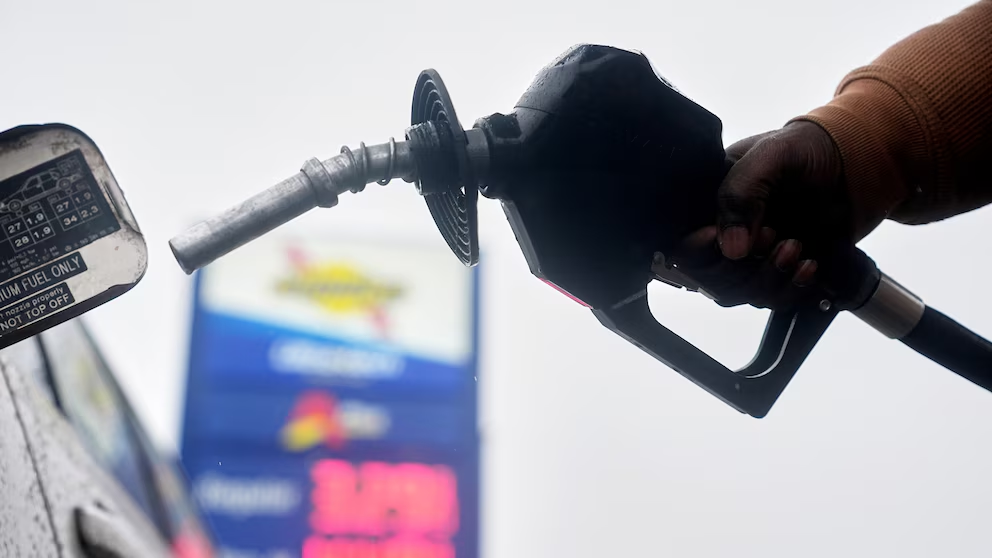
A driver extracts the nozzle from his vehicle at a filling station, in Philadelphia, March 3, 2026.Matt Rourke/AP
President Donald Trump ignited anxieties regarding a budget-straining surge in prices following a significant policy declaration that was broader reaching than numerous experts anticipated.
It transpired last spring, when Trump launched "Liberation Day" tariffs. Economic collapse projections never materialized, however, partially due to the president subsequently scaling back numerous of the duties.
Grim predictions reappeared in recent days after the U.S. and Israel commenced a conflict with Iran that elevated oil values and put consumers on the cusp of another potential bout of widespread inflation, analysts from Michigan State University and research organization Inflation Insights informed ABC News.
The spike in oil values is intensifying expenditures for gasoline and plane tickets, and it runs the risk of pushing up costs for a large collection of goods reliant on diesel-powered transport, including food items, the analysts expressed. Steeper inflation could in turn discourage the Federal Reserve from diminishing interest percentages, sustaining heightened lending rates for all things from home loans to charge cards.
Such a circumstance could adversely affect consumers if oil values stay high or increase further amid the continuous war, analysts conveyed, but a prompt resolution of the dispute could render the occasion hardly more than a fleeting occurrence.
"This emergency that is impacting energy — it influences everything," Jason Miller, a professor of supply chain administration at Michigan State University, stated. But, he cautioned, the eventual repercussion is "very, very, very unpredictable."
The Iran conflict has disrupted oil markets as dealers dread a drawn-out barricade of the Strait of Hormuz, a trading artery that enables the transit of approximately one-fifth of the worldwide oil inventory.
U.S. unrefined oil values lingered at roughly $86 per barrel on Tuesday, which signified an around 17% decrease from the prior day and considerably below a recent apex of almost $120.
Since one month prior, however, oil values have ascended by more than 30%.
Certain analysts cautioned costs still remain at danger of rising to $150 a barrel or higher. Saudi Aramco, the globe's foremost oil exporter, signaled on Tuesday of "catastrophic consequences" for oil markets, unless tanker activity resumes in the Strait of Hormuz.
"The chance of $150 or $200 a barrel is not individuals disliking the president and stating these figures for partisan motives," Miller clarified. "This is merely economic actuality."
In recent days, Trump has communicated differing messages regarding how the White House might tackle oil values and related financial hardships.
A decline in oil values on Tuesday occurred after the president suggested the day before the war might soon be concluded. Trump also threatened an intensification of the clash on Monday, however, asserting on social media that Iran would "be struck by the United States of America TWENTY TIMES HARDER" if it sought to impede tanker activity in the Strait of Hormuz.
The U.S. military has initiated exploring methods to accompany commercial vessels through the strait, in case Trump requests it take such an action, Gen. Dan Caine, chairman of the Joint Chiefs of Staff, stated at a press briefing on Tuesday.
Consumers have already encountered some price escalations. The average value of a gallon of gasoline in the U.S. climbed to $3.53 on Tuesday from $3.10 one week prior, AAA indicated.
If sustained, certain analysts stated, the current stage of gas values would negatively impact many shoppers — and an additional increase could substantially diminish spending.
"It will truly commence to diminish disposable income for consumers if it continues for several months," Inflation Insights founder Omair Sharif informed ABC News.
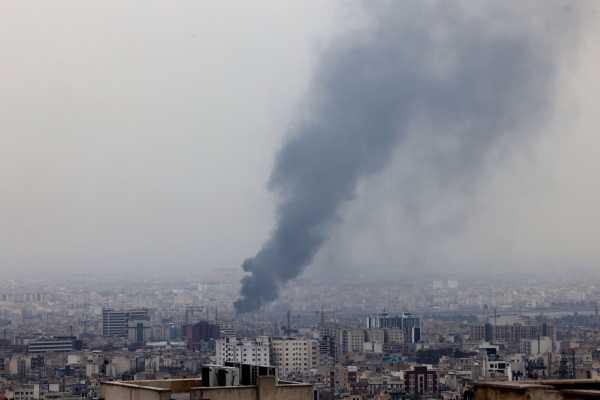
Smoke arises after an aerial attack in central Tehran, Iran, March 10, 2026.Abedin Taherkenareh/EPA/Shutterstock
The surge in prices could extend substantially beyond gasoline, some analysts conveyed. The justification for that is a rise in the value of diesel fuel, which could elevate the price of nearly everything transported throughout the global supply chain.
The average value of a gallon of diesel fuel stands jumped to $4.78 on Tuesday from $3.65 one month prior, equaling approximately a 30% surge, AAA data revealed.
"Energy price shocks permeate into production expenditures across practically every sector of the global economy," Thierry Wizman and Gareth Berry, global strategists with financial services group Macquarie, remarked in a note to investors. "In other words, no quantity of supply chain diversification could entirely shield manufacturers from a continued escalation in the value of oil or natural gas."
Every dollar expended on food commonly encompasses three or four cents that result from transportation expenditures, Sharif communicated, but a modest cost increase across all food items could be perceived by consumers.
"It's typically not a substantial digit," Sharif appended. "But we're observing massive spikes in diesel values."
To be certain, the inflation danger could be largely prevented by a swift resolution to the war or a differing measure that reopens the Strait of Hormuz, which would eventually bring oil and gasoline values down to pre-war levels, some analysts expressed. A brief surge in those values, they appended, would possess minimal lasting consequence on overall price tiers.
The threat of steeper inflation remains "modest," investment enterprise Vanguard conveyed in a note to investors on Monday, predicting that a larger increase would necessitate a "more prolonged shock."
Still, inflation rests at elevated tiers, though it has softened. In January, inflation decreased to 2.4%, its lowest tier in eight months. The U.S. Bureau of Labor Statistics did not publish inflation data in October 2025 due to a government shutdown. Inflation remains marginally greater than the Federal Reserve's target percentage of 2%.
While the war with Iran has ignited apprehension among some analysts, they acknowledged that the conflict has also broadened the spectrum of plausible outcomes.
"Forecasts are being revised day to day," Sharif expressed. "I don't believe anyone will desire to be held accountable on them."
Sourse: abcnews.go.com