
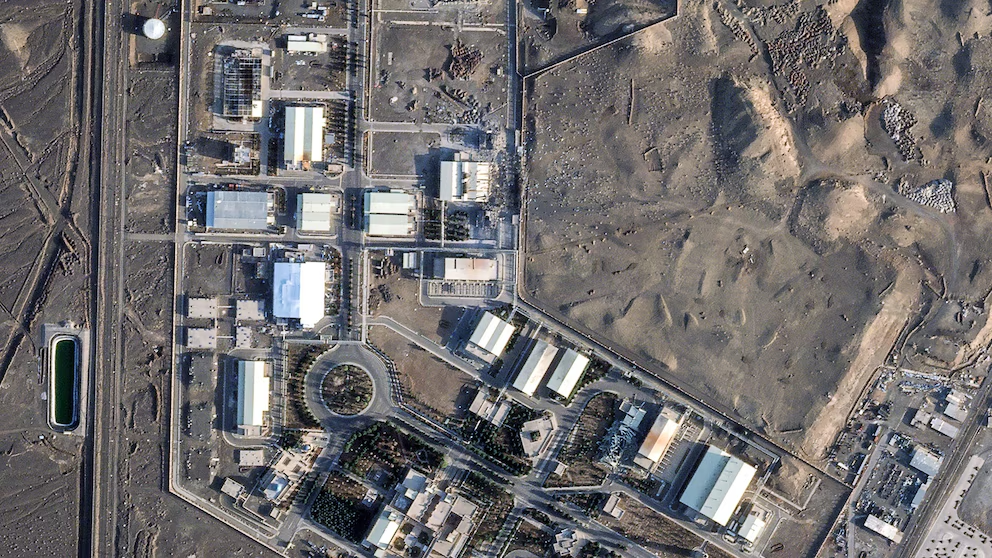
Damaged structures are visible in the Natanz Nuclear Installation vicinity, situated near Natanz, Isfahan province, in the core of Iran, according to a satellite image captured on March 3, 2026.Planet Labs PBC/AFP via Getty Images
President Donald Trump pledged on Friday to eliminate Iran’s "Nuclear ‘Dust" as a segment of his strategy to guarantee the country never gains atomic weaponry.
Previously, Trump informed journalists at the White House that Iran had consented to "return the nuclear dust that resides deep underground to us,” reiterating the expression he utilizes when mentioning Iran’s intensely enriched uranium.
During an appearance on Iranian State Television on Friday, Foreign Ministry spokesperson Esmael Baqaei firmly refuted Trump's assertion.
"Iran's enriched uranium will not be moved anywhere under any condition," Baqaei declared.
Iran's atomic initiative continues to be a crucial obstacle in the disagreement involving the two nations as the U.S.-Iran cessation of hostilities heads toward a deadline this Tuesday.
Iran asserts that its nuclear endeavors are intended for non-military applications, such as power generation.
Here’s what you should be aware of concerning Iran’s enriched uranium and its importance within the Middle Eastern crisis.
What is enriched uranium, precisely?
Uranium is composed of three naturally occurring isotopes, with only one capable of producing energy or fabricating a nuclear explosive. Known as U-235, this uncommon isotope constitutes under 1% of all isotopes within natural uranium. The uranium enrichment procedure raises the fraction occupied by U-235.
Commercial atomic reactors utilized for creating electricity generally operate using fuel enriched to between 3% and 5%, according to the Center for Arms Control and Non-proliferation.
Uranium enrichment suitable for armaments ideally reaches approximately 90%, although a basic weapon could be deployed utilizing material enriched at diminished amounts, Howard Hall, a nuclear security professor at the University of Tennessee, clarified to ABC News.
"The 90% level isn’t particularly remarkable," Hall stated.
How is uranium typically enriched?
Uranium is frequently enriched with centrifuges, which are swiftly spinning cylinders. Operators infuse uranium gas into centrifuges which revolve at speeds between 50,000 and 70,000 rotations each minute, Anna Erickson, a nuclear and radiological engineering professor at Georgia Institute of Technology, explained on Substack on Tuesday.
“During such swift gas rotation, the somewhat heavier atoms move toward the exterior boundary. The marginally lighter U-235 atoms remain more concentrated toward the midpoint. Both flows are extracted independently,” Erickson described.
By employing a network of centrifuges, scientists progressively fashion a substance consisting of a more significant proportion of U-235 atoms, Erickson contributed.
Uranium enrichment, she indicated, seeks to attain a “greater density of the precise isotope desired.”
What degree of enriched uranium is within Iran’s grasp, and how near is it to weapons-grade?
Iran possessed about 440 kilograms of uranium enriched to 60% as of June 2025, as stated in a report distributed in February by the International Atomic Energy Agency, a United Nations monitoring organization.
That uranium volume is sufficient to yield nine or ten nuclear explosives, provided it is enriched to levels necessary for weaponry, Erickson stated.
The concluding phase of enriching uranium from 60% to 90% represents a reasonably minor operation within the overall enrichment sequence, analysts confided to ABC News.
“The crucial aspect of uranium enrichment resides in accomplishing the shift from natural uranium to marginally enriched uranium,” Hall stated.
The more progressed the enrichment sequence becomes, the quicker the advancement, Hall added.
“Incremental steps accrue relentlessly — akin to compound interest,” he commented.
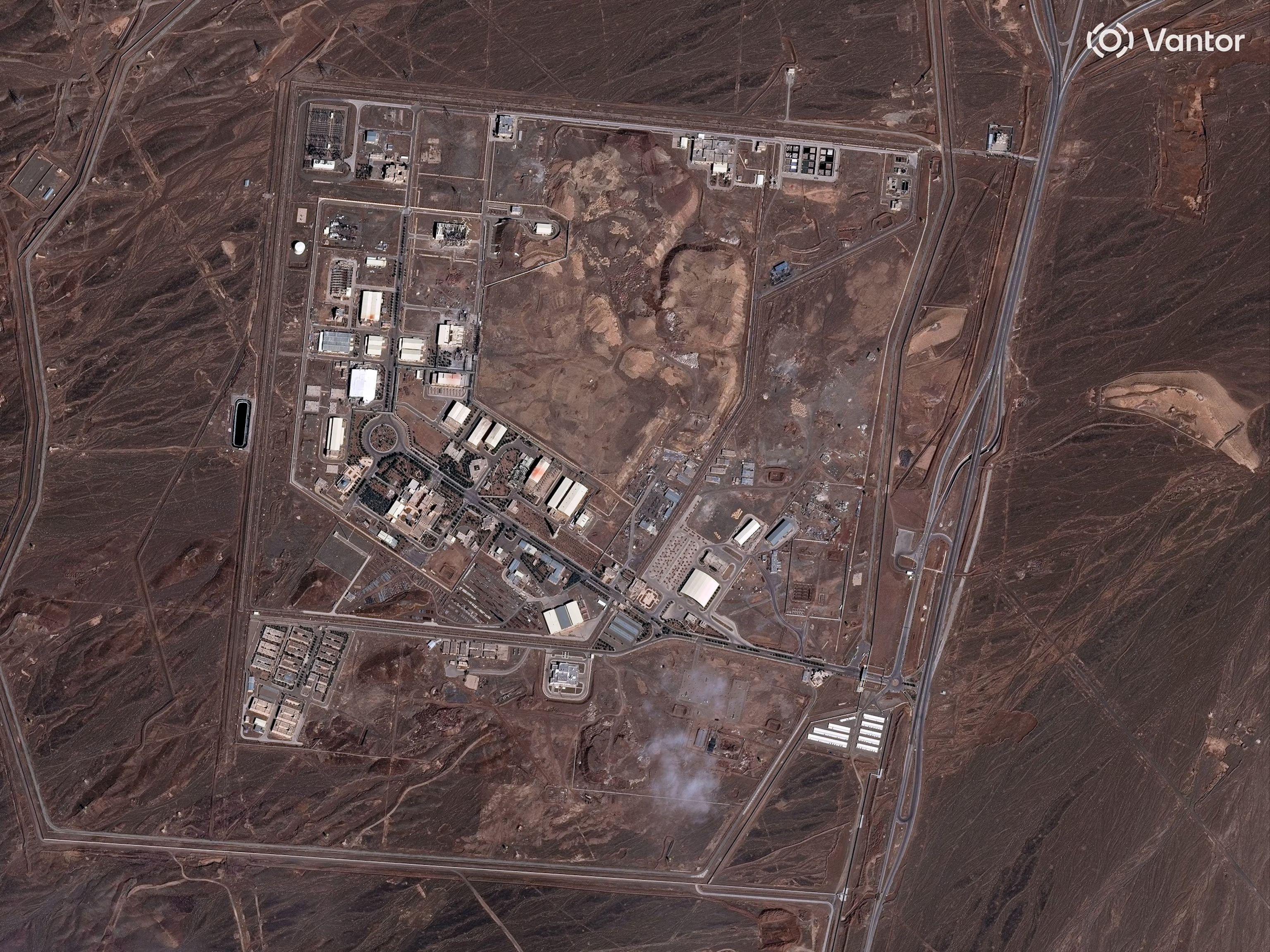
A wide-angle view of the Natanz nuclear facility displaying impairment observed on several structures close to Natanz, Isfahan province, Iran, per a satellite image taken on March 2, 2026.2026 Vantor/AFP via Getty Images
Stockholm International Peace Institute, an autonomous research entity, depicted the differential between 60% enrichment and weapons-grade enrichment as “extremely narrow” in one report.
This past March, United States Special Envoy to the Middle East Steve Witkoff commented that uranium enriched to 60% can be enhanced to weapons-grade within a week, while uranium enriched to 20% can be enhanced to weapons-grade in approximately three to four weeks.
Iran’s uranium reserves also included about 9,400 kilograms of uranium enriched at diminished intensities as of last June, most of which is enriched at or under 5%, the IAEA stated in February.
The IAEA has been unable to authenticate the nuclear stockpiles in the time since, the organization reported, detailing the necessity for inspection as “considerably overdue given typical safeguarding procedures.”
This past June, the IAEA enacted a resolution asserting that Iran had transgressed its non-proliferation accords and has been unlawfully accumulating enriched uranium.
Is Iran capable of enriching its uranium even further?
The venture of further enrichment demands operational centrifuges, but the prevailing capability of Iran’s atomic initiative remains unclear, some analysts suggested.
Iran's primary nuclear locations encountered attacks during the 12-day engagement in June and the present conflict.
This past June, Trump articulated, "Iran's central nuclear enrichment facilities have been utterly and completely demolished."
Following the assault, Trump stated that Iran’s governance “endeavored to reinstate their atomic initiative at a radically separate location, unequivocally signaling their lack of intent to relinquish their pursuit of nuclear weapons.”
The program’s precise situation is doubtful, according to certain analysts. This past February, the IAEA stated it could not verify “Iran’s collections of centrifuges and associated equipment.”
“Whether the organizational prowess to generate increased amounts of enriched uranium survives the bombardments on established facilities (within bunkers, across remote locations, and amongst engineers who weren’t present within those structures during the bombings) is genuinely uncertain,” Erickson communicated via Substack on Tuesday.
Did the U.S.-Iran nuclear agreement orchestrated under President Barack Obama restrict Iran’s uranium enrichment activities?
Indeed, the U.S.-Iran nuclear agreement in 2015 forbade the enrichment of uranium beyond 3.67%, thereby controlling the program considerably beneath weapons-grade. As per the arrangement, this provision was planned to lapse in 2030.
In 2018, President Donald Trump extracted the U.S. from the arrangement. A year subsequently, Iran escalated its uranium enrichment procedures, as per the Center for Arms Control and Non-proliferation.
In April 2021, Iran announced it had commenced enriching uranium to 60%, Reuters revealed.
How near is Iran to assembling a nuclear bomb?
Even were Iran to enrich uranium to intensities suitable for armaments, the nation would still have to weaponize the material and construct an explosive.
After acquiring adequate weapons-grade uranium, most specialists estimate it would require Iran from several months to a couple of years to actually formulate a deployable nuclear warhead.
Hall, from the University of Tennessee, stated that the timeframe would depend on the status of Iran’s nuclear sites.
“I’d be unwilling to fix a precise duration,” Hall remarked. “It would hinge greatly on the extent of the framework they’ve already established to conduct that.”
ABC News' Ivan Pereira, Bill Hutchinson, Desiree Adib and Victoria Beaule contributed to this report.
Sourse: abcnews.go.com