
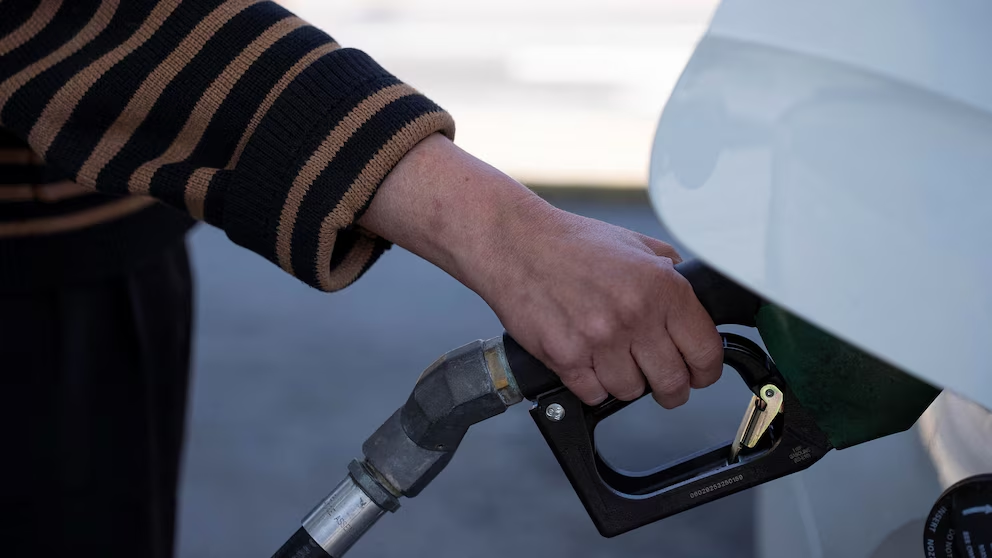
An individual fills up their vehicle at a filling station in Atlanta on March 20, 2026. Alyssa Pointer/Reuters
The joint U.S.-Israeli strikes on Iran triggered a significant worldwide petroleum crisis, leading to somber projections lately regarding the increased likelihood of an American economic slump.
Goldman Sachs increased its recession probability within the subsequent year from 25% to 30%, while Moody’s Analytics estimated the chances of a U.S. recession at just under 50%. EY Parthenon assessed the possibility of a recession over the coming year at 40%, yet it cautioned that those chances “could escalate swiftly” if the Middle Eastern dispute intensifies.
An extended petroleum deficit might inflate costs for a wide spectrum of commodities, diminishing vigor from consumer expenditure, which fuels the majority of the nation’s financial expansion, some economists informed ABC News. Inflation could likewise compel the Federal Reserve to elevate interest rates, they mentioned, propelling the U.S. closer to a contraction.
Nevertheless, specialists warned that the result remains deeply unpredictable, given the multitude of uncertainties surrounding the severity and timeframe of the Iran conflict.
Mark Blyth, a political economy professor at Brown University, described the war as a “genuine setback” for the U.S. economy.
“If items become overly costly, individuals cease purchasing them, and that damages growth,” he appended.
The connection between the Iran conflict and the American economy originates from petroleum and fuel expenses, which subsequently pose a threat of substantial increases in prices paid by consumers and expenditures incurred by enterprises, some economists noted.
Iran has instituted a near-blockade of the Strait of Hormuz, a vital maritime commercial pathway along the Iranian shoreline that facilitates the transit of roughly one-fifth of the world’s oil provision.
The U.S. is a net petroleum exporter, signifying that the country generates more petroleum than it utilizes. However, considering that petroleum costs are determined on a worldwide market, U.S. prices fluctuate in response to variations in global supply and demand.
The disturbance in petroleum transport has elevated global crude values above $112 per barrel, representing a remarkable surge of nearly 60% since the war commenced on Feb. 28.
The typical cost of a gallon of gasoline is at $3.99, increasing by $1.01 over the past month, according to AAA data.
“Fuel is essential – you must commute to work and retrieve children from school. Should the expense of one item rise, individuals will economize elsewhere. That can produce knock-on consequences,” Claudia Sahm, principal economist at New Century Advisors and a former Fed official, conveyed to ABC News.
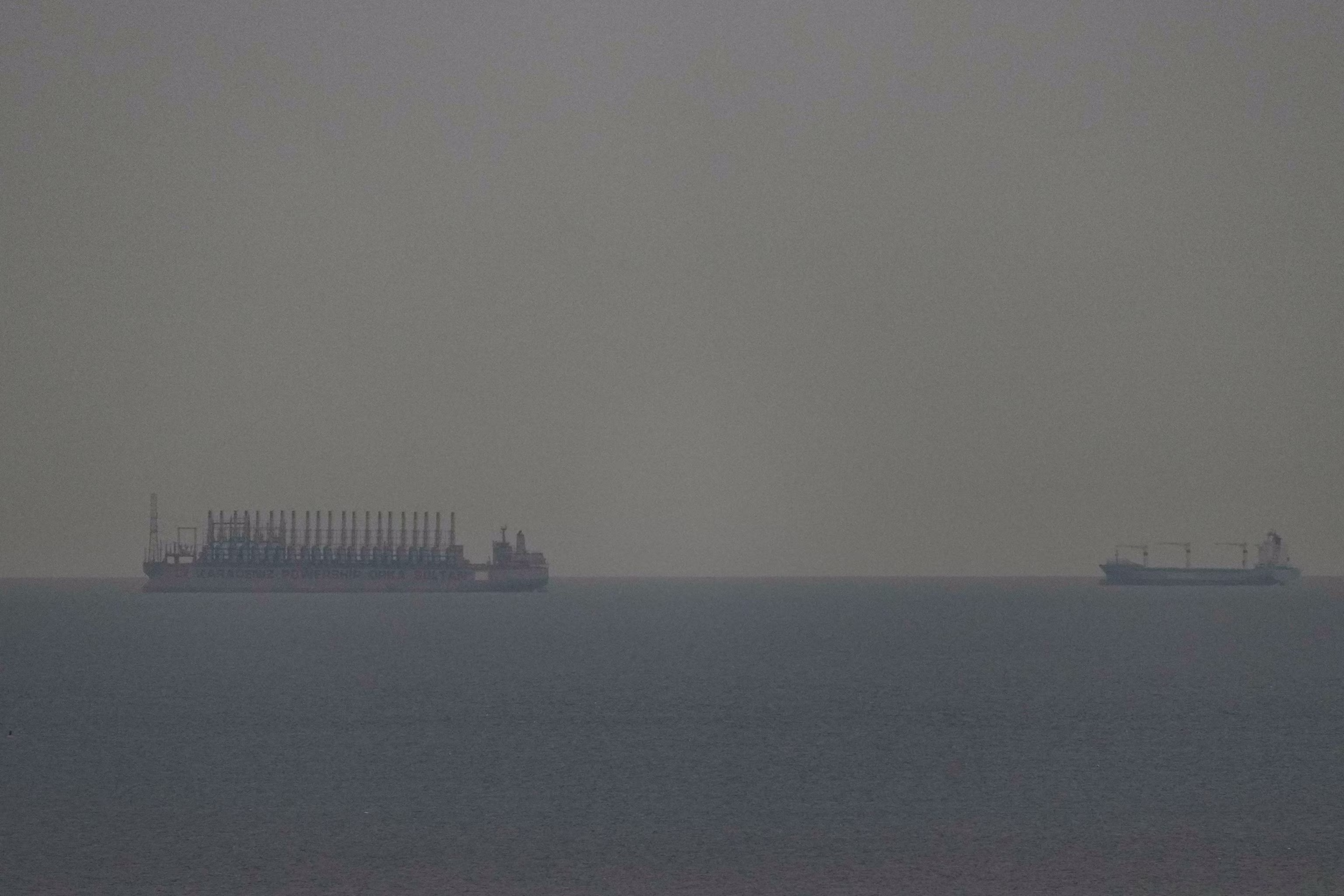
Karadeniz Powership Item Sultan, a drifting power station, is anchored near Dubai within the Arabian Gulf off the United Arab Emirates on March 27, 2026.Altaf Qadri/AP
The American economy underwent 11 recessions between World War II and the inception of the COVID-19 pandemic, Deutsche Bank stated in a message to clientele this month, also observing that six of the declines were preceded by, or closely aligned with, a year-over-year escalation in petroleum costs of a minimum of 50%.
In an endeavor to curtail petroleum expenses, the Trump administration has declared a release from the strategic petroleum reserve, relaxed sanctions on Russian petroleum, and halted a crucial regulation concerning domestic petroleum transport. The president has additionally sought to reestablish tanker movement within the Strait of Hormuz.
In a social media communication on Monday, Trump indicated the U.S. is in “significant dialogues with A NEW, AND MORE REASONABLE, REGIME to terminate our Military Operations in Iran.” Trump did not specify with whom the administration is conferring.
A prospective escalation in expenses for supplementary commodities conveyed via the Strait of Hormuz – such as fertilizer and diesel – could additionally elevate prices beyond fuel, exerting strain on the Fed to raise interest rates to suppress potential inflation, Blythe articulated.
The benchmark interest rate resides at a range between 3.5% and 3.75%. That figure constitutes a notable decrease from a recent summit achieved in 2023, yet borrowing costs persist considerably above a 0% rate established at the commencement of the COVID-19 pandemic.
Should the Fed proceed to raise interest rates, it would intensify borrowing expenses for numerous consumer and commercial loans, amplifying the likelihood of a conceivable economic slump.
“The Fed may have to elevate rates, and that will function as a deceleration for the economy,” Stewart Glickman, an analyst at research firm CFRA, reported to ABC News.
Speaking at Harvard University on Monday, Federal Reserve Chairman Jerome Powell asserted that despite escalating energy values and the prospective ramifications on inflation, he does not believe the central bank needs to elevate interest rates.
“We feel our policy is suitably positioned for us to observe and assess the progression,” Powell stated.
Assuredly, economic predictions are frequently inaccurate. Numerous Wall Street establishments and financial analysts augmented their recession probabilities in the aftermath of the Russian incursion of Ukraine in 2022 and the “Liberation Day” tariffs in 2025. In both instances, the U.S. economy circumvented a downturn.
“We should derive some solace from the fact that the U.S. economy has demonstrated significant robustness. It embodies a $30 trillion economy. Substantial force is required to reverse us,” Sahm commented.
“Recession probabilities are currently heightened, but it remains premature to initiate recession monitoring,” Sahm appended.
At present, uncertainty prevails, economists stated. Precise recession probabilities seemingly depend on the duration and magnitude of the conflict. A protracted war could propel petroleum values to astronomical altitudes and negatively impact household finances, economists cautioned, whereas a prompt settlement could enable the economy to sustain persistent expansion.
“Presently, predicting subsequent events remains infeasible,” Sahm stated.
Sourse: abcnews.go.com