
Thousands of mushroom pickers are about to head into the forest for a lucky hunt, adding headaches to rescuers who search for dozens of “lost souls” every year. But there is a way to navigate the forest, forgotten in the GPS era. I'm sharing it with you just in case, it might come in handy.
Walking through the forest, we came across a strange pillar. We had come across similar ones before, but they were usually mossy and decayed, like old grandfathers. But this one was handsome, new and bright.
The children could not explain what kind of pole it was and why it was there. And the man said that it was a quarterly pole, the fruit of many years of forest management work. It turned out that you can determine the approximate direction to the north by it. It is not placed at random, but at the intersection of clearings that divide the forest.
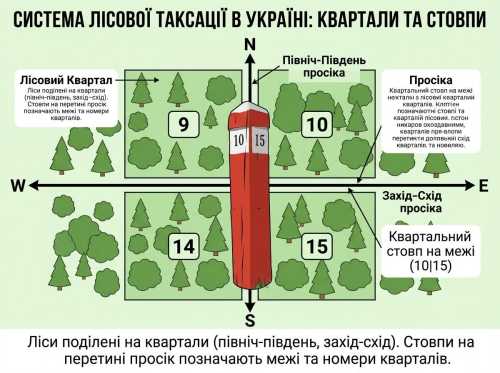
The fact is that practically all forests, at least in the flat part of Ukraine, are registered, measured and numbered. The entire forest massif is divided into conditional squares – blocks. This division, according to the classics of forest taxation, runs from north to south and from west to east. Clearings are cut between the blocks. It is at the intersection of these clearings, on the border of the blocks, that such a pole is installed.
In addition to the quarter marks, you can find other forest management signs in the forest (if you pay attention, of course), for example, sighting posts. But it is impossible to confuse the quarter marks with others. Their sizes are regulated by a special standard: they are much thicker and higher than the others (diameter about 20-24 cm, height above the ground – 130 cm). On special boards, which foresters call “cheeks”, the numbers of the quarters that converge at this point are written. And it is by these numbers that you can determine your position.
The main value of the pillar: lighthouse
Before we talk about orienteering, remember the most important thing: a quarter pole is first and foremost a reference point, your unique identifier in the forest. It is the only place that is guaranteed to be on the maps of foresters and rescuers. Therefore, its main function is to help find you, not for you to find a way out.
How does this work in practice?
Option 1 (Best): You have a phone and communication
This is the simplest and safest scenario. Just call the operator 112, report the numbers written on the sides of the pole, and name the region and approximate area where you are. Rescuers and foresters have special forest maps (tablets), where each block has its own unique number. These numbers will determine your location with accuracy to the intersection, and help will arrive much faster. Your task is to stay in place near the pole!
Option 2 (Risky): No connection, but there is strength
If you have trouble with communication, the best strategy is to stay near the pole. Light a fire (if safe), make the place visible. You will be searched for, and combing the forest always starts with key points such as the quarter grid.
If you are absolutely sure that help will not come and decide to go on your own, the pole can give you a clue about the direction. But it is a clue, not a 100% guarantee.
The numbering of blocks in forestry almost always follows a single rule: from northwest to southeast. That is, the first block is in the upper left corner of the forestry map, and the last one is in the lower right.
This leads to the “orientation rule”: the edge of the pillar between the two smallest block numbers probably points north.
For example, you see the numbers 25, 26, 37, 38 on the “cheeks” of the pillar. The smallest numbers are 25 and 26. This means that the clearing between them leads approximately to the north. Accordingly, the clearing between 37 and 38 leads to the south, between 25 and 37 to the west, and between 26 and 38 to the east.
But before you blindly trust this, check yourself! At noon, the sun should be in the south. If the direction behind the pole is blatantly at odds with the sun, trust the sun. The pole could have been turned by vandals, knocked over by a logging truck, tilted due to freezing soil, or simply carelessly installed decades ago.
Important nuances and pitfalls
1. The trap of the “impassable clearing.” Clearings receive more sunlight, so they often turn into an impenetrable wall of blackberries, nettles, and young trees. Fighting through such thickets is a waste of energy that can be fatal for a tired person. It is safer to walk not along the clearing itself, but parallel to it, under the forest canopy, keeping it in sight.
2. The trap of the “mountain forest”. In mountainous areas, for example, in the Carpathians, the quarterly grid is almost never oriented along the cardinal points. There it is tied to natural boundaries: rivers, ridges, roads. Trying to use the “rule of smaller numbers” in the mountains is guaranteed to lead you to the wrong place, and at best – just along the ridge, and at worst – into a deep ravine. However, moving along a clearing is still a salvation, because it is guaranteed to lead you either to a reservoir or to the road.
3. The “forestry boundary” trap. Sometimes the numbers on the pole can look strange, for example: 125, 126, 5, 6. This means that the pole is on the border of two forestry or forest cottages. The large numbers belong to one, and the small ones to the other, where the numbering has started anew. In this case, the “smallest numbers” rule will not work. The safest option is to walk along any clearing to the next pole, where the numbering can become standard.
4. The trap of “imperfect geometry”. The forest is not a chessboard. T-shaped intersections are often found, where only three blocks converge. In this case, the rule also works: find two adjacent numbers (for example, 45 and 46) – the clearing between them leads to the northeast or southwest. The main thing is to remember the general principle of numbering from northwest to southeast.
5. The trap of “forest logic.” Sometimes foresters install a pole not strictly diagonally to the cardinal points, but so that the “cheeks” with the numbers are clearly visible from the clearing or road they use most often. This can also introduce an error.
All this was once told to the man and his friends by the gamekeeper accompanying the team, “over a cup of tea” after a successful hunt. This old forest science is simpler than any gadget, but it requires prudence. It will not replace a compass or GPS, but it can be a lifeline if you treat it wisely.
Share