
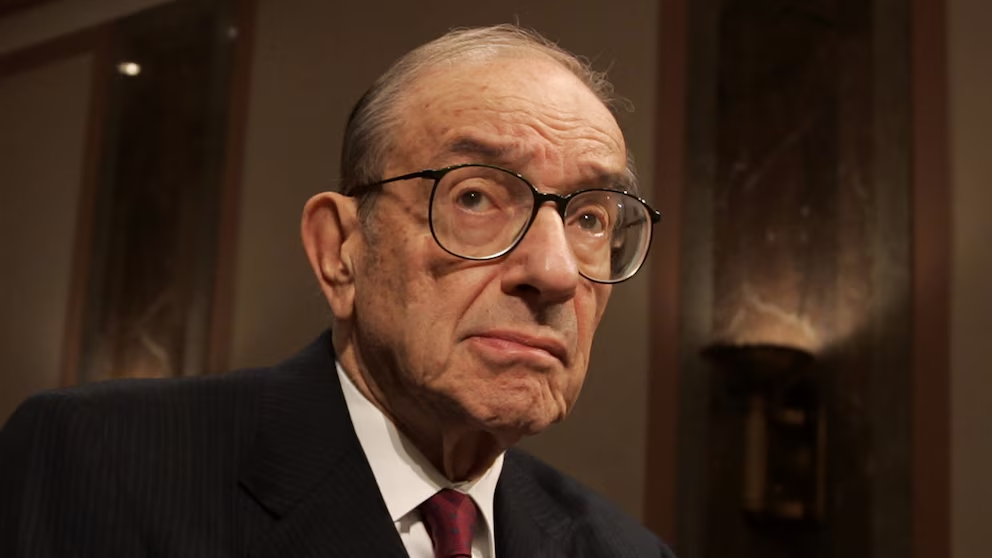
Federal Reserve Chairman Alan Greenspan testifies before a Senate Banking Committee hearing, Feb. 16, 2005 in Washington. Evan Vucci/AP
Alan Greenspan, the long-serving chairman of the Federal Reserve, has passed away, as confirmed by his spouse. He had reached the age of 100.
"Alan died at our residence this morning at the age of 100 due to complications from Parkinson’s Disease,” Andrea Mitchell, his wife and a chief correspondent at NBC News, stated in a release published by the network on Monday. The economist is recognized for guiding the American central bank through periods of significant U.S. economic prosperity, though critics contend his policies contributed to and worsened the 2008 mortgage crisis and financial collapse.
Greenspan, a Republican with libertarian leanings, assumed the role of the 13th chairman of the Federal Reserve System’s Board of Governors just two months prior to the stock market’s plunge on Oct. 19, 1987, a day known as Black Monday. He was lauded for his swift actions to assuage investor anxieties following the crash and played a crucial role in ensuring the Federal Reserve made ample funds available to mitigate the repercussions on financial markets. Stock values saw a rapid recovery.
He was appointed Fed chair by four different presidents throughout his career, beginning with Ronald Reagan in 1987. Greenspan continued his tenure as Fed chairman under presidents George H. W. Bush, Bill Clinton, and George W. Bush. He navigated the U.S. economy through the economic upswing of the 1990s, the dotcom bubble, and the terrorist attacks of September 11, 2001. His final term as chair concluded on January 31, 2006.
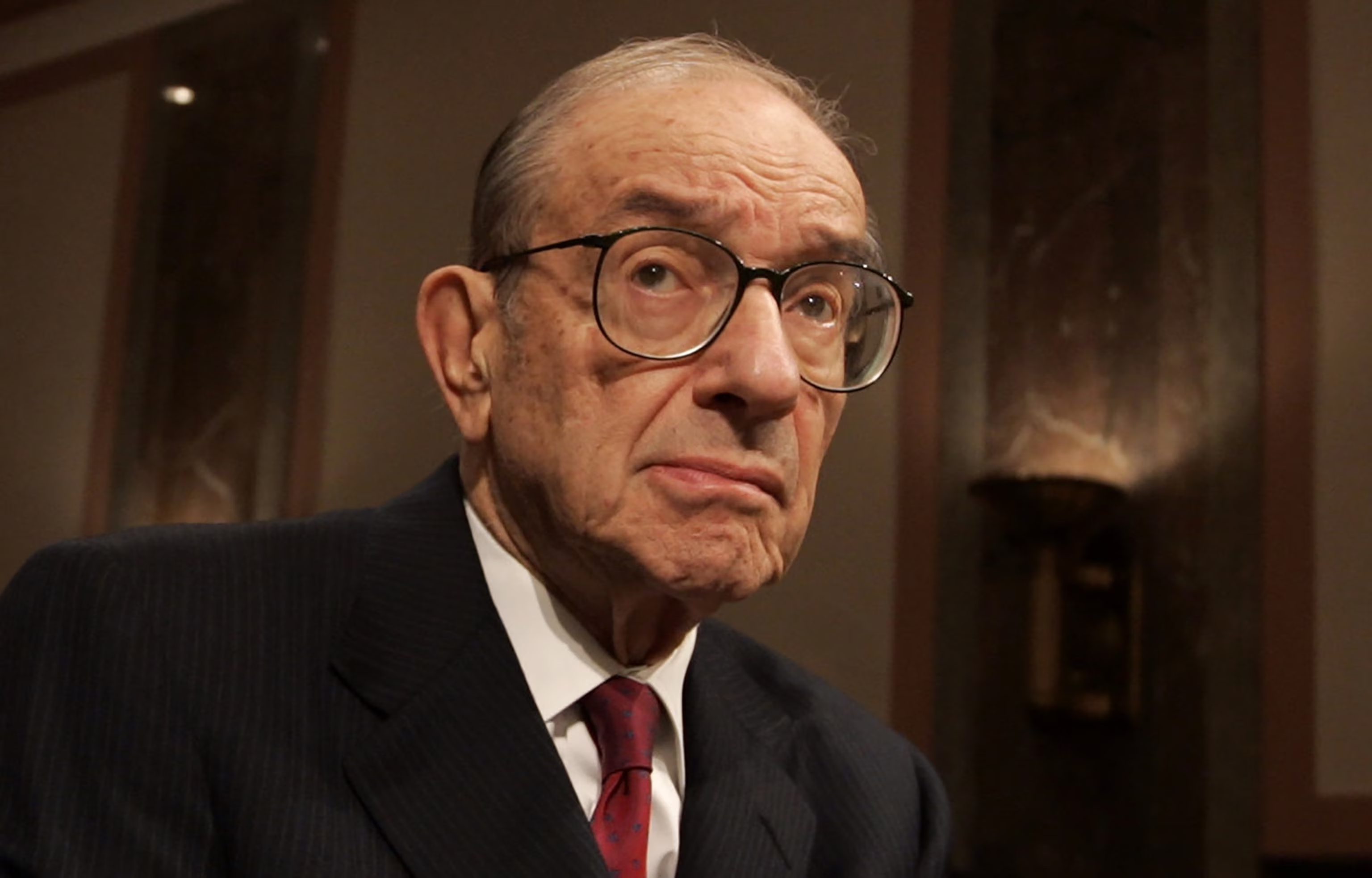
Federal Reserve Chairman Alan Greenspan testifies before a Senate Banking Committee hearing, Feb. 16, 2005 in Washington.Evan Vucci/AP
Under his direction, the Fed fostered a reluctance towards regulation and promoted exceptionally low interest rates in the early 2000s – two factors that critics argue fueled a housing price bubble which ultimately burst, leading to dire consequences for the global economy.
During his time in office, and preceding the onset of the financial crisis, the nation experienced one of the most extended periods of economic expansion in its history.
A distinguished economist, initially drawn to music
Greenspan was born on March 6, 1926, in New York City. He was the sole child of Herbert Greenspan, a stockbroker, and Rose Goldsmith Greenspan, who worked in retail. His parents divorced when he was four years old, and he was primarily raised by his mother and his maternal grandparents.
Initially aspiring to be a musician, Greenspan attended Juilliard for a year, playing the saxophone and clarinet before departing to enroll at New York University. He subsequently earned his bachelor’s, master’s, and doctoral degrees in economics from New York University. He also undertook some advanced postgraduate studies at Columbia University in New York, where he was mentored by the prominent economist Arthur Burns.
Although brief, his musical pursuits were a significant part of Greenspan’s life, and he viewed the transition to economics as a natural progression. He perceived the structuring of economic data into sound fiscal models as akin to arranging musical notes into melodies, according to Greenspan’s biographer, Justin Martin, in his book "Greenspan: The Man Behind Money."
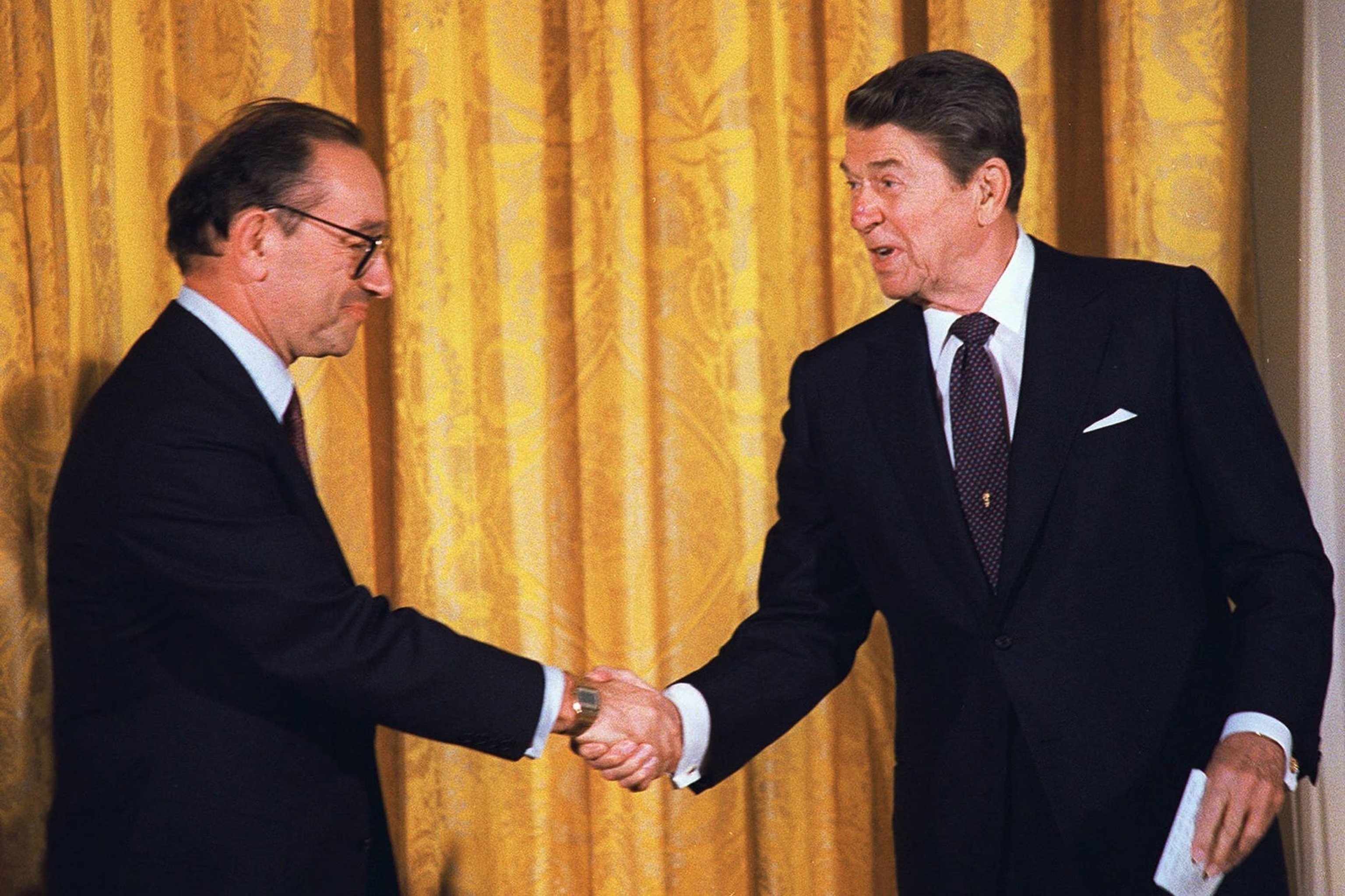
President Reagan congratulates Alan Greenspan after he was sworn-in as new chairman of the Federal Reserve Board during a ceremony at the White House in Washington, Aug. 11, 1987.Barry Thumma/AP Photo
"I derive the same sense of satisfaction from resolving a complex mathematical problem as I do from listening to a Haydn string quartet," Greenspan once remarked to The New York Times Magazine.
Greenspan instructed economics at NYU between 1953 and 1955 and subsequently established the economic consulting firm Townsend & Greenspan, where he held the positions of chairman and president from 1954 to 1974. He rejoined the firm in 1977 and remained until 1987.
President Richard Nixon put forward Greenspan’s name to chair the President’s Council of Economic Advisers in 1974, marking the first of numerous governmental economic roles he would undertake. Nixon resigned as president mere hours after Greenspan’s nomination, yet he continued to serve under President Gerald Ford. Greenspan also served as a member of President Ronald Reagan’s Economic Policy Advisory Board and acted as a consultant to the Congressional Budget Office.
In the private sector, Greenspan occupied board positions for numerous corporations, including Alcoa, General Foods, and J.P. Morgan & Co. He also served as a member of Time magazine’s Board of Economists and as a senior advisor to the Brookings Panel on Economic Activity.
In 2002, Queen Elizabeth II bestowed an honorary knighthood upon Greenspan in acknowledgment of his contributions to global economic stability. In 2005, President George W. Bush presented Greenspan with the Presidential Medal of Freedom.
He held the position of Fed chairman from his appointment by Reagan in 1987 until 2006, serving an unprecedented five terms across four presidencies before being succeeded by Ben Bernanke.
Many credit Greenspan with facilitating the longest economic expansion in U.S. history. The day following the Black Monday stock market crash, Greenspan affirmed the Fed’s "readiness to serve as a source of liquidity to support the economic and financial system," and the central bank took steps to encourage banks to lend under their usual terms. In contrast to earlier financial downturns, the events of Black Monday did not result in an economic recession or a banking crisis, and less than two years later, the U.S. stock market surpassed its pre-crash peaks.
Throughout his tenure, Greenspan gained a reputation as a consensus-builder and for his firm anti-inflationary stance, prioritizing price control over the promotion of full employment. He led the Federal Reserve through several events with significant economic ramifications, including two U.S. recessions, the 1997 Asian financial crisis, and the September 11, 2001, terrorist attacks.
‘How could we have possibly got it so wrong?’
Beginning in June 2003, the Federal Reserve set the federal funds rate, the benchmark rate for interbank lending, to one percent for a period of one year. While intended to reduce borrowing costs and stimulate the economy, critics argued that the rate was excessively low, encouraging investments in high-risk mortgage-backed securities, which they claim contributed to the 2008 financial crisis.
The National Bureau of Economic Research, a research entity widely regarded as an authority on economic performance measurement, later declared that the recession officially commenced in December 2007.
In September 2007, Greenspan released a book that served as both a memoir and an economic analysis, "The Age of Turbulence: Adventures in a New World." In it, he critiqued the George W. Bush administration’s spending habits and acknowledged his support for the administration’s tax cuts without emphasizing the necessity of corresponding spending reductions.
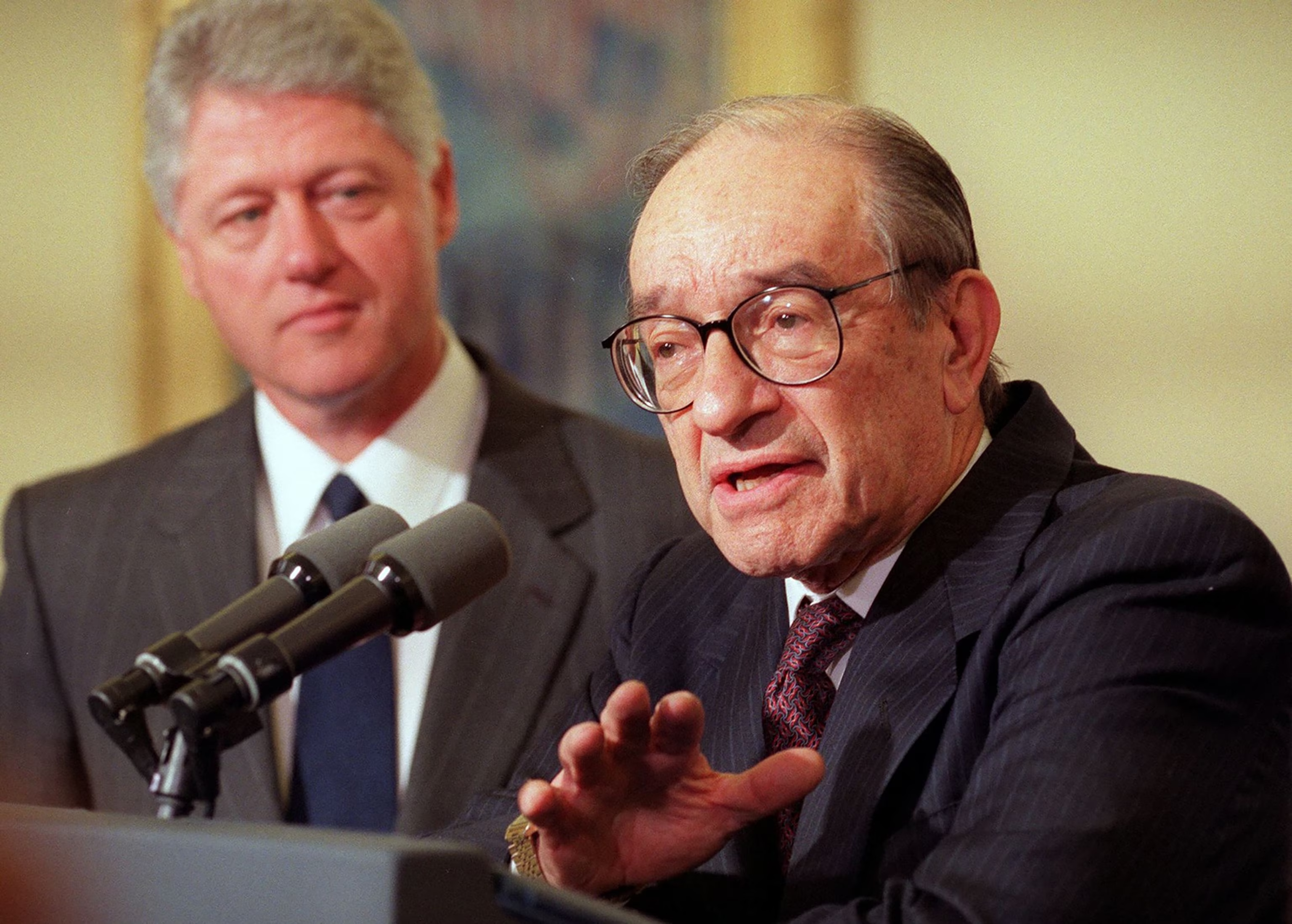
Federal Reserve Chairman Alan Greenspan speaks to the media in the Oval Office of the White House beside President Bill Clinton, January 4, 1999 in Washington.Mario Tama/AFP via Getty Images
In an interview with Bloomberg Businessweek in August 2012, Greenspan stated, "the day before Lehman Brothers collapsed, conventional wisdom did not even confirm the likelihood of a recession."
"Indeed, we discovered many months later that the decline had already begun," Greenspan commented. "How could we have possibly misjudged it so severely? I mean, I was actually stating, 'Yes, a recession is imminent, but we haven’t reached that point yet.' We were unaware that it had already commenced."
In October 2008, Greenspan conceded before a congressional committee examining financial regulation that, "I erred in assuming that the self-interests of entities, particularly financial institutions and others, were sufficient to protect their shareholders and their equity in the firms."
Following the conclusion of his term as Federal Reserve chairman in 2006, Greenspan established Greenspan Associates, an economic consulting firm located in Washington, D.C.
With Greenspan at the helm as president, the firm employed four individuals as of October 2012. His clientele included major financial entities such as the German firm Deutsche Bank and the hedge fund Paulson & Co.
Personal life
Greenspan married artist Joan Mitchell in 1952. The couple divorced in 1953 after less than a year of marriage, and the union was subsequently annulled. They maintained a friendship thereafter.
His first wife is noted for introducing him to novelist and philosopher Ayn Rand, with whom Greenspan shared a close bond, a conviction in free-market economic principles, and a philosophy of objectivism. During his thirties and early forties, Greenspan frequently spent time with Rand’s circle of adherents, known as the "Collective," engaging in discussions on subjects including politics, philosophy, current affairs, and economics.
In addition to Arthur Burns at Columbia, Rand and her group were instrumental in shaping Greenspan’s capitalist, free-market economic philosophy, according to Martin, Greenspan’s biographer.
The group’s open approach to debate and discourse served Greenspan well in his various government capacities. Throughout his career in public service, he became recognized for his adeptness at communicating with Congress without alienating those with differing perspectives or politicizing his messages.
Although he reportedly supported reforming the Social Security system and raising the retirement age, Greenspan was cautious about how his public statements as Fed chairman might influence markets. He seldom granted interviews. He was known for making notably ambiguous public pronouncements regarding the state of the U.S. economy, once telling Congress, "If I’ve made myself too clear, you must have misunderstood me."
Greenspan wed NBC News correspondent Mitchell in 1997. Their marriage ceremony was presided over by the late Supreme Court Justice Ruth Bader Ginsburg.
"We’ve shared a most wonderful marriage," he conveyed to Bloomberg Businessweek in August 2012. "It improves with each passing year. We remain deeply in love."
Mitchell is Greenspan’s sole surviving relative.
Sourse: abcnews.go.com