
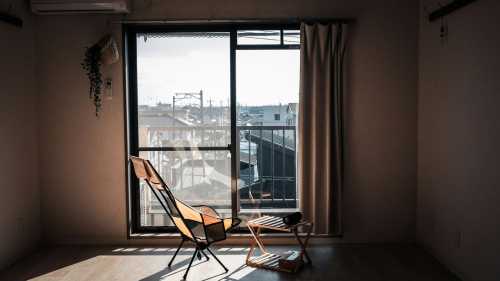
We have been told for a long time and persistently that empty space is a sign of a pure mind, and minimalism is almost a religion. And the main exporter of this religion has always been Japan.
But I came across an essay by American writer Matt Alt, who has been living in Tokyo for a long time. It turns out that we are praying to an idol that we ourselves invented.
The illusion of emptiness
When we hear “Japanese style,” our minds automatically picture bare concrete, bamboo mats, a lone sakura branch in a vase, and a complete lack of logos. That's convenient. But back in the nineties, Japanese photographer Kyoichi Tsuzuki released an album called Tokyo Style, showing how people actually live in one of the most densely populated cities on the planet. There was no Zen in it. These were apartments crammed with things from floor to ceiling.
In Japan, there is such a thing as “gomi-yashiki” – garbage mansions. And when things no longer fit inside and start to crawl out onto the street, it is called “afuredashi” (falling out).
Tsuzuki then said bluntly: the Western obsession with Japanese minimalism is the wet dreams of Japanophiles.
People live in cramped boxes bursting at the seams with household treasures. But the world seemed to prefer not to hear it. We continued to buy organizers and recite mantras about the importance of keeping only the things in the house that “bring joy.”
If Japan were so sterile and enlightened, why would it need Marie Kondo with her radical cleaning methods?
Translation difficulties
The history of this misunderstanding dates back to the nineteenth century. When Europeans and Americans gained access to closed Japan, they were surprised by the local interiors.
British ambassador Rutherford Alcock wrote in 1863 of the “Spartan simplicity” with the admiration with which aristocrats weary of luxury look at peasants. Western travelers saw rooms without furniture and attributed deep spiritual meaning to it.
Only a few, like zoologist Edward Morse, had enough common sense to notice the obvious: the lack of things in the homes of ordinary people was explained not by aesthetics, but by banal poverty.
But who needs the truth when myth sells better?
Garbage bag therapy
In the 1980s, Japan was experiencing an economic boom. There was so much money that people were buying and throwing away technology at the speed of sound. Alto recalls how, in those years, perfectly working televisions could be found in Tokyo's garbage dumps – they were simply exchanged for newer models.
And then the “soap bubble” burst. The nineties came, the economy froze, lifelong employment disappeared. People were left alone with their fears and mountains of purchased junk, which no longer brought joy, but only reminded of lost wealth.
It was then that the genre of cleaning books was born in Japan as an escape from depression. Getting rid of things became a way to regain, at least illusory, control over your life. If you can't fix the economy, at least you can clean out your closet.
Marie Kondo merely packaged this national neurosis in a beautiful wrapper and successfully sold it to the West, which was just recovering from the 2008 financial crisis.
The aesthetics of accumulation
But minimalism in the modern world is a very exhausting thing. Maintaining emptiness requires just as much energy as maintaining order.
Maybe we were just wrong about the mess.
The same Hayao Miyazaki, whose cartoons are considered the hallmark of Japanese culture, adores chaos. In his works (remember Howl's room) and on his own desk, absolute, dense, textured chaos reigns. This is not dirt. This is the layering of taste, time, interests and passions. This is a living space.
Japanese cultural scholar Seigo Matsuoka explains this perfectly.
Japan has two parallel philosophies. The “subtractive” one is rock gardens, tea ceremonies, and haiku. It is the world of the elite, contemplative, and quiet. And there is the “additive” one, with its noisy festivals and gaudy temples like Nikko Toshogu, covered in gold and carvings that Western critics have called “barbaric baroque.”
Minimalism is a way to maintain privacy. When a room is empty, you know nothing about its owner. Clutter gives you away. It shows what you read, what you drink, what you're passionate about, and where you've been too lazy to clean.
I look at my desk now and realize: I don’t want to live in a museum display case. The era of fast fashion and digital subscriptions is already imperceptibly taking away the material world from us. We buy disposable clothes, listen to music from cloud services, rent apartments. Soon we will simply have nothing to clutter our rooms with. Perhaps one day this bourgeois, cozy mess will disappear by itself. But while it’s there, I will enjoy it.
Share
Subscribe to UkrMedia on Telegram.
⚡ Readers' Pulse
What is a real home for you: immaculate emptiness or cozy, lived-in chaos?
0 people have already voted. Join the discussion.
🧸 I love living chaos ✨ Only pure Zen 🤔 I have my own opinion
☝️ First choose your position
✏️ Write a comment
📊 Mind map
🧸 I love living chaos 0% ✨ Only pure Zen 0% 🤔 I have my own opinion 0% 💡
The discussion is just beginning. Be the first to comment!
Comments
New ones first ↕
There are no comments yet. Be the first!