
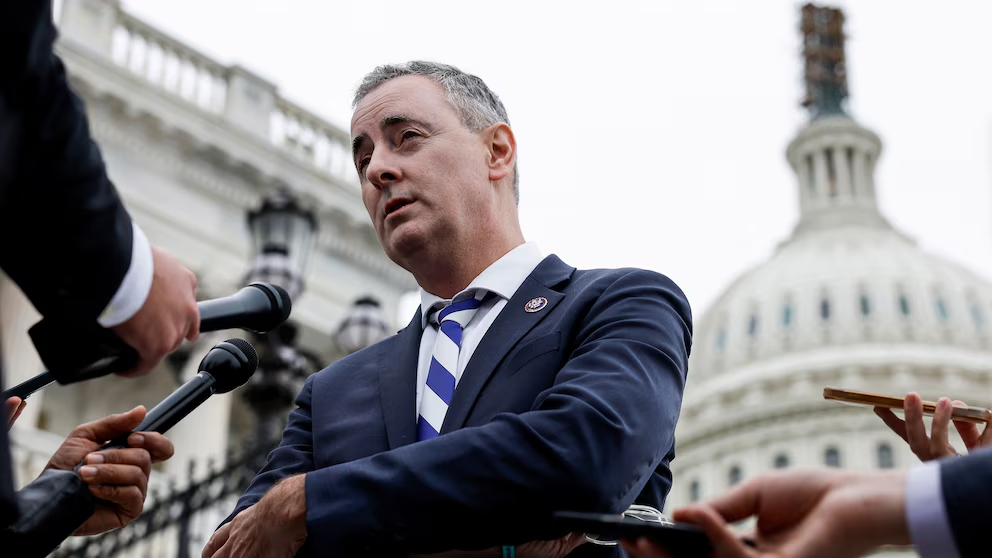
Here is a photo from our archives dated Sept. 29, 2023. It portrays Rep. Brian Fitzpatrick conversing with reporters on the exterior of the U.S. Capitol Building in Washington, D.C. Anna Moneymaker/Getty Images, FILE
A quick composition of "This Week with George Stephanopoulos" set to broadcast on ABC News, Sunday, May 24, 2026, is showcased below. This text might not represent the finalized edition, revisions may occur, and it could have slight errors from transcription. Prior show texts are available in the "This Week" transcript archives.
JONATHAN KARL, ABC "THIS WEEK" CO-ANCHOR: Developing story overnight: Are the U.S. and Iran drawing near to an understanding?
"This Week" commences now.
(BEGIN VIDEOTAPE)
MARCO RUBIO, SECRETARY OF STATE: Certain strides have been achieved; notable strides, even if they are not yet conclusive.
KARL (voice-over): President Trump suggests a resolution is mostly finalized. However, will Iran formally consent?
We'll provide the very latest directly from the area.
Erupting overnight: gunshots breaking out nearby the White House. Our Selina Wang was at the scene.
SELINA WANG, ABC NEWS SENIOR WHITE HOUSE CORRESPONDENT: There remain significant disagreements between the two sides —
(GUNFIRE)
KARL: Republican opposition on Capitol Hill.
SEN. THOM TILLIS, (R) NORTH CAROLINA: Plainly, this is completely absurd.
KARL: Senate Republicans voice sharp disapproval of the president's $1.8 billion resource.
SEN. JAMES LANKFORD, (R) OKLAHOMA: Numerous queries about this persist for us.
KARL: The acting attorney general's snswer to such inquiries yields unanticipated outcomes.
SEN. TED CRUZ, (R) TEXAS: The Republican senators were furious. They were — the whole meeting, they were shouting at the acting attorney general.
TODD BLANCHE, ACTING ATTORNEY GENERAL: Just for clarity, individuals who harm officers receive compensation routinely.
KARL: This morning, I converse with Representatives Brian Fitzpatrick and Tom Suozzi, the bipartisan alliance advocating a bill to obstruct this fund.
Texas Face-Off. Our John Quinones examines a vital voting segment that may determine control of Congress for either major party next year.
JOHN QUINONES, ABC NEWS CORRESPONDENT: Does the perceived shift of Latino electors back toward the Democratic Party give you any worry?
KARL: Plus, a panel discussion focusing on what was overlooked in the long-awaited Democratic National Committee report.
And this Memorial Day weekend, a premier look at Martha Raddatz's latest publication, entitled "The Hero Next Door".
(MUSIC)
ANNOUNCER: From ABC News, it's "This Week."
Introducing Jonathan Karl.
(END VIDEOTAPE)
KARL (on camera): Good morning. Welcome to "This Week."
We are monitoring two substantial news events that unfolded overnight.
Firstly, a plausible advancement with Iran, opening prospects of reaccess to the Strait of Hormuz. Extensive diplomatic measures have been undertaken concerning this situation; however, it remains to be determined whether Iran is in agreement.
I just spoke with President Trump to discuss this, pressing him on whether he has secured a pact. He indicated he could not provide details about the arrangement, sharing, quote, "It rests entirely with me", adding that potential news would be favorable, stating, quote, "I don't close on deals that are detrimental."
Additionally, here in Washington, we recorded a worrisome scene at the White House yesterday after dark. Selina Wang from our team was on site.
Selina is here with me now from the White House.
Selina, you were present as gunshots loudly erupted. I’d like to share part of that occurrence.
(BEGIN VIDEO CLIP)
WANG: President Trump has mentioned that a resolution is near, but both sides remain significantly divided —
(GUNFIRE)
(END VIDEO CLIP)
KARL: Selina, it was genuinely shocking. Those gunshot sounds lasted quite a while. What exactly was unfolding?
WANG: Indeed, Jon. The incident took place merely steps away from my current position. Actually, where I am at present is exactly the location featured in the video you showed. I was gearing up to go live for "World News Tonight".
You may notice in the clip, I continue speaking through the opening moments of the gunshots. This is because my first thought was that it must be fireworks or a similar occurrence, before I heard instructions to seek cover. Thus, the team and I instantly dove to the ground, hunkering down for safety.
Following that, we overheard Secret Service officers instructing us to shift location, sprinting to the press briefing room. We acted on that advice with utmost speed. Given the proximity of the gunshots, we worried they might permeate White House grounds.
From there, we remained in lockdown within the press briefing room for a duration exceeding 30 minutes. During this time, we did broadcast live segments from the briefing room. Then, we gradually began receiving details, and eventually were cleared to return outside.
Early this morning, the president expressed his thanks online to law enforcement and Secret Service agents for responding swiftly at the scene.
KARL: We also know the president was situated inside the Oval Office with some of his team when the shooting happened, taking place merely a block from that position. What have we confirmed about the shooter?
WANG: Yes, authorities have identified the shooter as a 21-year-old individual. He apparently has a documented history involving incidents related to the White House, having been previously taken into custody for attempting to infiltrate a White House security checkpoint, Jon.
KARL: Okay, prior to concluding, let’s shift back to the discussion you were having when the gunfire erupted, pertaining to the potential arrangement with Iran. Particulars are vague.
What have you learned? I am hearing some unease and unhappiness with what they are hearing concerning the emerging possible arrangement from the president's allies.
WANG: Precisely, Jon. Apprehension is building from certain top Republican senators, including Senator Ted Cruz from the GOP. He is indicating that what he is learning about what’s involved with this arrangement is raising serious concerns for him. He suggests that if the consequences here allow Iran to continue enriching uranium, building nuclear arms, and having full command over the waterway, the consequences could be disastrous.
Details under discussion remain indeterminate. One important sticking point centers on Iran's stores of enriched uranium; the question remains what path will be taken regarding its nuclear initiative moving forward. Will this simply amount to a time-limited pause or will it lead to a lasting conclusion to the standoff?
Earlier this morning, Secretary of State Marco Rubio signaled the possibility of announcements and noteworthy developments over the next several hours. Substantial progress has unfolded, although a definitive resolution remains elusive.
KARL: Okay. So, it appears uncertain whether this pact will materialize as of right now. We are also hearing criticisms from the leading Republican figure on the Senate Foreign Relations Committee who suggests the agreement could be essentially worthless. Former Secretary of State Mike Pompeo, under President Trump, is already scrutinizing the deal even before an announcement.
Selina, thank you very much.
We also have James Longman, reporting from the region on what Iran is communicating concerning any agreement.
Hey, James.
JAMES LONG, ABC NEWS CHIEF INTERNATIONAL CORRESPONDENT: Hi, Jon. Despite uncertainties on the elements of the deal, it appears that what may be happening is essentially extending the cease-fire while proceeding to reopen the Strait of Hormuz. Per Iran's foreign minister, a window of 30-60 days would then be available to address the outstanding matters. Iran is seeking an end to the U.S. blockade of its ports, release frozen reserves, and to de-escalate conflicts across the board, including Lebanon, while the U.S. wishes for Iran to curtail enrichment of uranium.
Diplomatic efforts accelerated over the weekend, with emissaries arriving from Pakistan and Qatar within Tehran. An expectation of imminent war had been forming. On the other hand, sources located in Israel, which has largely been sidelined from the negotiation process, have stated to ABC News that the evolving deal seems problematic from the perspective of their government. It tacitly validates Iran's capability in closing the Strait of Hormuz.
Israeli leaders are calling on the U.S. to pursue military action to reclaim Iran's enriched uranium. But the U.S. side appears to feel more time is merited for diplomacy — Jon.
KARL: Okay. Thank you, James.
Next, we will cover Republican resistance. This isn’t a common expression in recent Washington dialogue, especially relating to Donald Trump. Yet, across the chambers of Congress, Republican members challenged President Trump in the last week. The Senate, in particular, seemed on the verge of outright opposition, with Republican members ranging from the Senate leader, and other top members criticizing Trump’s supposed weaponization mitigation fund.
Previous Republican Senate Majority Leader, Senator Mitch McConnell, stated, quote, "Can it be true that the nation's highest-ranking law-enforcement official has presented a reserve to compensate people who committed battery on police officers? This is nonsensical and unethical. Make your case."
When acting Attorney General Todd Blanche tried to clear the air on these statements, the rebellion intensified. Senator Ted Cruz called this one of the most strenuous meetings he has observed during his time in the Senate. Republican senators, in short, were, quote, “shouting” at Trump’s acting attorney general. Following this, the Senate called off pending measures to vote on Department of Homeland Security financing.
Furthermore, the House exhibited resistance, considering a proposition to conclude military operations in Iran, unless authorized by Congress. A vote on this was abruptly sidelined. The House entered recess after realizing Speaker Mike Johnson wasn’t garnering enough support to prevent it. Adding to these events, the week began with considerable wins from a political angle for President Trump, including sidelining Thomas Massie, one of his nemeses.
Both Houses are in recess, as mentioned. Jay O’Brien will be reviewing what is expected for this Republican surge.
(BEGIN VIDEOTAPE)
JAY O'BRIEN, ABC NEWS CORRESPONDENT (voice-over): Donald Trump, who is traditionally accustomed to keeping his party following demands of allegiance, is now facing hurdles in subduing an unlikely uprising from Republican leaders.
SEN. JOHN KENNEDY (R-LA): I need this to be explained to us. We have very limited information.
SEN. TED CRUZ (R-TX): Things reached a boiling point that day. Republican senators were very upset.
O'BRIEN (voice-over): At issue, a total of $1.776 billion being held in reserve to cover costs and claims for political allies of President Trump. Applications for this funding stream can be made by anyone alleging they were subject to the purported weaponization of the Department of Justice, as the President has described it. All of this capital was allocated without congressional approval from Trump’s negotiations with the IRS that settled a dispute over his leaked tax returns from 2019.
SEN. JOHN THUNE (R-SD): Concerns have been, are, and will continue to be raised, and there will need to be more dialogue to alleviate these issues.
O'BRIEN (voice-over): Most worrisome for Republicans is that the applications will most likely come from the January 6th rioters, particularly those who injured and threatened officers of the law.
SEN. JOSH HAWLEY, (R) MISSOURI: No funding should be offered to people who commit violence on police officers.
SEN. THOM TILLIS, (R) NORTH CAROLINA: Restitution is not justified. In fact, many of these offenders must be in prison. These actions are simply idiotic.
O'BRIEN (voice-over): The same senators that Trump routinely denigrated and tried to remove are now striking back. Bill Cassidy of Louisiana, who forfeited his seat after Trump endorsed a challenger, stated, “People are worried about paying their mortgage, putting groceries on the table, and putting gas in their car, not paying $1.8 billion for the president and his allies.”
Todd Blanche, the Acting Attorney General, attempted to mitigate some of this unease.
TODD BLANCHE, ACTING ATTORNEY GENERAL: Compensation is commonly offered to those who inflict harm upon police officers.
O'BRIEN (voice-over): Yet, he could not sway Senate members. Sources have stated that even the most vocal supporters were worried, and warned him that the fund may cost their seats in November.
One lawmakers reportedly stated that, “You caused this problem. You must fix it.”
This standoff led Republicans to return home for Memorial Day weekend, while also quashing Republican plans to pass a $72 billion budget measure to aid with the president’s campaign to crackdown on immigration.
MANU RAJU, CNN CHIEF CONGRESSIONAL CORRESPONDENT: Do you believe this was a mistake to create this weaponization fund?
SEN. JONI ERNST, (R) IOWA: It has complicated things.
O'BRIEN (voice-over): This is the most recent example of President Trump failing to control Congress.
Senators balked a request for $1 billion in funding to shore up security for Trump’s newly constructed ballroom. This was scrapped given chamber rules and waning support.
President Trump shrugged this off when asked if he was losing control of Republicans in Congress.
DONALD TRUMP, PRESIDENT OF THE UNITED STATES: I am not sure. I honestly don’t know. I can say that I only act in an ethical manner.
(END VIDEOTAPE)
O’BRIEN: Jon, although Congress won’t be back in session until June, the issue is unlikely to subside by then. Jon.
KARL: Right, Jay, I think you are correct. President Trump is not going to back down soon.
Thank you, Jay.
We now have the bipartisan individuals responsible for drafting the first bill to block funding to the weaponization mitigation initiative. They are also the co-chairs of the House Problem Solvers Caucus, Republican Brian Fitzpatrick and Democrat Tom Suozzi.
Congressman Fitzpatrick, let me begin with you.
As I understand it, your bill would block the distribution of funds to anyone tied to the initiative. Tell me why.
REP. BRIAN FITZPATRICK, (R) PENNSYLVANIA & PROBLEM SOLVERS CAUCUS CO-CHAIR: I appreciate you speaking with me this morning, Jonathan.
Back in 1956, there was legislation passed called Title 31, Section 1304, which originated the Judgment Fund. From the 1960s, and later periodically, it was modified.
Instead of affirmatively approving and appropriating money for settlement payments, there was a reserve fund allocated to the attorney general that allowed him to distribute with discretion.
There were more changes throughout that decade that delegated authority from Congress toward the Attorney General. Now, we are seeing an improper use of this initiative.
Tom and I are seeking to amend the appropriation, and we will prevent its use for the fund. Additionally, we will target Title 31 to address the root cause of the issue.
KARL: So, as you probably know, President Trump has said he could’ve personally settled his lawsuit, given that his taxes were illegally leaked by a contractor. He is helping those who were abused by the Biden administration receive justice.
How do you respond to that, Congressman Fitzpatrick?
FITZPATRICK: At issue here is that there is a statute bypassing Congress. The statute originated for a purpose, to resolve lawsuits concerning tort violations or contractual disputes.
But we are not seeing Congress (AUDIO GAP) appropriate the funds. Every dollar in the executive budget is appropriated from the process in Article 1. We are in that process now to consider DOJ appropriations.
You better believe this situation will be a part of that (AUDIO GAP).
KARL: There is some interference in the audio.
FITZPATRICK: Congress must have that authority.
KARL: I assume that Speaker Johnson is not going to voluntarily put this on the floor. What will be the process to ensure it goes through?
REP. TOM SUOZZI, (D) NEW YORK & PROBLEM SOLVERS CAUCUS CO-CHAIR: Republicans must join with Democrats. Everyone sees this as wrong, either stupid or unethical as McConnell stated. There are checks and balances so that the other branch can prevent the others from acting wrongfully.
Americans are facing problems with the costs of living, and so we shouldn’t want to see $1.8 billion going to compensate those who beat up cops. So Congress and the Senate must keep the executive branch accountable.
People have been calling for this and the public is speaking their mind as we are getting closer to the elections. People don’t want this, and so we need to follow that.
KARL: Even if you find a way to get the necessary Republicans onboard, I assume you’ll file for a discharge petition as Massie did with the Epstein files. Even if this goes through the House, it may not go through the Senate. President Trump is not going to sign.
What is Plan B? Is he going to veto?
SUOZZI: I think there is going to be bipartisan support once the discharge petition is filed. If you look at the polls, there are concerns over the costs of living, and the costs of gas and groceries.
People want $1 billion going to a ballroom, or $1.8 billion going to insurrectionists on January 6th. We want to focus on issues affecting them.
It goes back to McConnell’s statement: Is it stupid or unethical? Pick your choice.
KARL: Congressman Fitzpatrick, how many of your Republican colleagues support this?
FITZPATRICK: I have been told there’s support, but we will see by who signs the bill.
KARL: If you succeed, as Massie did on the Epstein discharge, are you prepared for President Trump’s pushback?
FITZPATRICK: This is about representation. I represent an independent district and they want independent representation. They will see that reflected.
I don’t worry about outside criticism. I won’t criticize people for speaking their mind, but my job is to represent my people. I am going to do that.
KARL: What is the –
SUOZZI: I want to say –
KARL: Go ahead.
SUOZZI: Brian has done this before, such as signing other discharge petitions, on issues such as Ukraine.
We are willing to stand up and say that we need to work together to make our country a better place and focus on what people care about.
KARL: How important a political issue is this? Are you feeling the political impact?
SUOZZI: As we get closer to elections, this administration will be seen as out of touch.
We talk to our constituents, review the polls, the real issues are cost of living, and not keeping with that. Bill Clinton was famous for saying he would feel our pain.
The administration needs to feel the pain. There’s a cop who was beat up on January 6th, and his attacker received a pardon. There’s just one story I want to tell. There’s a cop on January 6th who received 12-year sentence for tasering the officer and said he got away with it. It’s just crazy.
KARL: Congressman Tom Suozzi, Congressman Brian Fitzpatrick, we will be following your efforts.
In the next segment, we are just days away from the Republican runoff in Texas. How could Latino voters flip the states to Democrats in November?
Sourse: abcnews.go.com