
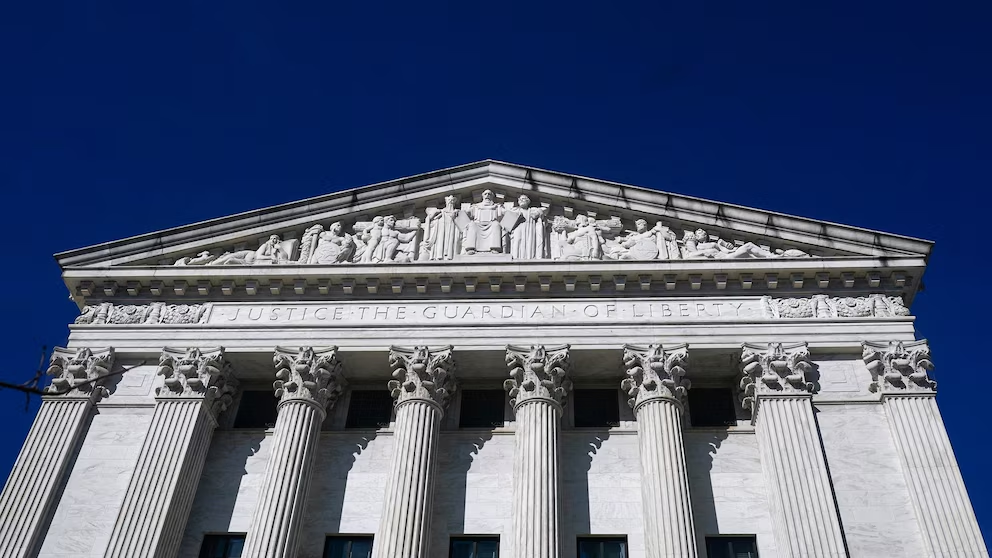
The U.S. Supreme Court edifice is depicted in Washington, D.C., on March 20, 2026. Nathan Howard/Reuters
In a significant ruling announced Wednesday, the high court, in Louisiana v. Callais, invalidated Louisiana's second congressional district with a Black majority and asserted that redistricting which considers race under Section 2 of the Voting Rights Act of 1965 is not in line with the Constitution.
The 6-3 decision does more than just alter a solitary state's electoral map. It signifies a radical alteration in the legal interpretation of equity, voting entitlements, and the jurisdiction of Congress to implement the Reconstruction Amendments.
Here are five crucial aspects of the ruling — and its implications.
1. Solutions considering race are now regarded as constitutional breaches
For over forty years, Section 2 of the Voting Rights Act functioned based on a clear tenet: when electoral frameworks generate outcomes that discriminate racially, they contravene federal legislation — even if discriminatory intent isn’t proven.
In Louisiana, where African American inhabitants constitute approximately a third of the populace, a federal tribunal determined that a map crafted after 2020, featuring just one district with a Black majority, most likely diluted Black voting influence. The legislative body addressed this by delineating a subsequent district where Black individuals comprised the majority, consistent with what courts have mandated in comparable instances.
The Supreme Court has currently proclaimed that solution unconstitutional. By asserting that the purposeful establishment of a district with a majority of minority residents breaches the Equal Protection Clause, the Court has upended the rationale of Section 2. The act of redressing racial dilution of votes itself, the court's majority reasoned, amounts to unacceptable racial categorization.
In doing so, the Court has essentially constitutionalized a "colorblind" ideology that prohibits remedies considering race–even when rectifying demonstrable racial bias in voting.
2. Section 2: The VRA's final functional protection is basically eliminated
Thirteen years prior, in Shelby County v. Holder, Chief Justice John Roberts authored the judgment invalidating the preclearance formula within the Voting Rights Act, thereby nullifying the stipulation that jurisdictions with pasts of discrimination must secure federal authorization prior to modifying voting regulations. The Court assured the populace that Section 2 remained as a safeguard.
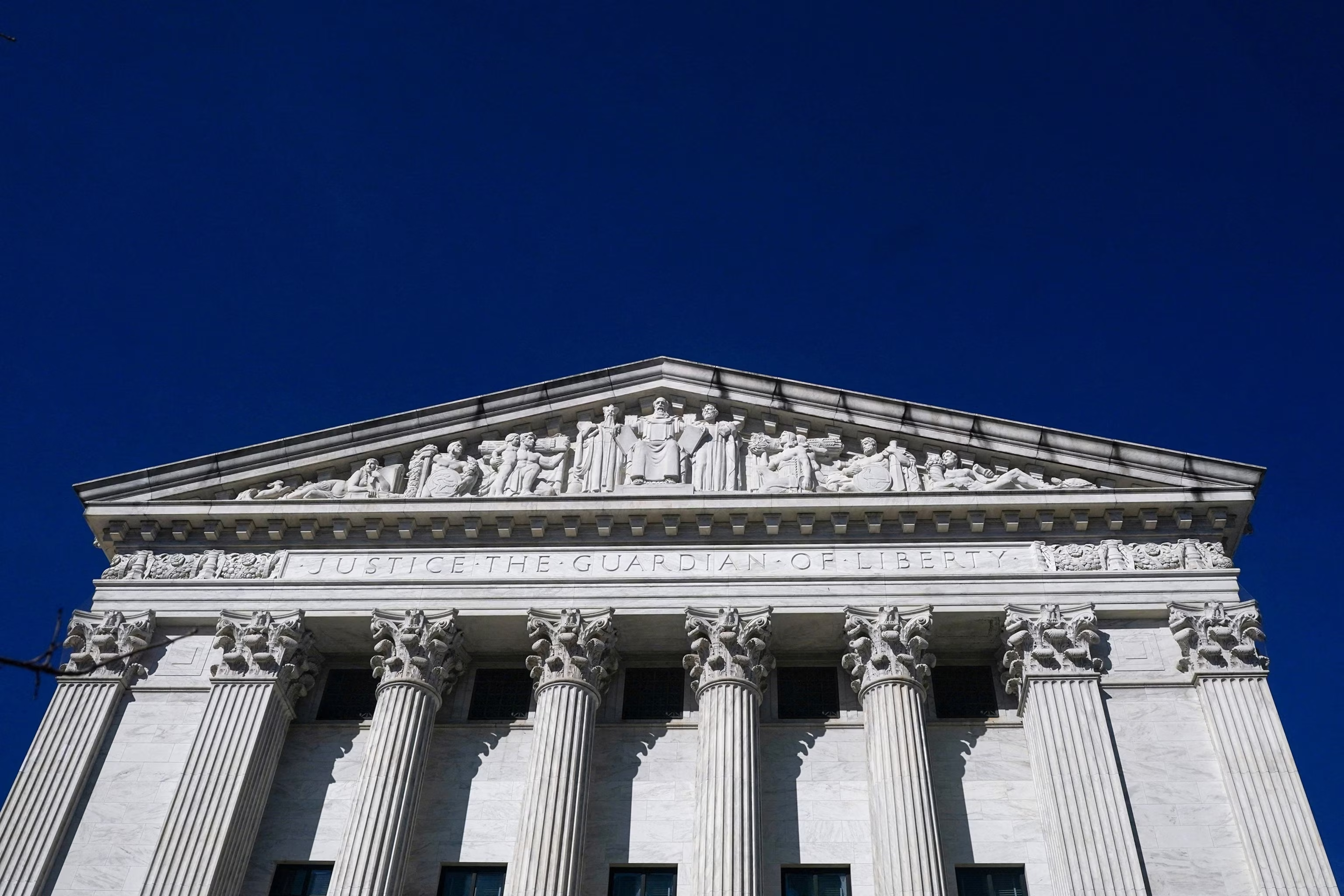
The U.S. Supreme Court building is shown in Washington, D.C., on March 20, 2026.Nathan Howard/Reuters
That safeguard is now essentially non-existent for redistricting situations.
Section 2's "disparate impact" framework — embraced by Congress in 1982 expressly because it is simple to mask discriminatory motivations — mandated that courts scrutinize results, not pronouncements. When voting patterns influenced by race combined with district boundaries to impede minority groups from electing chosen candidates, courts possessed the ability to necessitate that states designate extra opportunity districts.
By adjudging that such adherence considering race is unconstitutional, the Court has weakened Section 2's primary enforcement tool. The legislation remains valid, but its most potent utilization has been taken away.
3. Chief Justice Roberts: A decision taking decades to materialize
The judgment isn’t simply a modification in legal thinking. It represents the culmination of an undertaking that started during Roberts' early career.
As a junior legal professional within the Reagan administration, Roberts voiced disapproval regarding the Voting Rights Act's dependence on discriminatory consequences rather than discriminatory aims. In internal correspondence, he contended that Section 2 transcended the bounds of the Constitution by governing actions that merely culminated in racial differences. The anxiety wasn’t regarding enduring discrimination, but rather Congress' assertive reaction to it.
That stance never faltered. In Shelby County v. Holder, Roberts penned that "circumstances have evolved in the South," deducing that extraordinary federal surveillance was no longer justifiable. The effects materialized swiftly: states implemented restrictive voting laws, modified district boundaries and altered protocols in manners that disproportionately affected voters from diverse ethnic backgrounds.
With Louisiana v. Callais, Roberts has realized what he initiated campaigning for decades prior. By declaring that redistricting solutions considering race themselves contravene equal protection, the Court has eliminated what remained of the Voting Rights Act's practical effectiveness.
In that respect, it is Roberts' quintessential accomplishment.
4. Reinterpreting the Reconstruction Amendments
The case centered on a fundamental constitutional disagreement. The 14th and 15th Amendments were enacted following the Civil War to guarantee equitable citizenship and safeguard formerly enslaved individuals from racial discrimination, specifically in voting. Congress was explicitly granted the power to put those assurances into effect.
The Court's majority portrayed Section 2 as being "in conflict" with equal protection because it necessitates consideration of race. This portrayal treats the Constitution as prohibiting the very measures considering race that were conceived to fulfill its promises.
In dissent, Justice Elena Kagan cautioned that the majority's methodology threatens to dismantle decades of protections for civil rights.
"That exemplifies racial vote dilution at its most classic," Kagan expressed. "A cohesive minority group in both geography and political views, confronting continuous racial adversity, is partitioned—usually termed 'cracked'—diminishing their electoral power completely. Though members of the racial minority retain the right to vote, polarized state elections deny them an equal opportunity unlike their white counterparts, in electing representatives who understand and protect their interests.
The dissent underscored that dismissing the genuine existence of racial prejudice does not foster impartiality — it perpetuates inequality. The Constitution, she contended, authorizes Congress to tackle discrimination in its actual operation, rather than its refined legislative representations.
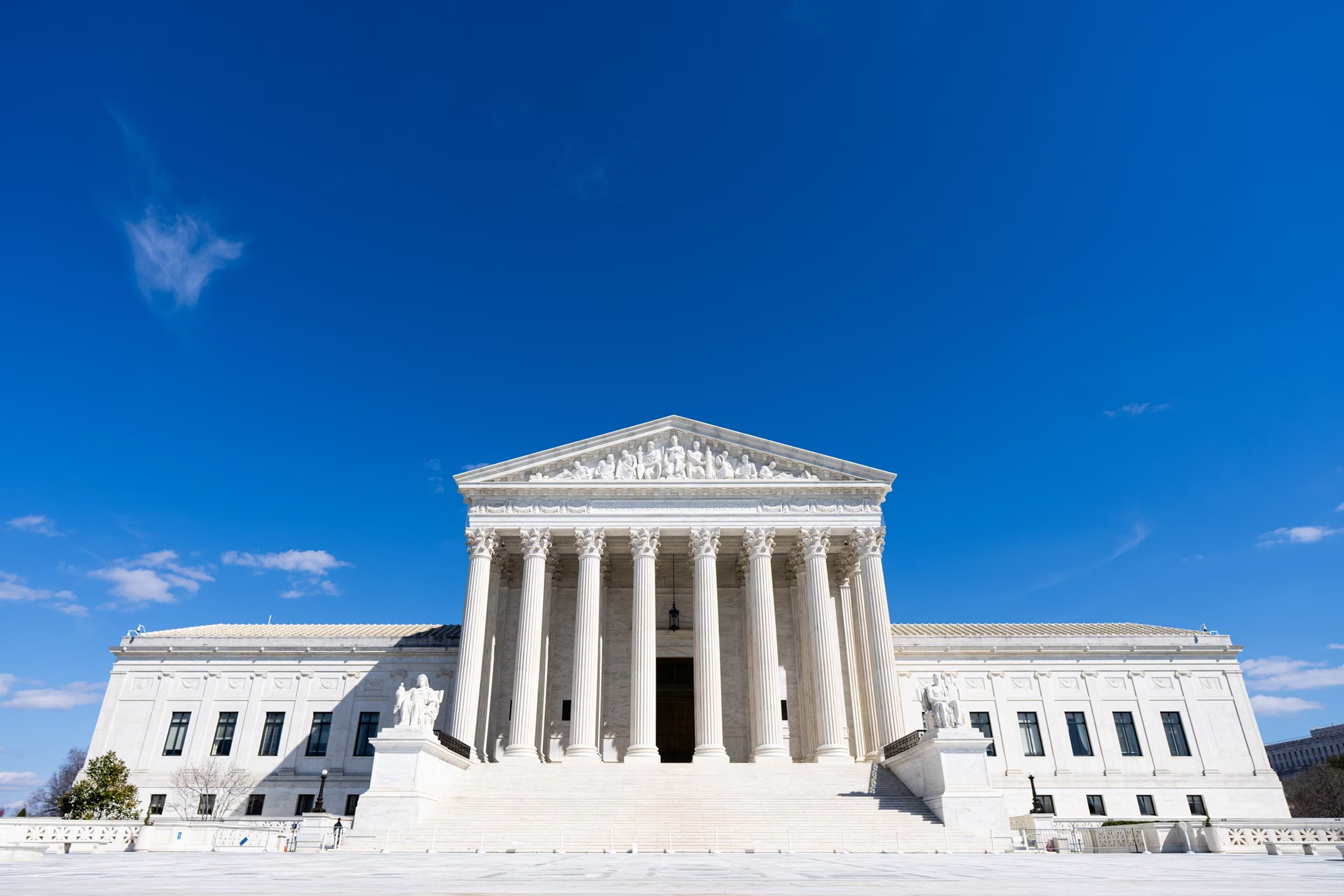
The Supreme Court building in Washington, D.C., March 18, 2026.Bill Clark/CQ-Roll Call via Getty Images
By prioritizing formal colorblindness above actual equality, the Court has redefined the Reconstruction Amendments, transforming them from instruments of inclusion into constraints on rectification.
5. The ramifications: Not solely impacting Louisiana
The outcome of Louisiana v. Callais won’t be restricted to a single state. Without enforceable Section 2 safeguards in redistricting, legislative bodies face considerably reduced federal restrictions on creating maps that weaken the voting strength of minorities — particularly in areas demonstrating severe racial polarization in voting behaviors.
Analysts caution that up to a quarter or greater of the Congressional Black Caucus and roughly a tenth of the Congressional Hispanic Caucus could be impacted by modifications to maps that would previously have triggered examination under Section 2. Beyond Congress, the ruling will hold influence over state legislative, local, and school board districts countrywide.
The broader consequences related to legal theory may extend even further. Standards concerning disparate impact also reinforce additional civil rights statutes, encompassing Title VII of the Civil Rights Act and the Fair Housing Act. Should the Constitution now be interpreted to prohibit governmental responses to racial differences absent substantiation of intent, long-standing enforcement structures could encounter renewed challenges.
The conclusion
The Voting Rights Act was not merely a statute. It embodied a national dedication to meaningful engagement in politics and a watchful approach against racial marginalization.
By overturning Louisiana's second district with a Black majority and declaring redistricting considering race under Section 2 unconstitutional, the Supreme Court has disavowed that dedication. The Court maintains that it is preserving equality. Critics contend that it has disarmed one of the nation's most potent instruments for attaining it.
What endures is a constitutional arrangement in which systemic discrimination must be substantiated solely through intent — and where solutions that once characterized the modern era of civil rights are now questionable under the very amendments they were crafted to uphold.
James Sample is a legal contributor for ABC News and serves as a professor of constitutional law at Hofstra University. The viewpoints articulated in this article do not necessarily mirror those of ABC News or The Walt Disney Company.
Sourse: abcnews.go.com