
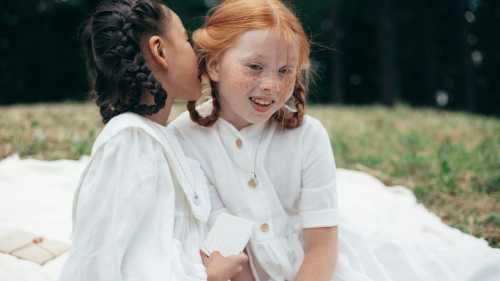
Our people have long said: “A small deed is better than a great deal of idleness.” This principle was strictly adhered to in upbringing. By the age of ten, both boys and girls in peasant families became independent “economic units” with a lot of responsibilities, Ukr.Media reports.
Girls were taught to work very early, even earlier than boys. From the age of 5-6, they were expected to know how to spin, help around the house, in the garden, and look after children, poultry, and livestock.
By the age of 10, thanks to the “science” of mothers, grandmothers, and other older women, girls were moving to a new level of responsibility. Of course, a ten-year-old daughter did not yet have the status of an adult girl in the publication (it physiologically and socially reached the age of 15-16). She became a teenager, a young woman, but she received the responsibilities of a completely adult. If the neighbors gave her the contemptuous nickname “neprakha”, it was a stigma. With such a characteristic, one could not count on a good groom in the future.
How was the learning process structured?
Exclusively on personal example. Usually, during household or field chores, the mother showed and explained her actions to her daughter, and then trusted her with the simplest things. As soon as the girl mastered the skills, the tasks became more complicated. If at 5-6 years old the little housewife grazed chickens, then at 10-12 she would already drive a cow to pasture and milk it. Such gradualness and continuity guaranteed excellent results.
Did teenagers rebel against this way of life? Of course not. On the one hand, work skills from an early age helped them survive in difficult social realities. It was not for nothing that they said:
“With a craft you can travel the whole world – you won't get lost.”
On the other hand, a strong Christian tradition prevailed among ordinary people, especially the strict Old Testament. According to it, serving one's parents was likened to serving God, and disobedience was an insult to higher powers. Children were instilled from infancy with filial and filial duty, respect for old age, and the realization that family is the most important thing, and any work for its benefit is respected.
“To run a household is not to walk around with your mouth open.”
What exactly was a village girl supposed to know by the time she was ten? Her tasks were extremely diverse, despite the deceptive simplicity of peasant life.
Babi's corner
This is a real “women's kingdom” near the stove. Usually it was separated from the rest of the house by a curtain, and the stronger sex did not enter there without urgent need. Moreover, the appearance of an outsider in the “women's corner” was considered an insult. Here the hostess spent the lion's share of her time: she prepared food, maintained order in the pantry, on shelves with milk jugs, clay and wooden bowls, salt shakers and cast iron pots. Loose products were stored in wooden stands and birch bark boxes. A ten-year-old girl actively helped her mother in these chores: she washed dishes, cleaned and could cook simple but healthy peasant food herself.
House cleaning
The duties of a teenage girl also included maintaining cleanliness in the house. She had to sweep the floor, wash and scrape the benches and portable benches nailed to the walls, beat out the sidewalks, clean and shake out the bed. The girls also took care of lighting: they changed the wick or candles, and later, at the turn of the 19th and 20th centuries, when technological kerosene lamps appeared in the villages, they also cleaned them. Often, ten-year-old helpers washed and rinsed the laundry on their own in the river, and then hung it out to dry. If in the warm season it was more of a pastime, then washing in a hole in the ground turned into a severe test in winter.
Caressing
In large families, the care of the older children for the younger ones was a strict necessity – the parents worked hard in the fields. Therefore, a teenage girl could often be seen near a cradle suspended by a ring from the central beam of the ceiling (svoroka). The older sister, sitting on a bench, would insert her leg into the loop, rock the cradle, and in the meantime she would do needlework.
In addition to rocking, a 10-year-old little nanny could change a baby's diaper herself, make a pacifier out of chewed bread, or feed it from a horn.
Historical background: This method of feeding was completely unsanitary. The transmission of bacteria through chewed bread or cow horn became one of the main causes of colossal infant mortality.
But they didn't know about it then. So the little nanny simply did her job: she calmed the baby, entertained him with songs, caresses and sayings. If necessary, at the age of 10-12, the girl could be hired out – to be a “nanny”. Over the summer, she earned from three to five rubles – a lot of money for a teenager. Sometimes, by agreement with her parents, she was paid in natural products: flour, potatoes, apples and pieces of fabric.
Weaving
This is an extremely important element of peasant culture. The peasants made all the fabric for clothes, towels, tablecloths and household items themselves (that is why it was called homespun). First, the girl was taught to wind threads on sevki – tubes made of hollow reeds or carved from wood. Then she learned to beat flax and spin threads from the cones (cleaned fiber). In the southern provinces, wool was also combed. Usually, long winters were spent on this occupation in a large company of women.
Already at the age of 5-7, the girl mastered basic skills, and her father made her a personal spinning wheel or spindle — smaller than adults'.
By the way, it was believed that one's own tool was sacred. One would not give one's spinning wheel to girlfriends because they would “spoil it”, and it was also not worth taking someone else's: a good craftsman works only with his own tool.
Later, the girl was taught to weave. A full-fledged loom was too big for a child (she lacked the arm span and leg length), so by the age of 10, girls mastered narrow weaving on berdechki or boards – this way they could create a belt on their own. And later, wide canvases (for example, towels) were woven on large looms. The first “handmade” was necessarily left to the little craftswoman, after which she began to prepare her dowry.
In addition to the above, the 10-year-old girl helped adults in the field: she tied sheaves, gathered ears of corn, and turned hay. She worked in the garden, grazed a cow, goats, geese, and ducks, raked manure, and cleaned the cattle. In short, the teenage crisis passed unnoticed — the girl simply did not have time for it. In return, the hardworking helper always received support and praise from her elders. They lived by the principle:
“Not the kind of daughter who runs away from work, but the one who is visible at every job.”
However, one should not think that peasant children were completely deprived of ordinary joys. Younger girls played “mother-daughter” with rag dolls: they themselves wove their braids, sewed clothes, and invented jewelry.
It was believed that if a girl willingly played with dolls, she would become a wonderful housewife and mother.
The elders gathered for evening parties – they chatted, sang, knitted, embroidered and sewed. All the children – from the youngest to the oldest – were often sent to the forest to pick berries, mushrooms, herbs, brushwood or to the river to fish. And this was also a fun adventure, which at the same time adapted them to adult life.
Share
⚡ Readers' Pulse
Do you think such early responsibility is beneficial for a child, or is it still a stolen childhood?
0 people have already voted. Join the discussion.
💪 Cultivates a strong character 🛑 This is an excessive load 🤔 There were other times
📊 Mind map
💪 Cultivates a strong character 0% 🛑 This is an excessive load 0% 🤔 There were other times 0% 💡
The discussion is just beginning. Be the first to comment!
Comments
There are no comments yet. Be the first!