
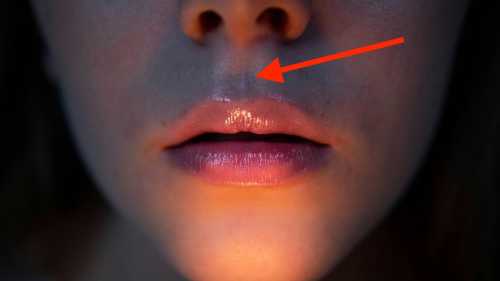
When you stare at yourself in the mirror for a long time in the morning while shaving or brushing your teeth, you start to notice strange things. Our face has a rather specific design in general, but there is one detail that raises the most questions. The dimple under the nose. The vertical groove that anatomists dryly call the “philtrum.”
It would seem, what good is it? To collect drops of sweat in the summer? To interfere with shaving? It seems like just a skin relief that makes no sense. But absolute coincidences rarely happen in our bodies. This small depression is actually an indicator of how we were sewn together in pieces before birth, and a visible trace of the mechanism that allows us to speak normally now.
Dog's legacy
Let's start with those in which this mechanism still works for its intended purpose. You've probably seen such a groove in cats or dogs. For them, it's something like a capillary pump: it constantly pulls moisture from the mouth to the nose. And a wet nose is an ideal radar. It picks up odor molecules as clearly as a good antenna does a radio signal.
Once upon a time, several tens of millions of years ago, our very distant ancestors also ran around with such “wet noses.” Then priorities changed. Higher primates had to rely on vision, and the need to sniff out prey somehow disappeared. The function disappeared, the pump broke, and the hole remained.
The seam on Frankenstein
To understand why we need a philtrum today, it's worth remembering how we form in the womb. Between the fourth and eighth weeks, an embryo's face is not a cute little replica of a human. It's more like a collection of separate biological pieces that grow from different sides and are supposed to meet exactly in the center.
The philtrum is literally a place of growth. The seam where these tissues collide and merge into one whole. The palate, the gums, the muscles – all of this must be sewn together in a few weeks with jeweler's precision.
Sometimes, at this stage, a malfunction occurs. The tissues do not fuse together, and a cleft of the upper lip appears (what used to be rather cruelly called a “cleft lip”). About one in 700 babies is born with this problem. The reasons range from a genetic lottery to a lack of certain substances at the beginning of pregnancy. Surgeons are now correcting this, but for doctors, this groove is forever a marker of how the basic stage of human assembly went.
Anchor for a skeptical smile
So, is it just a residual scar? Yes and no. The dimple in the skin itself doesn't do anything anymore, but evolution has a habit of repurposing old parts for new purposes.
Under this skin relief lies the orbicularis oculi muscle. It is precisely where the tissues grow together that the fibers of this muscle intricately intertwine and attach to the skin. It is a kind of biomechanical anchor. Try pronouncing the sounds “p”, “b” or “m”. Or portray a slight contempt or a crooked smile. The muscles under the groove are responsible for all this subtle facial expression.
People with naturally flat philtrums speak perfectly, their device works as it should. But plastic surgeons know that when reconstructing a lip, the most important thing is to properly sew the muscle itself so that the person can eat and speak. But they recreate the dimple itself simply for aesthetics.
Sofa diagnosticians, relax!
There's one more thing worth mentioning, if only to reduce the amount of paranoia. The philtrum is indeed one of the markers for pediatricians.
If toxins enter the body during the first trimester of pregnancy (most often large doses of alcohol), they disrupt the cell migration route. The seam may close crookedly, or the relief may become smoothed out altogether. In medicine, this is one of the symptoms of fetal alcohol syndrome.
But here I want to put a big red “stop” sign. A flattened philtrum is a reason for the doctor to look at the child more carefully, not a reason for passers-by to make diagnoses. In a huge number of people, a flat philtrum is simply a genetic norm, an inheritance from a great-grandmother or an ethnic feature. In addition, it tends to wear off with age anyway. Therefore, playing diagnostician on the playground, looking closely at other people's faces, is a frankly so-so idea.
Our body is not at all like a perfectly designed mechanism. And that inconspicuous dimple under our nose is a remnant of a long history.
Share
Subscribe to UkrMedia on Telegram.
⚡ Readers' Pulse
How do you perceive this “seam” on the face: as a unique highlight or as an unnecessary anatomical rudiment?
0 people have already voted. Join the discussion.
✨ This is a natural charm 🧬 Just an extra scar 🧐 I have my own opinion
☝️ First choose your position
✏️ Write a comment
📊 Mind map
✨ This is a natural charm 0% 🧬 Just an extra scar 0% 🧐 I have my own opinion 0% 💡
The discussion is just beginning. Be the first to comment!
Comments
New ones first ↕
There are no comments yet. Be the first!