
This week, the Trump administration unveiled substantial new duties on numerous nations, including key U.S. trading partners such as Canada and China.
This action represents President Donald Trump’s most recent endeavor to re-establish extensive taxes that were invalidated by the Supreme Court earlier this year.
The new set of tariffs would place taxes on a variety of imported consumer items, potentially driving up prices at a moment when inflation is escalating due to the conflict in Iran.
Here’s what you need to know about the suggested tariffs and their potential impact on your finances:
What are the new proposed tariffs from Trump?
The Office of the U.S. Trade Representative (USTR) on Tuesday put forward levies of at least 10% targeting 60 trading partners, ranging from Costa Rica to Saudi Arabia and the European Union.
This measure aims to penalize countries for their supposed failure to prevent the import of goods manufactured through forced labor. The USTR asserts that such labor practices enable these nations to reduce costs and gain an unfair competitive edge over American workers.
Under this policy, 54 countries, including India and Brazil, would face a 12.5% tariff due to their alleged inability to prohibit the importation of products made with forced labor. An additional six countries, such as Canada and Mexico, would be subject to a 10% tariff for their purported inadequate enforcement of such prohibitions.
This finding of misconduct follows an inquiry launched by the Trump administration in March under Section 301 of the Trade Act of 1974, according to the USTR. This provision empowers the executive branch to implement temporary tariff authority in response to adverse trade actions taken by other countries.
“The inability of our most significant trading partners to address the importation of goods produced with forced labor is unacceptable. This creates a situation where American workers are compelled to compete globally on an uneven playing field,” stated U.S. Trade Representative Jamieson Greer.
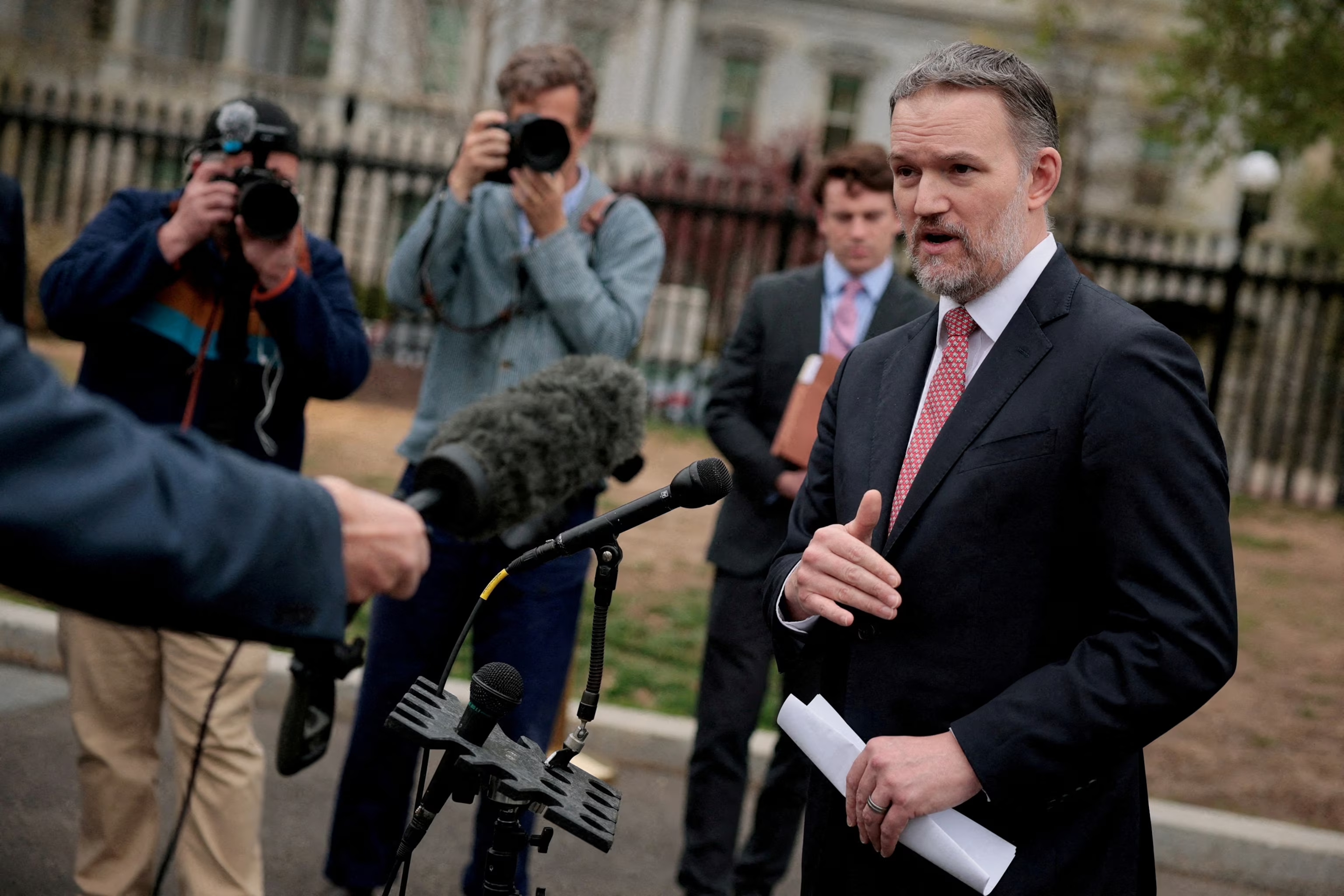
Trade Representative Jamieson Greer addresses reporters at the White House on April 2, 2026. Evan Vucci/Reuters, FILE
What would the proposal mean for overall tariff rates?
The proposal would increase overall duty rates, although they would remain below the levels reached before the Supreme Court’s decision against Trump in February, Jason Miller, a professor of supply-chain management at Michigan State University, informed ABC News.
As of last week, the administration had processed approximately $20 billion in reimbursements for those tariffs, according to a court document.
Trading partners impacted by the potential round of tariffs represent about 99% of all U.S. imports; however, a series of exceptions would significantly mitigate the measure’s effect, according to an investment bank, Macquarie, in a report shared with ABC News on Thursday.
The suggested tariffs, for example, would exempt imports covered by the United States-Mexico-Canada Agreement, or USMCA, a free trade pact with Mexico and Canada. These goods constitute roughly one-fifth of all U.S. imports.
Many agricultural, apparel, and energy products would also be exempt, Macquarie noted.
Before the Supreme Court’s ruling, the U.S. had an average tariff rate of 14.5%, which has since decreased to 8.2%, according to the Tax Foundation.
“The Trump administration is increasing tariffs from their current level, but we are not reverting to what we had previously,” Miller stated. “Consumers will be in a better position than they were under the prior tariffs.”
What is the next step for the proposed tariffs?
A public hearing for the proposed tariffs is scheduled for July 7, suggesting that the duties would likely come into effect in the weeks following, according to Macquarie.
Following the Supreme Court’s decision earlier this year, Trump moved swiftly to implement a new set of tariffs under Section 122 of the Trade Act. This provision allows him to impose duties of up to 15% on all imports for a period of 150 days.
These duties, which were initially struck down by a federal court but allowed to remain in effect for most importers pending appeal, are slated to expire next month.
The duties proposed by the Trump administration this week may also face legal opposition, according to some analysts.
Alan Wolff, a former deputy director-general of the World Trade Organization, expressed in a blog post his expectation that the proposed tariffs will not withstand legal scrutiny. Wolff argued that under Section 301, Congress intended to grant the president the authority to address one country at a time, rather than impose a broad tariff.
“There is no indication that Congress meant for ‘one or more, or multiple foreign countries’ to be addressed simultaneously,” Wolff commented.
However, economists at Macquarie highlighted the court’s history of upholding previous tariffs enacted under Section 301.
“This suggests a higher likelihood that these tariffs would survive legal challenges if implemented,” the Macquarie report stated. “Nevertheless, it remains possible that courts could limit their application or demand more substantial justification than has been provided by the USTR to date.”
Sourse: abcnews.go.com