
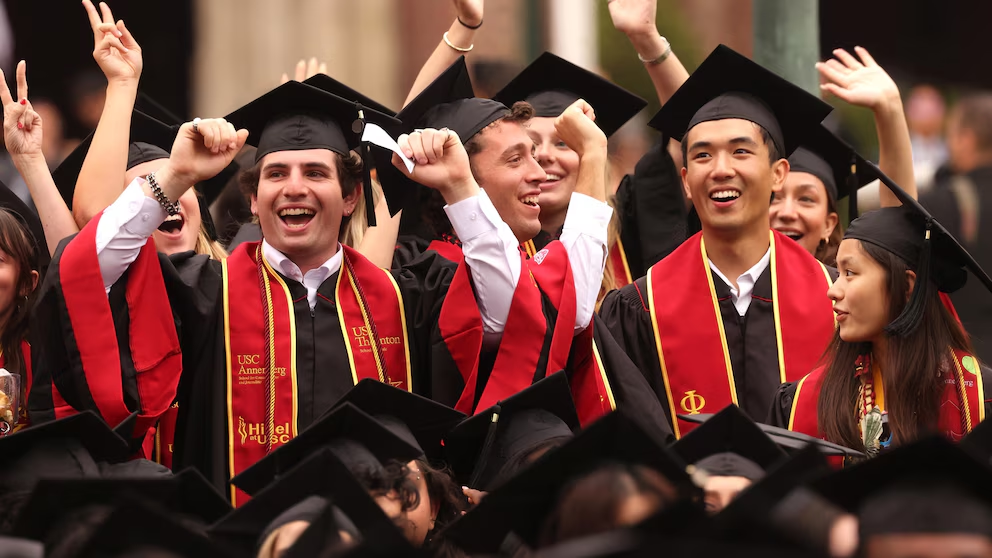
Graduates celebrate after receiving their diplomas during the USC Annenberg commencement ceremony in Los Angeles, May 15, 2026. Genaro Molina/Los Angeles Times via Getty Images
Millions of emerging adults may be confronted with a stark reality this summer as they transition from the college graduation stage into the employment sector.
Data from the New York Federal Reserve indicates the unemployment rate for recent college graduates stands at 5.6%, considerably exceeding the overall unemployment rate of 4.2%. Just four years prior, unemployment rates for these two groups were nearly identical.
The New York Fed characterized the employment situation for college grads at the start of this year as "challenging."
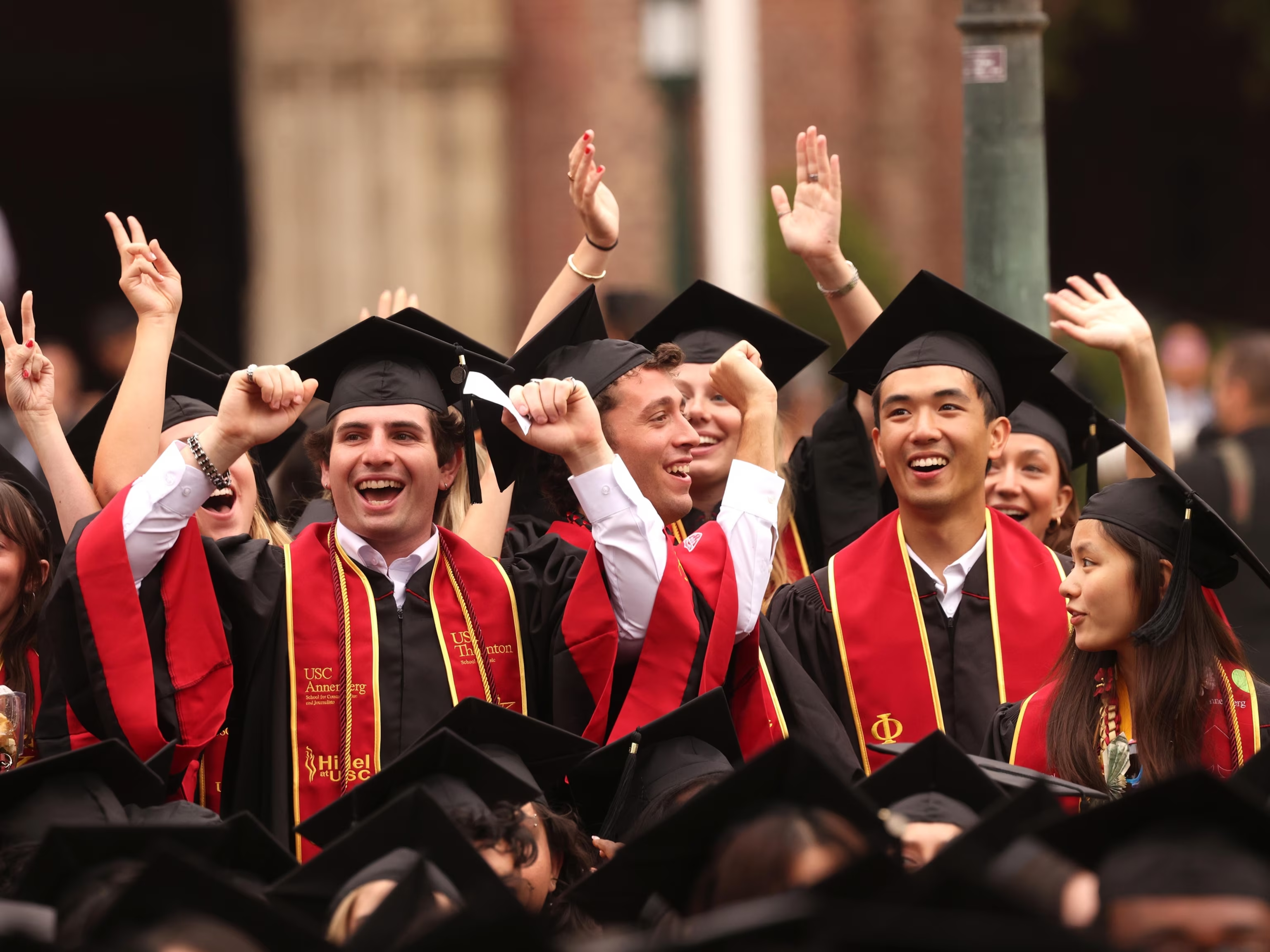
Graduates celebrate after receiving their diplomas during the USC Annenberg commencement ceremony in Los Angeles, May 15, 2026.Genaro Molina/Los Angeles Times via Getty Images
These somber forecasts emerge as certain tech industry leaders caution that artificial intelligence could devastate entry-level positions, frequently filled by new graduates. Anthropic CEO Dario Amodei, whose company manages an AI model named Claude, suggested last year that the technology could halve U.S. beginner jobs by 2030.
In principle, AI could revolutionize lower-level work as newly graduated college students enter the workforce, eliminating numerous positions at the lower rungs of the white-collar career path, or at the very least, transforming them.
However, for the moment, analysts are at odds regarding the degree to which AI is responsible for the lackluster job market faced by recent degree recipients.
Economists who attribute blame to AI highlighted comparatively slower job increases for recent graduates in sectors considered susceptible to the technology. They added that uncertainty alone may be sufficient to discourage hiring, as some companies await potential repercussions from AI.
Conversely, skeptics emphasized a labor market characterized by "low hire, low fire," with limited new opportunities for anyone, particularly recent graduates who may require more training than their seasoned counterparts.
"There's absolutely no doubt that new hiring has slowed down dramatically," stated Harry Holzer, a professor of public policy at Georgetown University and previously the chief economist at the U.S. Department of Labor. "The question is whether AI is making that even worse."
Last year, researchers at Stanford University published a widely circulated study that corroborated concerns about an AI-driven slowdown in hiring for young workers, at least within specific sectors.
The study indicated that early-career employees, aged 22 to 25, in occupations with high AI disruption exposure — such as customer service and software development — saw a 16% decrease in employment compared to experienced employees in recent times. On the other hand, the study indicated that employment for young workers remained consistent with that of their older counterparts in fields less prone to AI.
The comparatively unfavorable outcomes for young employees in AI-vulnerable roles seemed to begin following the release of OpenAI's ChatGPT in late 2022, the Stanford researchers discovered, implying that the adoption of the popular chatbot may have negatively affected the job prospects of some applicants.
These findings are in line with a perspective held by Laura Ullrich, director of economic research at the job search platform Indeed, who informed ABC News that the impact of AI has varied across different sectors.
She noted that a nursing degree might result in a prompt job offer in the rapidly expanding and relatively AI-resistant healthcare sector. But, according to Ullrich, a computer programming degree could put a job seeker at risk of a drawn-out job hunt.
"The job market is not awful for all graduates — it really hinges on what you studied," she said.
However, certain analysts express reservations about whether AI has significantly excluded recent graduates from employment. They drew attention to a widespread shortage of hiring across the economy, placing young employees in a precarious situation as they vie for positions with more experienced candidates.
Photo illustration of AI artificial intelligence technology .Adobe Stock
U.S. Bureau of Labor Statistics data revealed that the hiring rate as of March, the most recent month recorded, stands at 3.5%. Four years prior, that figure was at a more substantial level of 4.4%.
The current group of graduates would not be the first to encounter a challenging job market impacted partly by economic duress. Many young employees struggled to secure jobs after the 2008 financial crisis, and a similar predicament confronted graduates entering the workforce immediately following the COVID-19 pandemic.
"We're observing a slowdown in new hiring — and new hiring is crucial for young people," Holzer stated. "We observed it during the Great Recession. We observed it during the pandemic."
Jed Kolko, a senior fellow at the Peterson Institute for International Economics, challenged the conclusions of the Stanford University study and similar ones that link AI to employment problems.
In a report for the left-leaning Brookings Institution in March, Kolko stated that various studies had established inconsistent definitions of occupations considered vulnerable to AI disruption. Moreover, he asserted that the studies provided limited predictive power, given that jobs considered at-risk would change as the technology advances.
Kolko added, "None of this research is — nor could be — the final say," labeling it "collectively inconclusive."
For their part, the co-authors of the Stanford study published a follow-up report in February emphasizing the employment effects of economic forces such as interest rates, while upholding their finding of AI-related effects in certain susceptible fields. The researchers broadened their perspective on the onset of considerable AI-specific effects from as early as 2022 to 2024.
"Even if employment outcomes diverge notably only following the launch of ChatGPT, this could stem from other changes that happened concurrently," the report stated.
To be sure, numerous college graduates are securing employment, defying pessimistic views on the job market, Ullrich stated. Still, she added that as AI remains a focal point for numerous companies, the consequences for young employees will continue to be closely examined.
"We don't know what the future holds," Ullrich said.
Sourse: abcnews.go.com