
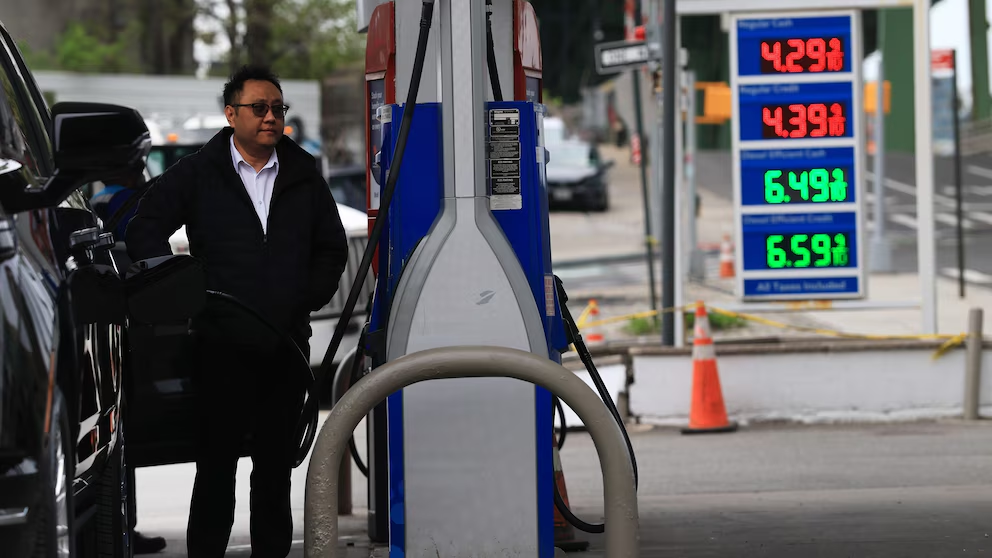
Fuel costs are advertised at a Brooklyn filling station on April 28, 2026, in New York City. Spencer Platt/Getty Images
With the nationwide cost of petrol surging, President Trump communicated to journalists Monday that he would like to put a stop to the national petrol tax for a limited time.
However, he’d first need approval from the legislative branch.
The petrol tax, which has existed for almost a century, supports the vital Highway Trust Fund and has never been successfully halted, despite prior suggestions.
Suspending the tax would likely deplete the fund by billions across some months, creating a further political risk for Republicans as the midterms approach, according to projections.
Today, several Republican representatives hurried to present new actions in both legislative houses. It remains uncertain which, if any, of these emerging measures has Trump’s backing.
What precisely are these proposals?
Representative Jeff Van Drew, R-N.J., presented legislation aiming to suspend the federal petrol tax for 18 months — removing the existing federal fuel taxes, specifically 18.3 cents per gallon on petrol, 24.3 cents per gallon on diesel fuel and kerosene, and 19.3 cents per gallon on aviation petrol. Van Drew’s plan does not halt the Leaking Underground Storage Tank fee of 0.1 cents per gallon on both fuels, but after 18 months, the petrol taxes would gradually come back over time, rather than fully returning all at once.
Senator Josh Hawley, R-Missouri, conveyed via X on Monday that he is introducing legislation to suspend the petrol tax and underground storage tank fee. Hawley, previously having supported making the petrol tax holiday permanent, is now advocating for a 90-day suspension of the petrol tax, paired with the option for the president to extend that authorization for another 90 days if he judges that economic circumstances warrant such an extension.
Additionally, Representative Anna Paulina Luna communicated: “This week, in response to Trump’s recent statements, I will introduce a bill in the House to suspend the federal petrol tax.”
Since the commencement of Operation Epic Fury, elements among the Democrats have shown hints of bipartisan agreement in the discussion, pushing to suspend the petrol tax during the last 10 weeks.
Senators Mark Kelly, Richard Blumenthal, and Representative Chris Pappas have developed legislation that would provisionally halt the federal petrol tax through Oct. 1, 2026, ending roughly one month before the midterms. The group of Democrats introduced this bill on March 9.
And Representative Brendan Boyle proposed a bill to put the federal petrol tax on hold whenever the national average price of petrol exceeds $4 per gallon. Boyle stated that the legislation would compensate for lost revenue by taking about $30 billion in existing federal subsidies currently allocated to oil and gas companies and re-routing it into the Highway Trust Fund. Boyle introduced his bill on April 14, 2026.
Could a gas tax holiday be adopted by Congress?
Removing the federal petrol tax — currently 18.4 cents per gallon for standard petrol and 24.4 cents per gallon for diesel — would mandate congressional approval – and almost certainly bipartisan agreement.
In response to inquiries about this suggestion, Senate Majority Leader John Thune, who previously dismissed a suspension under the Biden administration, promptly lessened expectations regarding a petrol tax holiday.
“I’ve not, historically, been in support of such an idea. However, there are colleagues out there who may view it favorably; we’ll listen to their arguments,” Thune, R-South Dakota, initially conveyed to reporters off-camera Monday afternoon at the Capitol.
Still, he later voiced openness to President Trump’s call for a suspension, citing tough conditions in the Middle East.
“In my judgment, the optimal route to restoring stability to petrol prices is to reopen the Strait,” Thune noted.
“Nonetheless, the broad subject of the petrol tax is something that many of our members have discussed before.
“If the President is inclined to offer a rationale in support of it, I’m sure everyone will grant him an opportunity and listen to his presentation,” Thune further commented.
Senate Minority Leader Chuck Schumer notably didn’t reject the concept outright; however, he contended that the most effective approach to decreasing prices would involve resolving the conflict in Iran.
“The American public needs more than just a few cents back,” he stated. “They deserve the cessation of the unrest that has instigated these soaring petrol prices.”
Representatives for Speaker Mike Johnson and House Minority Leader Hakeem Jeffries were not immediately able to respond to a request for comment on Trump’s desire to suspend the federal petrol tax.
The High-Stakes Politics of Rising Petrol Costs
Oil and petrol values have skyrocketed across the globe throughout the months-long battle, as the critically important Strait of Hormuz remains practically closed, preventing the passage of 20 million barrels of oil each day.
As of Monday, the nationwide average for a gallon of unleaded petrol in the U.S. stood at $4.52, according to data from AAA, an increase of over $1.50 since the war’s start on Feb. 28.
While lawmakers worry that heightened pain at the pump could cause a discontented, angered populace this fall, Trump’s endorsement for suspending the federal petrol tax puts the onus on Congress to act.
However, initiating a petrol tax holiday is also like openly admitting that Operation Epic Fury has resulted in amplified international and domestic petrol costs—a reality neither congressional Republicans nor the administration is enthusiastic to embrace with this fall’s congressional midterm elections approaching.
This discussion is already being felt on the campaign front – notably in the Texas Senate race, where Democratic nominee James Talarico attacked Senator John Cornyn, who is in a tough primary runoff, fighting for his political standing.
“Reducing prices at the pump should be a collaborative aim for both parties,” Talarico expressed. “I strongly encourage Senator Cornyn to withdraw his resistance to suspending the petrol tax. He should follow President Trump’s and my lead in supporting this crucial tax relief for Texans.”
Congress holds the power of financial decisions, specifically including control over the national petrol tax, initially created by the National Revenue Act of 1932 during the Great Depression.
There isn’t yet a single proposal that Republicans are collectively supporting. The timeline for Congressional action could exceed the president’s war in Iran, so it is unknown whether leadership perceives sufficient urgency to resolve the pain at the pump.
President Joe Biden suggested a national petrol tax holiday in 2022, when Russia’s conflict with Ukraine spurred a surge in costs, but he met opposition even from his own party. At the time, Democrats questioned whether it benefited the petrol companies more than the consumer.
What About the Monetary Impact?
There is also the matter of whether Congress can manage the loss of billions of dollars in tax revenue.
The federal petrol tax supports the Highway Trust Fund, which the Congressional Budget Office anticipates could exhaust its funds by 2028 given present spending rates. The Bipartisan Policy Center estimates that putting the petrol tax on hold for five months would reduce the fund by $17 billion.
Even though analogous ideas have surfaced before amid moments of higher costs at the pump, Congress has never been able to put the national petrol tax on pause.
The last instance of the petrol tax being raised was in 1993, as former President Bill Clinton approved a reconciliation bill into law.
Sourse: abcnews.go.com