
Share
Since the start of its full-scale invasion of Ukraine, Russia has upgraded its Kh-101 strategic air-launched cruise missile at least four times, the Ukrainian Ministry of Defense reports.
Main theses:
- Russia improved the Kh-101 missiles during the invasion of Ukraine to make them more effective against Ukrainian air defenses.
- The modernization consisted of increasing the destructive power, adding cluster charges, and installing a more accurate navigation system.
Russia has modernized the Kh-101 missile to bypass Ukrainian air defenses
As the ministry noted, the purpose of these changes was “an attempt to compensate for the growing effectiveness of Ukraine's air defense and an attempt to intensify terror against peaceful Ukrainians.”
Ukrainian Defense Minister Mykhailo Fedorov stated that protecting civilians and infrastructure is the state's top priority, and the military's goal is to identify 100% of air threats in real time and intercept at least 95% of missiles and drones.
Share
Since the beginning of 2026, Ukrainian air defense has shot down about 88% of Russian Kh-101, Kh-55, and Kh-555 missiles.
The Ministry of Defense noted that military engineers and scientists systematically study missiles after their use in real combat conditions in order to effectively counter Russian air attacks. In particular, experts found out how Russia “methodically transformed the Kh-101 missiles through modernization into a means of targeted terror of peaceful cities.”
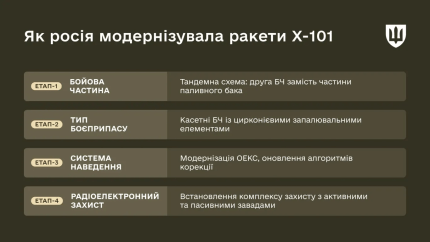
Modernization of the Russian X-101
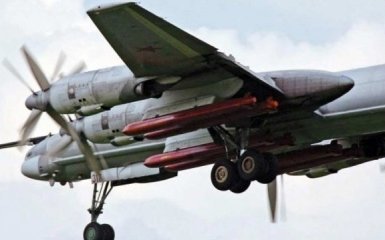
The Kh-101 is launched from Tu-95MS and Tu-160 strategic bombers. Launches are carried out mainly over the Caspian Sea. The missile's flight time from the launch point to the target in Ukraine is about 12 hours.
In the basic version, the X-101 had:
-
a monoblock high-explosive fragmentation warhead weighing about 480 kg;
-
flight range of 2,500 km — with a large margin exceeding the distance to any point in Ukraine;
-
inertial navigation system based on a laser gyroscope;
-
correction by satellite navigation on the route;
-
an optical-electronic extreme correlation system (OEKS) for aiming at the final stage of the flight.
It was the excess range that became the starting point for a series of modernizations that Russia carried out starting around 2022–2023.
The first modernization — increasing the warhead
After a significant number of Kh-101s began to be shot down, the Russians decided to reduce the flight range and instead increase the destructive power.
For this purpose, part of the fuel tank was allocated for the second warhead. The missile received a tandem scheme – two warheads of different types with a total mass of about 800 kg.
The second modernization – cluster charges
In parallel with the tandem scheme, the X-101 gained the ability to carry cluster warheads — bullet-shaped submunitions that disperse over the target area.
According to the military, the Russians have added steel balls to the cluster munitions, some with a zirconium belt. Zirconium is a metal with a self-ignition temperature in air of about 230…390°C, which ignites when dispersed by friction with air and, when deposited on combustible materials, provokes sustained combustion.
In addition, the high-explosive fragmentation warheads of the Kh-101 use a new generation plastisol explosive as an explosive (it is approximately 30–40% more powerful than hexogen) and they have additional capsules with titanium hydride, which also has a strong pyrophoric effect. That is why after Kh-101 hits, especially with cluster submunitions, fires are recorded at the impact sites.
Third modernization – more precise guidance
The X-101 uses a combined navigation system:
-
inertial system based on a laser gyroscope — the main one on the entire route, practically impervious to electronic warfare (EW) means;
-
satellite navigation system — corrects the accumulated error of the inertial system;
-
optical-electronic extreme correlation system (OEKS) — performs “aiming” in the final section (~20 km to the target).
The fourth modernization is protection against interception
According to the Ministry of Defense, the SP-504 airborne electronic defense (ED) complex was installed on the Kh-101 around 2024–2025.
It has two subsystems:
-
active system – records the radiation of ground-based radars and airborne radars of air interceptors. In response, it generates simulated interference, forcing the radars to “see” false targets, and anti-aircraft missiles to deviate from false signatures;
-
Passive system – fires thermal and dipole traps (false targets for thermal and radar-guided missiles). It is triggered automatically when the system detects the missile's radiation from the radar or homing head.
The Ministry of Defense noted that in parallel with the modernization of the missile, Russia faced the problem of wear and tear of the Tu-95MS and Tu-160 strategic bombers.
Due to the scale of use and the long distance of the routes (for example, for one flight from the Ukrainka airfield to the Caspian Sea, the Tu-160 spends 6–8% of the engine's service life), the carriers quickly exhaust their resource. The Tu-95MS now carries two missiles instead of six, the number of combat-ready carriers is decreasing, and the potential of Russia's nuclear triad is objectively decreasing – after all, these same aircraft are carriers of strategic nuclear weapons.
Share