
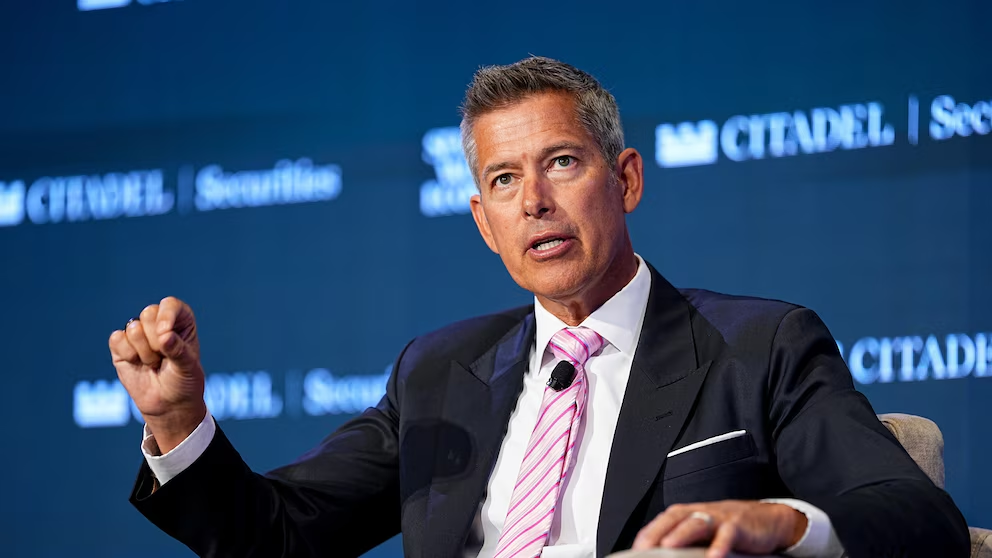
Sean Duffy, the U.S. Secretary of Transportation, addresses the Semafor Global Economy Summit amid the International Monetary Fund (IMF) and World Bank springtime assemblies in Washington, D.C., April 17, 2026.Aaron Schwartz/Bloomberg via Getty Images, FILE
A fast transcript of "This Week with George Stephanopoulos" broadcasting on ABC News this Sunday, May 3, 2026, is provided below. Note that this text is preliminary, might be revised, and could include slight transcriptional inaccuracies. Prior show transcripts are available in the "This Week" transcript collection.
MARTHA RADDATZ, ABC “THIS WEEK” CO-HOST: Fuel costs surge as President Trump assesses his upcoming actions regarding Iran, with only a half-year until voters go to the voting booths.
“This Week” commences immediately.
(BEGIN VIDEOTAPE)
RADDATZ (voice-over): A pair of months of warfare.
DONALD TRUMP, PRESIDENT OF THE UNITED STATES: They aspire to strike an accord, but I am not content with it.
RADDATZ: With the United States and Iran in a deadlock, the financial distress escalates.
UNIDENTIFIED MALE: To be compelled to decide between fuel and nourishment presents a formidable predicament.
RADDATZ: As Trump's job performance draws heightened critique from Americans, we unveil the outcomes of our fresh survey this morning.
Moreover, Transportation Secretary Sean Duffy will elaborate on the escalating implications of the conflict, along with the operational halt of Spirit Airlines.
Impassioned deposition.
PETE HEGSETH, SECRETARY OF DEFENSE: We stand two months into what history will recall as a triumphant military maneuver in Iran, and yet you portray it as a failing?
RADDATZ: Representatives scrutinize the administration regarding the ensuing steps following 60 days of conflict.
I shall confer with the leading Senate Armed Services Democrat, Jack Reed.
Landmark judgment.
SEN. RAPHAEL WARNOCK, (D) GEORGIA: This constitutes a significant setback for the cause of racial equity and the well-being of our democracy.
RADDATZ: The Supreme Court delivers a setback to the Voting Rights Act. We host a panel discussion concerning states’ attempts to redraw electoral maps leading up to the midterms.
Additionally, a notable new ruling restricting the means to acquire an abortion drug.
(END VIDEOTAPE)
(MUSIC)
ANNOUNCER: Broadcasting from ABC News, it's “This Week”. Here is Martha Raddatz.
RADDATZ (on camera): Greetings, and welcome to “This Week”.
Today marks a half-year until the midterm elections in November, and we are now in the 10th week of the Iran conflict, which is twice the period initially projected by the president.
Moreover, this morning, both the economic and political repercussions stemming from the conflict are becoming more intense. Our latest ABC News/Washington Post/Ipsos survey reveals rising apprehension among Americans about President Trump's work execution and his handling of critical challenges.
The majority of Americans are critical of Trump's management across all measured areas – encompassing the cost of living, inflation, the Iranian war, and the broader economic situation. The president's job approval figures are at 37 percent, nearing the lowest points of his initial tenure, with disapproval at a record high of 62 percent.
Democrats do not show significantly better outcomes concerning essential matters, although they don’t entirely dominate the midterms thus far; our survey suggests that independents largely lean towards Democratic candidates for the House, signifying a possible cautionary sign for Republicans.
In a short while, we will delve into the Iran conflict’s repercussions on petroleum and fuel costs alongside Transportation Secretary Sean Duffy, as well as receive his insights regarding the federal reaction to the budget airline Spirit Airlines’ shutdown over this weekend.
Nonetheless, we initiate with ABC's Elizabeth Schulze, who will analyze the intensifying financial impacts of the conflict.
(BEGIN VIDEOTAPE)
ELIZABETH SCHULZE, ABC NEWS CORRESPONDENT (voice-over): Today, fuel costs are escalating, almost reaching four-year highs as Americans confront the domestic ramifications of President Trump's military actions in the Middle East.
STEVEN DRUMMER, DRIVER: I must work and drive, but the situation lacks endurance.
SCHULZE (voice-over): The median fuel cost stands at $4.45 per gallon, an escalation of 40 cents in one week, and $1.51 since the conflict’s commencement. The expense to replenish a medium-sized SUV is now $27 steeper than prior to the conflict.
Wondie Tiruneh, a taxi driver in D.C., attempts to replenish his fuel tank when essential and seeks out cost-effective options.
WONDIE TIRUNEH, TAX DRIVER: If I locate a cheaper alternative when transporting my passenger, I will refuel at that point.
SCHULZE (voice-over): Costs are even loftier on the West Coast, notably in California, where averages surpass $6 a gallon.
UNIDENTIFIED FEMALE: The present price we’re paying is fairly astonishing.
SCHULZE (voice-over): Across the Midwest, Indiana, Michigan, and Ohio observed cost increases of approximately one dollar within the span of a week.
PATRICK DE HAAN, GASBUDDY HEAD OF PETROLEUM ANALYSIS: This could not have occurred at a worse moment for consumers getting ready for the summer vacation timeframe.
SCHULZE (voice-over): President Trump asserts that petroleum and fuel costs will subside when the conflict concludes.
TRUMP: I expected oil would be notably steeper than its current level. I wouldn’t label it low, but certainly not inexpensive. Its cost will dramatically decline upon the cessation of this conflict.
SCHULZE (voice-over): However, our recent ABC News/Washington Post/Ipsos poll shows that 50% of Americans anticipate that fuel costs will surge over the ensuing year, whereas only 21% expect declines, and 15% foresee costs remaining at the same elevated figures.
Moody's Analytics projects that if oil costs remain persistent for a year, the common household will expend an incremental $1,300 on petroleum and diesel. At present, 40% of Americans assess their monetary condition as diminished compared to when Trump assumed office, while just 17% claim enhancements.
Americans now confront trade-off scenarios, with 44% stating that they’ve curtailed their driving habits in response to mounting fuel costs, and 42% indicating reductions in other household expenses.
UNIDENTIFIED MALE: I lessened grocery shopping marginally because fuel is a bigger concern currently. Previously, I was unconcerned.
SCHULZE (voice-over): The conflict’s impacts spread extensively beyond just gasoline. Jet fuel charges have roughly multiplied, contributing to the final blow that caused the hard-pressed budget airline Spirit Airlines to cease operations this past Saturday.
Additionally, diesel fuel, essential to American commerce for sustaining trucks, tractors, and trains, is nearing record-breaking costs.
SCHULZE: Oil costs may also influence food costs.
STEVE SALIS, RESTAURANT OWNER: Undoubtedly.
SCHULZE (voice-over): Threatening to raise grocery and restaurant costs, such as at Ted’s Bulletin in Arlington, Virginia, where proprietor Steve Salis notes the sharp surge in delivery expenses.
SALIS: The amounts sum up to tens of thousands of dollars at this juncture. Well —
SCHULZE: Tens of thousands in incremental costs —
SALIS: Definitely, yes.
SCHULZE: — over the past eight to nine weeks.
SALIS: That is correct.
(END VIDEOTAPE)
SCHULZE (on camera): And, Martha, oil experts predict that if the strait were to resume operations tomorrow, the reinstatement of previous supply levels would span months, with a potential recovery of fuel costs to pre-conflict ranges in more than a year. – Martha.
RADDATZ: We extend our appreciation to Elizabeth.
Therefore, we shall directly engage with our specialists regarding the conflict’s financial consequences: Karen Young from the Columbia University Center on Global Energy, and also a Senior Fellow at the Middle East Institute, and Diane Swonk, the Chief Economist and a Managing Director at the accounting firm KPMG.
Karen, let's begin with you immediately.
President Trump had anticipated several weeks earlier that fuel costs, which he assessed weren’t high at $4 a gallon, would subside. This occurrence has not materialized; instead, the prices average $4.45 this morning.
What explains this week’s surge?
KAREN YOUNG, GULF REGION POLITICAL ECONOMIST & COLUMBIA UNIVERSITY RESEARCH SCHOLAR: They are quite possibly scheduled for ongoing augmentation, correct? The escalation is likely linked to the reality of these existing nine weeks of crisis. Existing inventories are dwindling; stocks previously oriented toward the market have fully supplied. Current withdrawals dip into existing reserves.
This reveals an awareness of impending limitations, specifically regarding refined products. Southeast Asia experienced the initial repercussions of this disruption; the United States is also suffering similar effects now. With respect to proportional rate hikes, gasoline has witnessed a 37 percent rise in Southeast Asia and approximately 42 percent in the United States.
We endure analogous or even heightened implications relative to the most heavily affected countries in the East, which initially encountered the shortages.
RADDATZ: Without question, we are enduring the effects.
Diane, President Trump also declared that fuel costs will plunge rapidly once the conflict with Iran concludes. There is no indication that such a scenario will happen imminently.
Transportation Secretary Sean Duffy, our impending guest, forecasted a swift resurgence in energy charges following the conflict’s end a few weeks earlier.
Do you concur?
DIANE SWONK, KMPG CHIEF ECONOMIST: Conventional dynamics reveal that as oil rates and fuel charges increase, these increases tend to spike rapidly and drop quite slowly. Addressing this component is a must.
What remains critical is recognizing that this scenario is more than a mere oil surge; it poses a supply chain shock. The disruptions that ripple across global supply chains replicate those experienced during the pandemic, although buffers are not in place currently. Many of these compounding outcomes will progressively surge and intensify inflation as the year unfolds.
The principal challenges confronting consumers extend beyond mobility. Transportation usage also declines under loftier fuel costs currently. This dilemma expands into the realm of food prices, particularly for farmers who predominantly rely on diesel, not to mention fertilizers and chemical components in comestibles, as well as escalating transportation rates.
These factors present hardship for consumers and constitute prominent prices related to foundational considerations: nourishment, commute, and lodging. These aspects matter fundamentally to average households.
RADDATZ: Do you, Diane, project the potential for even more heightened costs, surpassing the record thresholds of $5.03 per gallon, considering solely fuel prices?
SWONK: From our vantage point today, I concur with Karen's assertions; costs will likely escalate, potentially breaking the existing records.
As aforementioned, resources lack the traditional buffers. Previous economic stimuli bolstered spending in the initial fiscal quarter, leading to robust progress during the first quarter at 2 percent.
Note that economic enhancements remain consolidated to affluent households and a limited array of organizations relative to preceding years; this pattern has continued from 2025 and into current times, despite expanded tax refunds.
Escalated anxiety will emerge broadly during the calendar year, posing noteworthy concerns for U.S. consumers.
RADDATZ: Karen, if the strait were accessible currently –
KAREN YOUNG, GULF REGION POLITICAL ECONOMIST & COLUMBIA UNIVERSITY RESEARCH SCHOLAR: Affirmative.
RADDATZ: – or in the near future, how long would recovery take, and what transformations can we anticipate? What implications do the Strait's mines present?
YOUNG: There is no facile solution to this predicament.
The primary hurdle lies in securing agreements from ship owners and insurers to navigate the Strait to load cargo. Stock replenishment is essential, as we have witnessed operational disruptions in Iraq, Kuwait, and presently Iran. After the completion of loading, operations to restart wells and refineries can commence.
This process could potentially span three to four months, as Kuwaiti petroleum executives reported.
Subsequently, amplifying the throughput of traffic must ensue. The projected 120 vessels of normal volume prior to February 28 will take time to reach from day one.
Finally, if mines remain in the water and active hostilities persist, the potential for Iranian leverage to threaten shipping to neighboring regions compromises any return to typical trade flows.
RADDATZ: I deeply appreciate the insights offered by both of you this morning.
YOUNG: My pleasure.
RADDATZ: My next guest is Transportation Secretary Sean Duffy.
Welcome, Secretary Duffy.
Our specialists emphasized that fuel prices might reach record-breaking numbers, and even should the Strait open today, recuperation might take months, along with declines in cost. What reactions do you have?
TRANSPORTATION SECRETARY SEAN DUFFY: We should keep in mind several elements. Regarding presidential views on energy expenses, he consistently references them during meetings held within the Oval Office, particularly ever since his commencement of a second term in Washington.
His concerns extend to American energy authority, guaranteeing domestic energy proliferation and cost optimization. He recognizes the potential nuclearization of Iran, a threat he comprehends.
Iran has served as the primary source of worldwide instability for 40 years. He assesses that stance as untenable, an evaluation I mirror; a nuclearized Iran is unacceptable. President Trump is boldly acting on his beliefs.
Ultimately, he will work to assure security across America and globally for the span succeeding the conflict, extending across years and even decades subsequent to his presidential tenure.
RADDATZ: It seems that the critical priority for President Trump rests in this sphere. However, with respect to cost, do you align with estimates that recovery could take months, even with an opening, and prices may breach record limits?
DUFFY: Given my role with DOT, my knowledge doesn’t extend to the energy markets; however, based on provided briefings, rate decreases should surface promptly with an open Strait.
Still, there will be a duration for return. Regaining pre-conflict conditions may require time, but immediate relief is anticipated when the Strait opens.
RADDATZ: Immediate alleviation.
On Friday, President Trump stated he is committed to brokering a deal with Iran. Relating to your references toward Iran, along with my understanding of your role at DOT, this challenge signifies as notably significant. Do you have details on available proposals from the Iranians, or their current status?
Furthermore, what does President Trump's statement imply about them needing to meet the appropriate price point?
DUFFY: Throughout his career, the president has flourished as a property builder and a president. This is why the particulars of present conversations will remain private. The President may or may not want to release this and potentially undermine future goals.
Let’s witness and evaluate what unfolds as the president sets sights on securing equitable results, both in terms of American interests and general worldwide welfare, pertaining to Iranian affairs. Granting the prospect of Iranian ownership of nuclear weaponry is simply untenable; Iran must yield control across its straits.
RADDATZ: I –
DUFFY: The president’s negotiations are still in session. In the long run, America stands to reap rewards.
RADDATZ: Back during early periods of the situation, President Trump aimed for resolution within roughly 4-6 weeks. To understand, let’s examine Energy Secretary Chris Wright’s comments addressing how long Americans need to brace for elevated prices.
(BEGIN VIDEO CLIP)
CHRIS WRIGHT, ENERGY SECRETARY: This conflict is definitely set to subside in weeks, possibly shorter. Following this conclusion, look for a supply rebound and price decline.
(END VIDEO CLIP)
RADDATZ: This was over seven weeks ago. Similar sentiments were mentioned by you soon after. Why do you consider the projections not being realized?
DUFFY: As cited by Secretary Hegseth and General Razin Caine, the conflict orchestration achieved broad military success. The successful military actions resulted under President Trump’s conduct. Currently, we aim to guarantee safety across the Strait of Hormuz, in addition to addressing Iran’s nuclear resources, factors that are extending the overall process for another number of weeks.
Nonetheless, to echo Chris Wright, the promise of prompt relief remains once straits open, supply volumes rise again, and substantial developments occur.
I believe it vital for Americans to comprehend that American resources exist on a broad scale. Although the globalized nature of oil and fuel affects prices, domestic production in the U.S. assures ample supply, bringing considerable benefits.
When examining rates of jet fuel, including fuel supplies for transport to the public, deep and constant inventory stays in place. This is vital to acknowledge because President Trump concentrated heavily on American energy and power in the markets.
RADDATZ: Even while you portray this with much optimism, most American are bleak about financial conditions. According to new surveys, driving and home spending declined in 44% and 42% of Americans, respectively, along with 34% changing vacation strategies. Increasing fuel rates can make drastic changes.
What information can you convey to Americans in the shadow of persistent conflicts?
DUFFY: Precisely for that very reason, the focus has come to energy costs along with American sources, President Trump has made these core priorities. Contrarily, prior administrations had been attempting to steer Americans to electric transportation over oil and gas. Because this proposition failed to take hold among citizens, President Trump advocated for dominance of American-sourced energy production.
Although price increases are undeniable, the president sought to deliver advantages to consumers through means such as substantial tax refunds. Although perhaps not captured by current reports, his objective revolved around tax relief via nontaxable tips and non-taxable social security.
(CROSSTALK)
RADDATZ: My focus remains on the present.
DUFFY: Delivering taxation relief to benefit the American public makes for a high-priority element.
RADDATZ: I am concerned about the present. What statements can you deliver to the public experiencing detriment stemming from amplified fuel rates?
DUFFY: With taxes impacting the American public through tax season, my present focus remains dedicated on developments surrounding refunds.
(CROSSTALK)
RADDATZ: In light of the circumstances, their response fails to align.
DUFFY: As you have cited, energy pricing has witnessed growth. The president acknowledges the challenges associated with Iranian threats toward weaponry and long-range threats across bases and regions occupied by allies. He cannot tolerate such cases.
Addressing a long-time problem is imperative. In this regard, this particular president has declared the end toward accepting a nuclearized Iran, advocating for a decisive stance which receives admiration within America. Personally, I share similar approval.
Lowered rates, a result of an opened Strait, enable Americans to commute with the opportunity to foster a wealth surge and create economic prospects like never before.
RADDATZ: Secretary, I aim to briefly address Spirit Airlines as well. After ceasing operations over the recent weekend, you suggested external factors were unrelated to closing Spirit Airlines after bankruptcy records last summer. Conversely, recent statements from Spirits CEO revealed the fuel charges made that alternative unavailable. Care to provide insights?
DUFFY: Initially, Spirit and JetBlue began conversations regarding a merger. That deal fell through via the decision by the Biden-Buttigieg administrations along with that of the DOJ. A bankruptcy occurred in the events after. Financial hardships existed.
Subsequent bankruptcy occurred the year after that. Wasting assets led toward eventual liquidation of the company and that has been known for some time. In the meantime, competing American airlines step in to care for Spirit Airline Passengers, while Spirits’ personnel gains expedited opportunities regarding employment for other companies.
Sourse: abcnews.go.com