
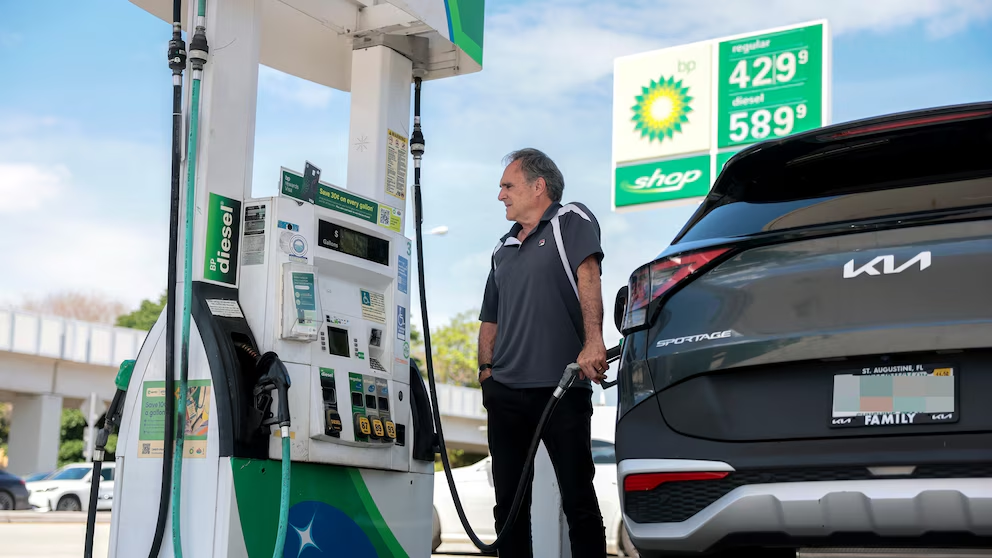
A person is fueling up their automobile at a service station on April 6, 2026, in Miami, Florida. Fuel costs in Florida have climbed to above $4 per gallon in early April 2026, as the conflict in Iran has impacted worldwide petroleum resources, causing increased unrefined petroleum costs.Joe Raedle/Getty Images
Petroleum values declined sharply on Wednesday in the hours following the announcement of a two-week truce between the U.S. and Iran, sparking hopes of respite from rapidly rising gasoline costs.
Motorists might not have a lengthy wait. Fuel costs could commence their descent within days as merchants consider decreasing petroleum values, certain experts informed ABC News, although it might require weeks or months to reverse a substantial portion of the expense escalations resulting from the Middle Eastern dispute.
The future course is still packed with ambiguity, they noted, given that sustained price reductions will hinge on the stability of the ceasefire and the restart of tanker activity via the Strait of Hormuz, a crucial route for petroleum shipments.
“Fuel values will decrease, but I anticipate we’re in for a difficult stretch,” Ramanan Krishnamoorti, a professor specializing in petroleum engineering at the University of Houston, conveyed to ABC News.
Ordinarily, numerous vessels transport one-fifth of the planet’s petroleum through the Strait of Hormuz daily, but Iran essentially shut down the passage during the war. That petroleum deficit pushed gasoline values up globally, inclusive of the U.S.
On Wednesday, fuel values within the U.S. edged up to $4.16 on average for each gallon, signifying an increase of $1.18 since the beginning of the conflict, per AAA information.
As an element of the ceasefire, Iran states it shall permit tanker passage via the Strait of Hormuz on the provision that they coordinate with the nation’s armed forces.
The restoration of tanker activity is still questionable. Tanker movement was halted on Wednesday after Israeli assaults on Lebanon, according to Iran’s semi-official Fars News Agency.

President Donald Trump addresses reporters at a press briefing situated in the James Brady Press Briefing Room at the White House, April 6, 2026, situated in Washington.Mark Schiefelbein/AP
However, should the agreement persist, investors seemingly were optimistic that it will mitigate one of the most severe worldwide petroleum deficits in decades.
Petroleum values in the U.S. plummeted 15% on Wednesday, registering at roughly $95.50 per barrel. Nevertheless, the value stayed considerably above pre-conflict amounts of approximately $67 per barrel.
“Petroleum markets have breathed a sigh of relief at the lack of additional intensification,” stated Timothy Fitzgerald, a business economics professor at the University of Tennessee who researches the petroleum sector, while speaking to ABC News.
Unprocessed petroleum constitutes the primary constituent within auto fuel, representing more than half of the expense accrued at the pump, as indicated by the U.S. Energy Information Administration at the federal level.
The recent downturn within petroleum values shall be transmitted along the supply chain, influencing users by means of reduced values, some experts commented, anticipating respite at the pump commencing this week.
“Fuel values nationally could commence reversing in roughly 48 hours, decreasing by a couple of cents on a daily basis,” Patrick De Haan, a petroleum analyst at GasBuddy, conveyed in an X post on Tuesday evening. De Haan further mentioned that the nationwide average expense for a gallon of gas might descend below $4 within one or two weeks.
De Haan, on Wednesday, restated his forecast within another post on X, appealing to drivers: “REFRAIN FROM FILLING UP!”
However, some experts suggested that a more considerable value reduction could require weeks or months.
Usually, fuel values decline at a more measured tempo relative to their increase, considering that merchants favor sustaining elevated values whilst depleting stock acquired at an elevated expense, stated Krishnamoorti.
Moreover, fuel values typically escalate during springtime, as warmer-weather tourists amplify demand and refineries transition to a more costly mixture of summertime fuel. Such seasonal dynamics could offset some of the savings stemming from reduced petroleum values.
Experts held divergent views pertaining to the velocity and magnitude of value savings. Krishnamoorti posited that the nationwide average expense for a gallon of gas might diminish to $3.60 over the approaching months, which equates to a decrease of roughly 56 cents from current levels. Fitzgerald anticipated a decrease of 50 cents commencing as early as the close of April.
“I anticipate such a decline transpiring over a period of weeks, not days,” Fitzgerald remarked.
Assuredly, some experts noted that the outlook is still uncertain as questions remain concerning the ongoing stability of the ceasefire and the reopening of the strait.
“Circumstances pertaining to the conflict in the Middle East appear to be shifting remarkably swiftly,” Steve Allen, an economist affiliated with North Carolina State University, communicated to ABC News. “There exists a great deal of ambiguity such that I still find it challenging to accept that individuals within the gasoline supply chain are confidently celebrating that positive times are upon us once more.”
Fuel values will diminish provided petroleum costs remain at decreased levels, yet a revival of the conflict might propel fuel values back toward their positions preceding the ceasefire, according to Allen.
“This conflict could worsen within a week or two,” Allen incorporated.
Even in the event that the ceasefire remains intact, certain experts anticipate that fuel values are improbable to decrease to pre-conflict amounts in the immediate future. The restoration of compromised energy infrastructure situated in the Gulf necessitates an extensive timeframe for repairs. Enduring geopolitical stresses and a potential toll arrangement within the strait could introduce supplementary expenses.
“Those purchasing gasoline within the U.S. should anticipate that gasoline expenses at the pump will be elevated moving forward relative to their levels preceding the initiation of this situation,” Fitzgerald expressed.
Sourse: abcnews.go.com