
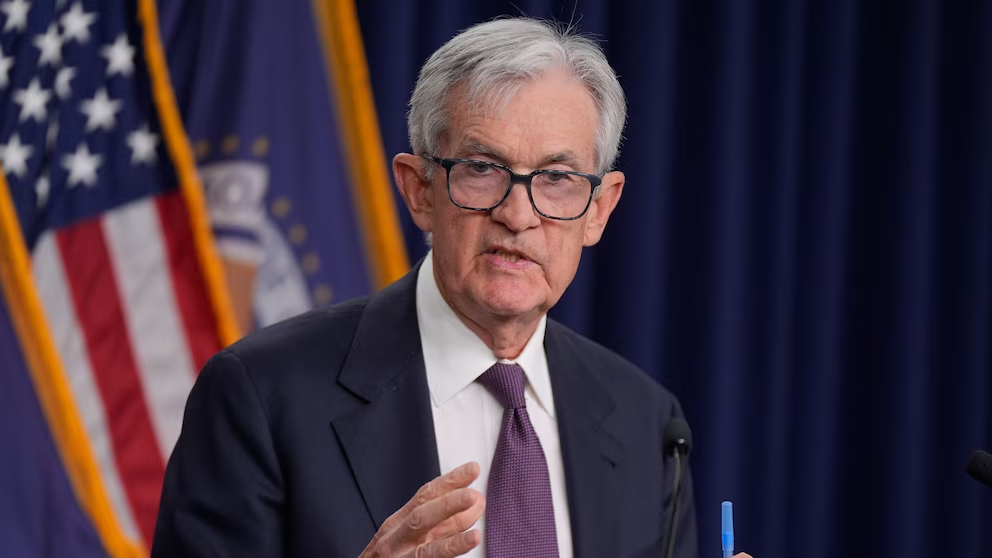
Federal Reserve Chairman Jerome Powell offers remarks during a press conference, March 18, 2026, in Washington. Manuel Balce Ceneta/AP
The U.S. Federal Reserve maintained stable interest rates on Wednesday during its initial assembly following the U.S.-Israeli conflict with Iran, which propelled increases in fuel costs and introduced the potential for wider inflationary pressures.
The central bank's action signaled the second successive instance of electing to keep borrowing rates at their present values since the beginning of 2026. Prior to this, the Fed decreased rates by a quarter percentage point on three separate occasions. The announcement on Wednesday lined up with market forecasts.
"The effects of developments occurring in the Middle East on the U.S. economy are uncertain," the Federal Open Market Committee (FOMC), a policy-shaping entity within the Fed, expressed in a statement released on Wednesday.
The rate pronouncement seemed to exacerbate a previously unfavorable trading session on Wall Street. The Dow Jones Industrial Average concluded with a drop of 768 points, equating to 1.6%, while the S&P 500 diminished by 1.3%. The technology-focused Nasdaq experienced a decline of 1.4%.
The FOMC released a projection anticipating a single quarter-point interest rate decrease throughout the remaining part of 2026 and an additional quarter-point reduction in 2027.
The 12-member group cast a vote of 11-1 favoring the maintenance of the existing interest rate level. Stephen Miran, a previous official from the Trump administration who recently joined the group, provided the only differing vote, advocating for a rate cut.
Elevated cost augmentations have occurred simultaneously with a deceleration in economic expansion, posing the risk of intensifying a financial “stagflation” condition, which creates difficulties for the Fed.
Inflation registered at 2.8% in February, as indicated by the Personal Consumption Expenditures index, which is the preferred metric of the Fed. Price escalations show a nearly one percentage point variance above the Fed’s desired rate of 2%.
"These high measures predominantly mirror inflation within the goods sector, which has received a boost through the consequences of tariffs," Federal Reserve Chair Jerome Powell communicated during a press discussion held in Washington, D.C., on Wednesday.
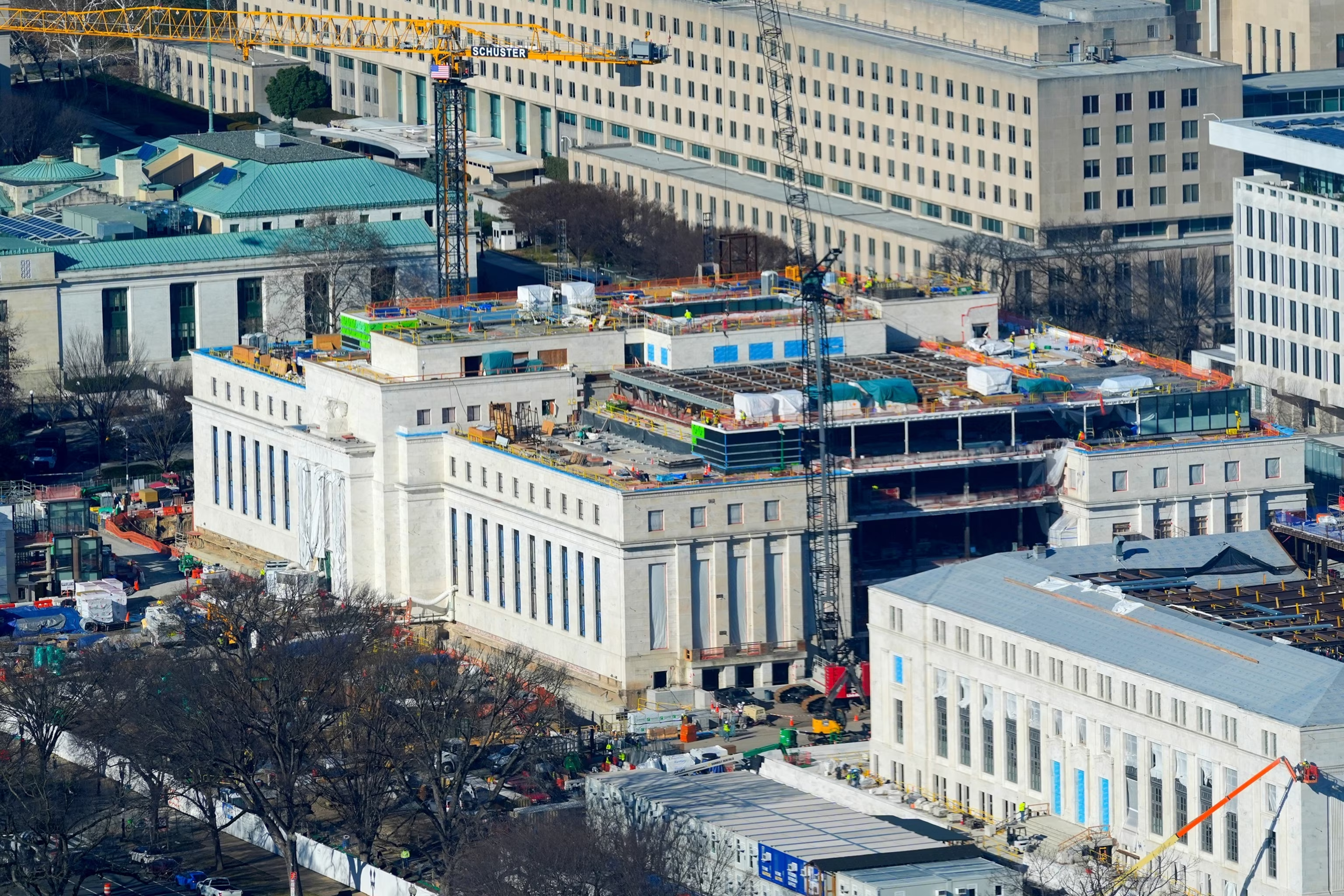
In this Jan. 13, 2026, archived photo, the Federal Reserve Board Building is depicted amidst ongoing renovations, located in Washington, D.C.Pablo Martinez Monsivais/AP, FILE
"Short-term assessments of inflation anticipations have grown in recent weeks, potentially reflecting the marked increase in petroleum values due to supply interruptions within the Middle East," Powell contributed.
Should the Fed determine to lessen borrowing expenses, it could propel advancement, albeit at the cost of magnified inflation prospects. Conversely, the determination to elevate interest rates may curtail price augmentations, while also heightening the chance of a contraction in economic output.
The benchmark rate is sustained at a degree spanning between 3.5% and 3.75%. That numerical value constitutes a considerable reduction from a recent pinnacle realized in 2023, however, borrowing costs still remain appreciably above a 0% rate instituted at the inception of the COVID-19 pandemic.
A deficient jobs announcement from the prior week revealed that the U.S. economy shed 92,000 positions in February, which symbolized a reversal in prospects for the employment landscape and eliminated the majority of employment advancements reported in 2026.
The rate of unemployment edged upward from 4.3% in January to 4.4% in February, according to the BLS. Unemployment lingers at a diminished level in comparison to previous norms.
A modified governmental report released last week on gross domestic product (GDP) demonstrated that the economy progressed at a languid annualized rate of 0.7% across the final trimester of 2025.
These financial deterrents supported the formulation of circumstances predating the commencement of conflict with Iran, which spiked fuel values and carried the risk of price augmentations for a collection of goods transported via diesel fuel.
U.S. unrefined petroleum values climbed to approximately $97 per barrel as of Wednesday, showing an intensification of over 50% since a month prior.
Since the origin of the military confrontation, U.S. gasoline values have increased by 86 cents to an average of $3.84 per gallon as of Wednesday, according to AAA.
The rate pronouncement on Wednesday designated the initial measure of its kind following a federal judge’s action to impede Justice Department subpoenas directed toward the Federal Reserve's Board of Governors subsequent to determining the government "generated practically no evidence" substantiating a criminal examination of Fed Chair Jerome Powell, as shown in an unsealed legal assessment.
"A considerable accumulation of evidence recommends that the Government delivered these subpoenas to the Board with the intention of pressuring its Chair to advocate for decreased interest rates or tender his resignation," U.S. District Judge James Boasberg stated within his evaluation on Friday.
Acting U.S. Attorney Jeanine Pirro denounced Boasberg as an "activist" judge and asserted intentions to challenge his determination.
ABC News' Alexander Mallin, Allison Pecorin, and Jack Date assisted in the composition of this record.
Sourse: abcnews.go.com