
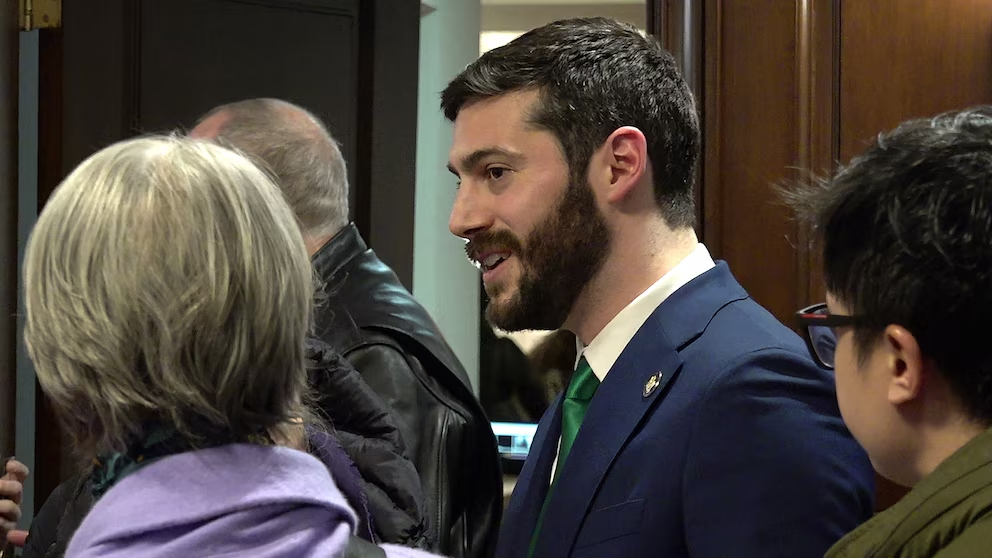
New York State Assemblyman Alex Bores engages with individuals at an ecological meeting at Hunter College in Manhattan on March 17, 2026. Jared Kofsky/ABC News
Significant capital linked to artificial intelligence is flowing into the 2026 midterm elections.
Organizations partially financed by AI industry leaders are at odds regarding how the government should supervise AI — and that is already influencing political commercials, some specialists informed ABC News.
"The form that oversight will take is somewhat of an open question," University of Rochester academic David Primo stated to ABC News. "The risks are quite elevated because once a regulatory framework becomes established, altering it becomes quite challenging."
An AI-connected political group, Innovation Council Action, associated with two of President Donald Trump's consultants, declared on Sunday that it would allocate a minimum of $100 million, as reported by The New York Times.
The contributions related to the AI field extend beyond partisan divisions. Federal Election Commission documents reveal that principal industry participants are investing funds in committees that support both Democrats and Republicans, with certain entities criticizing contenders who have signaled endorsement for novel AI-related legislation, while others do the contrary.
"Businesses have consistently sought to influence regulations, invariably attempting to mold them to their advantage. Nevertheless, what we are witnessing presently is that the major corporations are not unified," Primo observed.
As AI’s impact grows increasingly apparent, certain legislators are imploring their peers not to accept funds from the burgeoning sector.
"Their funds will ultimately prove detrimental regardless," Rep. Alexandria Ocasio-Cortez, D-N.Y., communicated on social media. "People are recognizing this."
One sector, divergent political objectives
In February, Anthropic, the creator of Claude AI, revealed it would donate $20 million to an entity known as Public First Action, elucidating that it concurred with the majority of Americans that insufficient measures were being undertaken to oversee AI and that the technology entails "substantial hazards."
Public First Action representative Anthony Rivera-Rodriguez conveyed that they have already broadcast advertisements expressing gratitude to Rep. Nikki Budzinski, D-Ill., Sen. Marsha Blackburn, R-Tenn., and Rep. Josh Gottheimer D-N.J., for their work regarding AI.
Gottheimer presented a piece of legislation in February that would institute tax incentives for organizations instructing employees in AI development.

Anthropic’s emblem is visible in this depiction from March 1, 2026.Dado Ruvic/Reuters
It remains unclear who else has provided funding to Public First Action, which characterizes itself as a "pro-regulation" organization.
"Public First Action refrains from disclosing its benefactors," Rivera-Rodriguez informed ABC News. "As of now, the project has amassed approximately $50 million. The affiliated super PACs will publicly reveal their contributors in their forthcoming FEC reports."
One of Anthropic’s foremost rivals, ChatGPT proprietor OpenAI, has articulated backing for nationwide "rules of the road that make sense," but has cautioned that the U.S. should not lag behind other nations.
In a financial plan issued the previous year, OpenAI juxtaposed AI’s advancement with the emergence of the car, emphasizing that while the motor vehicle "industry’s expansion was hindered by regulation" in the United Kingdom, the U.S. "adopted a markedly distinct approach," resulting in the growth of the American automotive industry.

A smartphone showcasing the Open AI logo is staged in Grenoble, France, on February 12, 2025.Anouk Anglade/AFP via Getty Images
FEC disclosures indicate that OpenAI co-founder Greg Brockman and his spouse each allocated $12.5 million to an entity designated Leading the Future, which presents itself as backing candidates who "champion policies that utilize the economic advantages of AI and reject endeavors to impede American innovation."
Committees possessing connections to Leading the Future have already made millions worth of contributions, according to filings.
One organization expended more than $500,000 each in support of North Carolina Republican House nominee Laurie Buckhout and Texas Republican House nominee Jessica Steinmann. The identical committee allocated more than $700,000 supporting Texas Republican House nominee Chris Gober.
Buckhout, Steinmann, and Gober each triumphed in their March primaries. All three candidates include analogous statements on their websites, indicating that China cannot surpass the U.S. in the AI domain.
Millions expended solely in Manhattan
The prominence of AI is most pronounced in New York’s 12th Congressional District.
Numerous Democrats are vying in this Manhattan contest, but Assemblyman and former Palantir staffer Alex Bores, who co-sponsored New York’s Responsible AI Safety and Education Act, is the contender who has primarily garnered AI’s attention.
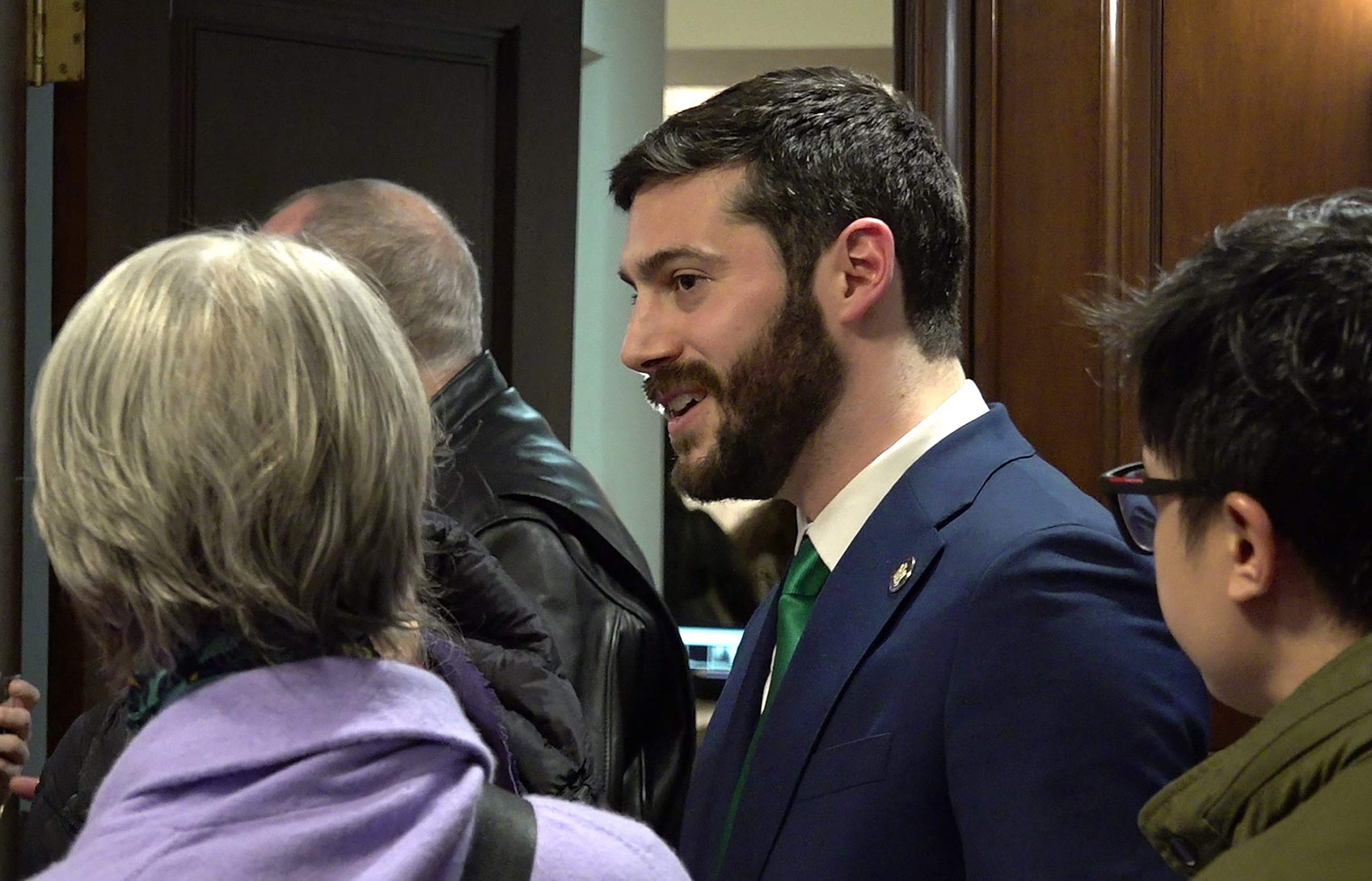
New York State Assemblyman Alex Bores converses with participants at an environmental symposium at Hunter College in Manhattan on March 17, 2026.Jared Kofsky/ABC News
Bores’ website communicates that he aspires to hold prominent AI corporations liable and would endeavor to formulate nationwide safety and privacy stipulations.
A PAC connected to Anthropic-backed Public First Action is endorsing Bores, Rivera-Rodriguez verified. Leading the Future is not.
"Alex Bores is a double-dealer pushing policies that would weaken America’s capacity to spearhead the world in AI innovation and job creation," Leading the Future spokesperson Jessie Hunt informed ABC News.
As of March 16, a super PAC affiliated with Leading the Future had already expended more than $2.2 million opposing Bores, according to FEC filings.
"There are a handful of Trump’s major donors who amassed billions of dollars from AI who believe there should be no oversight of AI whatsoever," Bores told ABC News following a recent gathering.
Given the substantial AI-related funds channeled into races similar to NY-12 throughout the nation, Primo posited that these funds are not being expended discreetly or for payoffs. Instead, the funds are being employed to persuade voters regarding whom they should elect.
"This could potentially be democracy functioning exceptionally well," he remarked.
Sourse: abcnews.go.com