
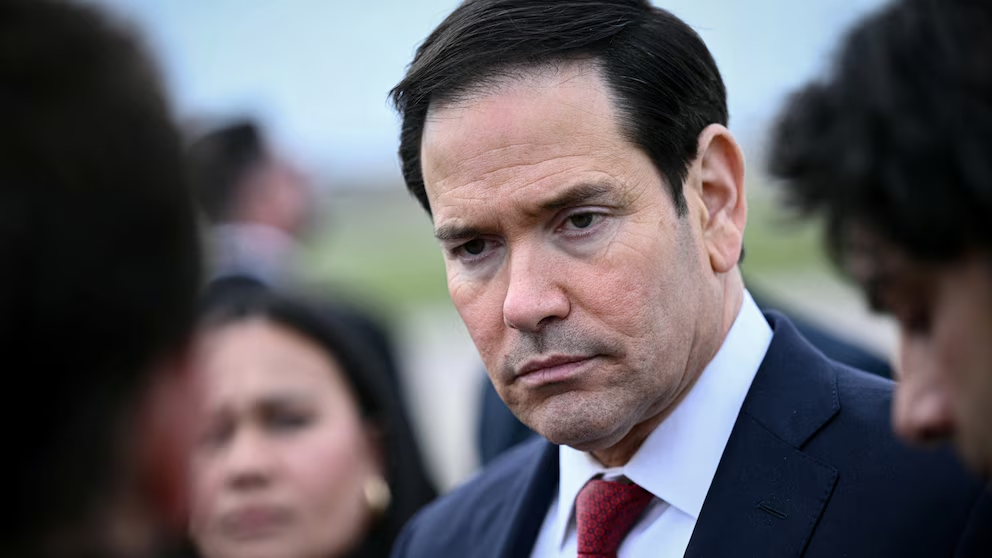
Secretary of State Marco Rubio observes as he addresses the media before his departure subsequent to a G7 Foreign Ministers’ assembly with Collaborating Nations prior to his leaving at the Bourget airport situated in Le Bourget, just outside Paris, March 27, 2026. Brendan Smialowski/Pool via Reuters
Senior figures in the Trump government have promoted efforts at diplomacy to cease hostilities in Iran, as the president intimates it could conclude without undertaking the intricate military undertaking of securing the Strait of Hormuz with naval protection.
During a discussion with "Good Morning America" presenter George Stephanopoulos on Monday, Secretary of State Marco Rubio made no mention of reopening the strait, the crucial strategic point through which approximately 20% of global petroleum transits, which has been largely inaccessible to maritime transport, as an ambition of the U.S. President Donald Trump declared early in the conflict that the U.S. Navy would execute actions to guarantee vessels could traverse it.
Rubio detailed the "devastation" of Iran's aviation forces, naval power, missile capabilities, and defense manufacturing as the four aims of what he characterized as a U.S. "operation."
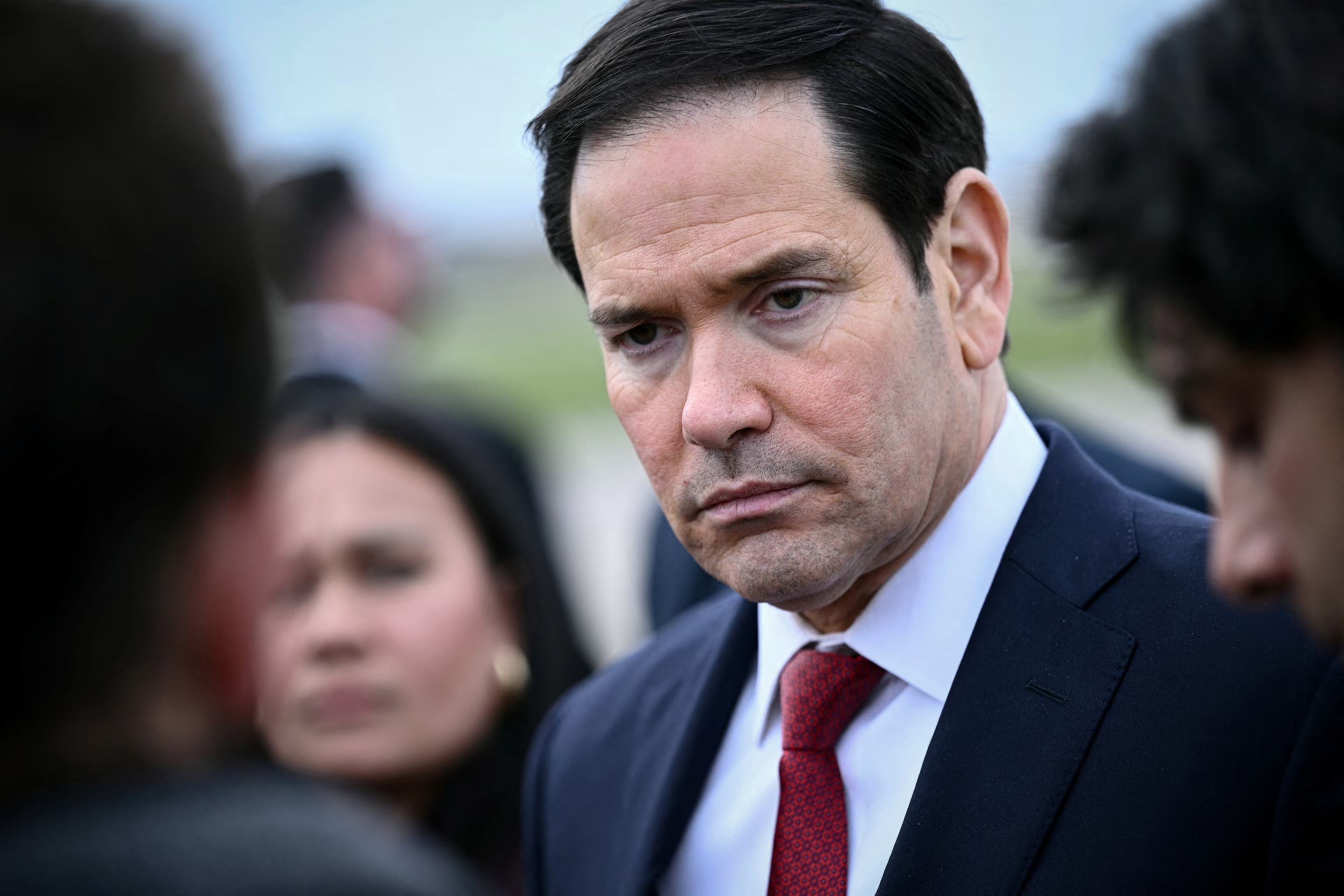
Secretary of State Marco Rubio looks on as he speaks to the press before his departure following a G7 Foreign Ministers’ meeting with Partner Countries before his departure at the Bourget airport in Le Bourget, outside Paris, March 27, 2026.Brendan Smialowski/Pool via Reuters
"All this to prevent them from concealing ambitions to obtain nuclear arms," Rubio stated. "That has been, and remains, our objective from the start."
Secretary of Defense Pete Hegseth likewise, on Tuesday, did not list unrestricted passage in the Strait of Hormuz among the Department of Defense's priorities, instead urging other nations with vested energy interests to become involved in its restoration.
The president transferred responsibility for the strait — largely blockaded by Iran as retaliation to U.S. and Israeli aggressions against the nation — to those confederates and associates.
"They are capable of overseeing it themselves," Trump remarked to ABC's Jonathan Karl on Tuesday. "Why must I execute this duty for them?"
This evident adjustment — merely days after Trump cautioned about increased military involvement if Iran neglected to act to liberate the strait — hints at a potential U.S. scheme for withdrawal, where it asserts the fulfillment of the specified military objectives without addressing the war's most severe economic repercussions, according to a former distinguished U.S. diplomat.
"I believe Rubio may have indicated one avenue accessible to the president," the prior diplomat, who had participated in discussions with Iran, expressed. "It is suboptimal, but… of the unfavorable options, it is arguably the comparatively less poor choice."
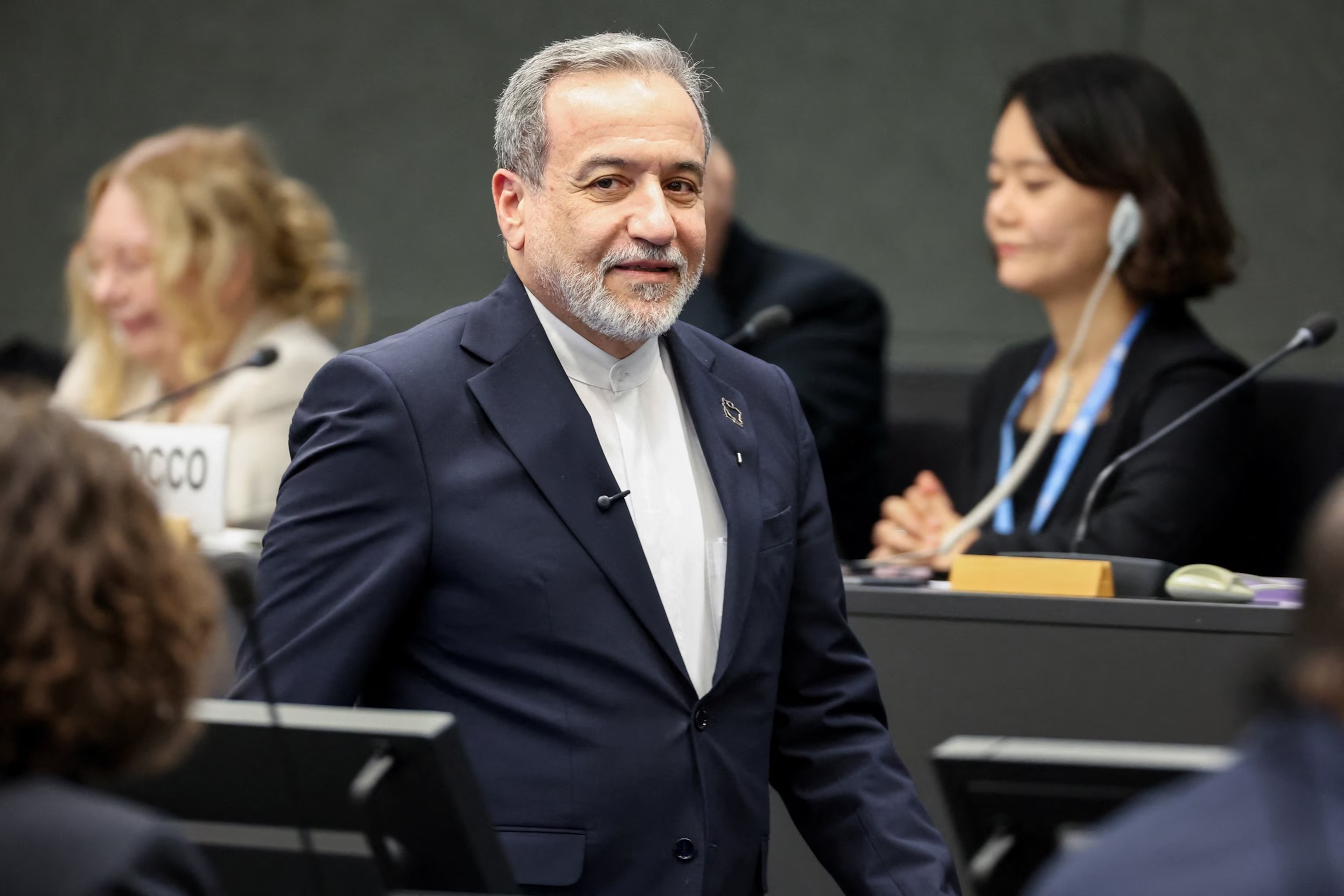
Iran’s Foreign Minister Abbas Araghchi on the day he addresses a special session of the Conference on Disarmament at the United Nations, aside of U.S.-Iran talks in Geneva, Switzerland, Feb. 17, 2026.Pierre Albouy/Reuters
The former U.S. representative commented that a hasty departure from the dispute without settling two of its most vexing matters — the Strait of Hormuz and Iran's nuclear materials — implies a possible diplomatic arrangement that would terminate the hostilities.
"I am under the impression that Rubio, at the very least, seems inclined to finalize this [conflict] on the terms he outlined, with the subsequent expectation that international pressure will ensure the opening of the Strait of Hormuz," the former representative conveyed.
Goals put forth by the administration at the commencement of the conflict — such as governmental transition and denuclearization — would remain unfulfilled via such a resolution, according to the former diplomat.
Tehran's diplomatic view
Regardless of whether the U.S. is pursuing a diplomatic exit, it will present challenges for a distressed Iran to engage with a nation that initiated war against it a month prior, analysts of Tehran's governing body informed ABC News.
Iran may be receptive to diplomacy, the analysts suggested, but would seek firm assurances against future attacks from the U.S. or Israel.
Iranian Foreign Minister Abbas Araghchi affirmed on Tuesday that his nation was not in negotiations with the U.S., but acknowledged that communications were being conveyed.
Pakistan, alongside Turkey and Egypt, has presented itself as a go-between for the U.S. and Iran, delivering those communications between the warring states, thus establishing a significant "arena" for dialogue, according to Syed Mohammad Ali, a professor at Johns Hopkins University and observer of Pakistani politics.
"I believe the paramount factor at this juncture is the establishment of a channel for mediation," Ali remarked. "And this holds vital significance in conflict scenarios."
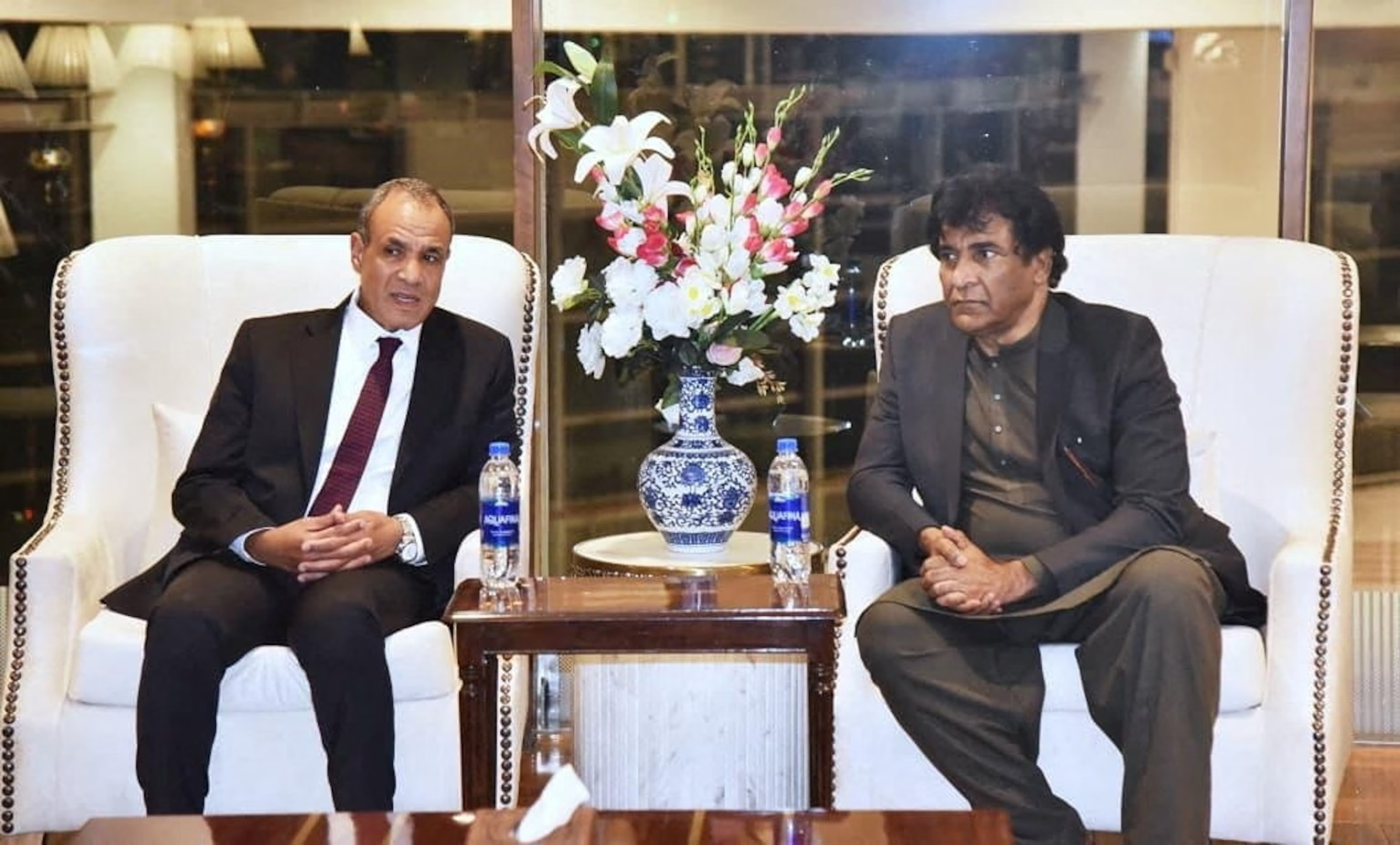
Egyptian Foreign Minister Badr Abdelatty sits as Pakistan hosts talks with the Foreign Ministers of Saudi Arabia, Egypt and Turkey in Islamabad, Pakistan, March 28, 2026.Ministry Of Foreign Affairs via Reuters
Ali, familiar with the initial negotiations, noted that early diplomatic communications have been "maximalist," as the two factions remain considerably divided.
He cautioned that Pakistan, having offered to host face-to-face conversations, would individually "lack the capacity to effectively resolve this matter… they may continue to perform this function, but the terms will be defined elsewhere."
The introduction of China into the diplomatic exchanges, he posited, might contribute the magnitude of "major power influence" and "strategic advantage" to which the U.S. and Iran, whose economies are intertwined with Beijing's, might be susceptible.
The Chinese and Pakistani governments jointly publicized a five-point strategy, advocating for an immediate cessation of hostilities and "unrestricted passage" through the Strait of Hormuz, subsequent to a meeting between their respective foreign ministers held in Beijing on Tuesday. Trump is scheduled to visit China in May.
Esfandyar Batmanghelidj, a specialist in Iranian politics and economics and an affiliated professor at Johns Hopkins, proposed that any long-lasting diplomatic breakthrough would likely be predicated on a collection of "high-level tenets" that would facilitate a truce.
Leaders within the Iranian establishment won’t readily enter negotiations, Batmanghelidj specified, unless the conflict is perceived as a "stalemate" with the U.S., and the negotiations aren’t interpreted as capitulation to Trump. Hardliners in Tehran, notably the leadership of the Iranian Revolutionary Guard Corps, who would resist negotiating with Washington, are still considered to wield significant influence.
Nonetheless, "the elements" for a resolution "are present," Batmanghelidj stated.
"Ultimately, this conflict has proceeded sufficiently advantageously for the Iranians, enabling them to also lay claim to a victory, yet it has concurrently been sufficiently harrowing that even the most hardline elements within the Iranian system will grasp their disinclination to preside over a nation reduced to a state of destitution."
Sourse: abcnews.go.com