
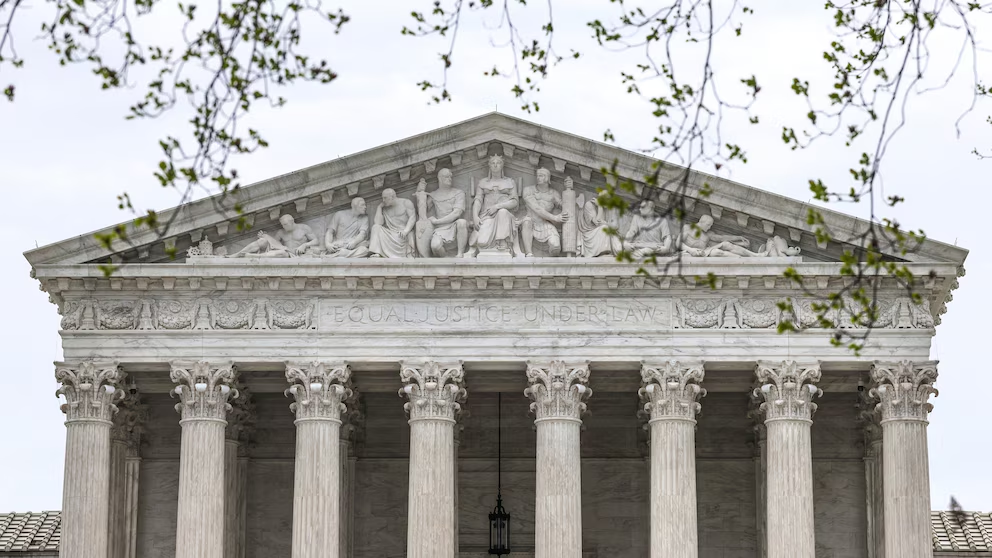
The U.S. Supreme Court edifice in Washington, March 30, 2026. Evelyn Hockstein/Reuters
In an 8-1 ruling, the Supreme Court on Tuesday decided against Colorado's restriction on so-called "conversion therapy" for minors, deeming it a likely infringement upon counselors' rights to free expression under the First Amendment.
LGBTQ organizations, which have praised conversion therapy prohibitions as essential for the psychological well-being of young individuals navigating their identities during adolescence, assert that the verdict will lead to more children being "traumatized" moving forward.
Justice Neil Gorsuch, delivering the court's judgment, stated that the statute — enacted in 2019 to shield minors from attempts by mental health specialists to alter their sexual orientation or gender identity — "restricts expression based on perspective" and must undergo the highest degree of legal examination, which a lower court had not implemented.
"Colorado might view its policy as vital to communal health and safety. To be sure, censorious administrations all through history have felt similarly," Gorsuch penned.
"But the First Amendment acts as a safeguard against any endeavor to impose conformity in thought or speech within this nation," he went on. "It instead embodies a belief that each American possesses an unalienable entitlement to contemplate and articulate freely, alongside a confidence in the open exchange of ideas as the optimal avenue for discerning truth. Regardless of the purity of intentions, any regulation that stifles expression grounded in perspective signifies an 'egregious' assault on both of those dedications."
Spring blossoms flourish outside the U.S. Supreme Court structure in Washington, March 30, 2026.Evelyn Hockstein/Reuters
Justice Ketanji Brown Jackson stood as the sole dissenter.
"Our established principles do not mandate this result," Jackson wrote. "Expression voiced for the objective of rendering medical care can be indirectly limited when the state reasonably governs the speaker's provision of medical interventions to patients."
Kaley Chiles, a Christian licensed therapist hailing from Colorado Springs, initiated the legal dispute, alleging the statute contravenes her rights to free expression and impedes her from candidly conversing with clients regarding their aspiration to eliminate same-sex attractions or more closely align with their biological sex.
"Colorado legislation doesn't merely oversee the substance of Ms. Chiles's discourse. It advances an additional stride," Gorsuch articulated, "stipulating which viewpoints she is permitted and forbidden to articulate."
The pronouncement remands the case to a subordinate court for further appraisal of the law.
Colorado will likely no longer possess the authority to bar state-certified providers from endeavoring to alter a patient's orientation through verbal therapy.
"States are unable to quell voluntary discussions that aid young individuals in seeking solace within their bodies," remarked Jim Campell, Chiles's attorney who presented the case before the court. "The judgment rendered today constitutes a noteworthy triumph for free expression, sound judgment, and families fervently seeking to assist their offspring."
Conversion therapy has been extensively discredited by leading American mental health and medical bodies for decades. Half of the states across the U.S. have prohibited the practice as ineffectual and detrimental to minors, frequently through bipartisan support. Those regulations are now under scrutiny.
Human Rights Campaign President Kelley Robinson conveyed that more children will "endure suffering" as a consequence of this determination.
"Today’s imprudent resolution signifies that more American children will undergo hardship. The Court has turned free-speech into a weapon to prioritize anti-LGBTQ+ prejudice over the security, well-being, and soundness of children," Robinson expressed in a declaration.
Colorado Attorney General Phil Weiser, who has defended the state's conversion therapy prohibition in court, characterized Tuesday's verdict as a "regression for Colorado's initiatives to protect children and families from detrimental and discredited mental health practices."
"For generations, states have established and enforced criteria to guarantee that licensed professionals deliver secure and suitable care," Weiser stated within a declaration. "We vehemently disagree with the court’s rationale and are diligently scrutinizing the pronouncement to evaluate its comprehensive ramifications on Colorado legislation and upon our obligation to safeguard consumers and patients."
Sourse: abcnews.go.com