
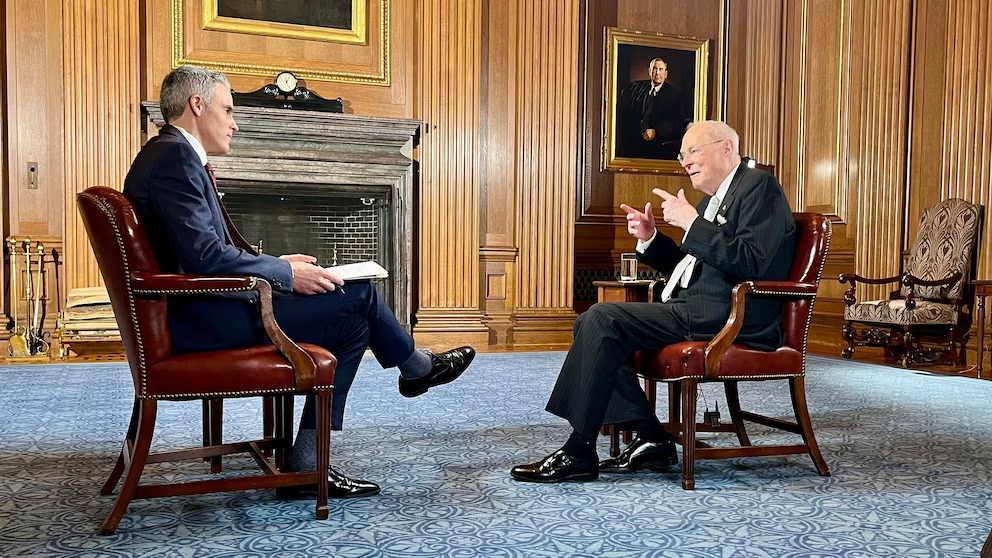
1:52Retired Supreme Court Justice Anthony Kennedy speaks with ABC News senior Supreme Court reporter Devin Dwyer in a rare on-camera interview.ABC News
In his 30 years on the Supreme Court, former Justice Anthony Kennedy delivered key votes in narrowly decided cases that struck down state bans on anti-discrimination protection for LGBT people, overturned state laws criminalizing same-sex intimacy, and required the federal government to recognize legal marriages of same-sex couples under state law.
But Kennedy, nominated in 1987 by President Ronald Reagan, said he’s not certain his landmark opinions on gay rights will endure the test of time.
"We'll see. That's for the next generation to decide," Kennedy, 89, told ABC News in a rare interview reflecting on his life, legacy and newly released memoir "Life, Law & Liberty.”
Watch: One-on-one with former Justice Anthony Kennedy Monday at 7 p.m. and 9 p.m. ET on ABC News Live PRIME or on Hulu, Disney+ and ABC News apps.
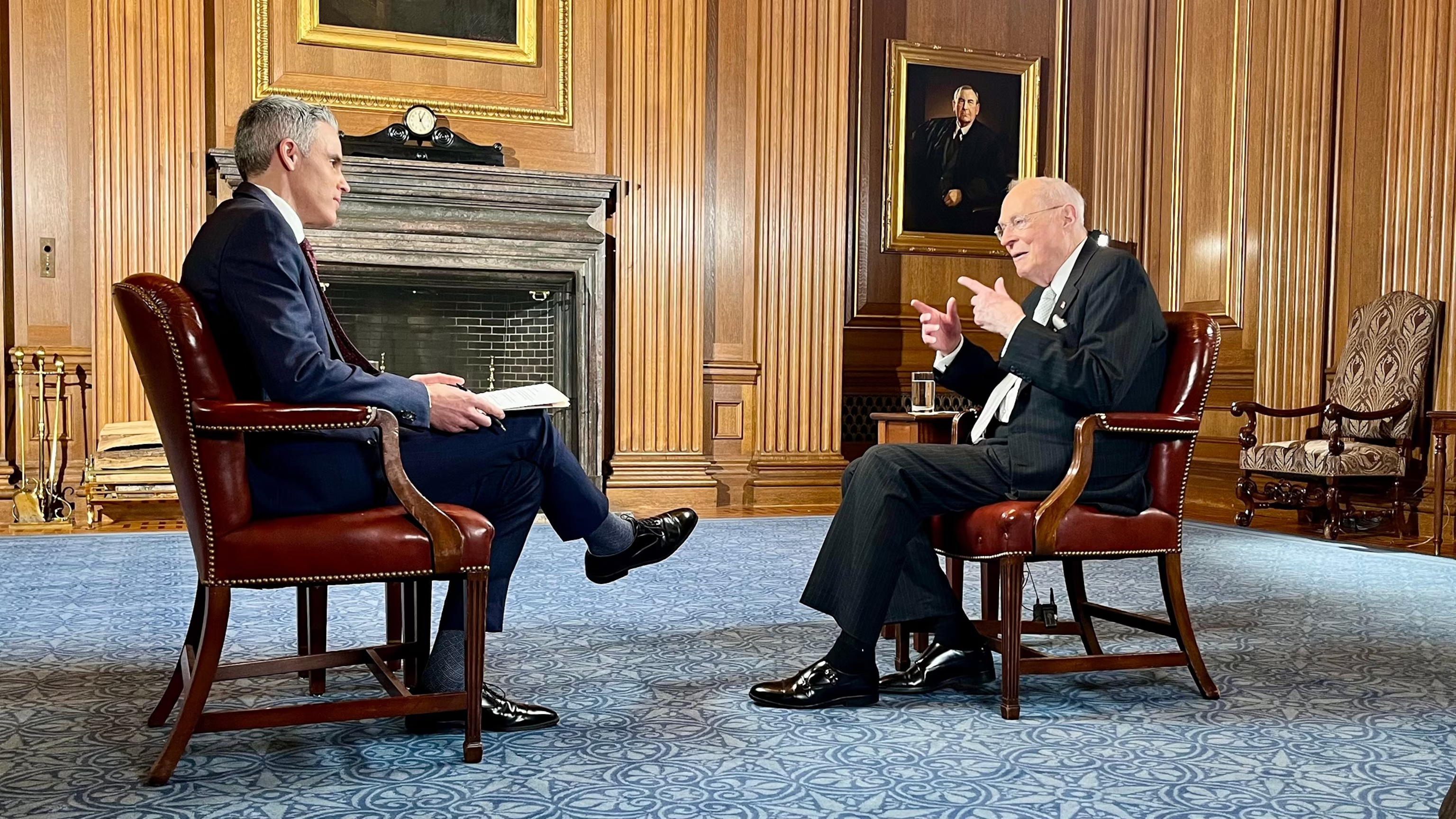
Retired Supreme Court Justice Anthony Kennedy speaks with ABC News senior Supreme Court reporter Devin Dwyer in a rare on-camera interview.ABC News
In 2015, Kennedy's opinion for the court in the case Obergefell v Hodges extended marriage rights to same-sex couples nationwide. Several of his former colleagues, including Justice Clarence Thomas, have since openly called for the ruling to be revisited.
Several states have also enacted resolutions calling on the justices to overturn Obergefell and the the Southern Baptist Convention, the nation's largest Protestant denomination, has mounted a new campaign to reverse the decade of settled law.
"Stare decisis, the rule that a precedent should be given great weight, in part, depends on reliance," Kennedy said. "There's been so much reliance on the marriage opinion that if it were to reverse, people who had had what they thought were decent, honorable lives all of a sudden would be adrift again."
There are an estimated 823,000 married same-sex couples in the U.S., including 591,000 that wed after the Supreme Court decision in June 2015, according to the Williams Institute at UCLA Law School. Nearly one in five of those married couples is parenting a child under 18. Kennedy, a devout Catholic and one-time altar boy from Sacramento, California, described a "long" personal evolution of views toward gay and lesbian people that was cemented in the 1990s by a proliferation of same-sex couples with adopted children.
"There were thousands of children that were adopted by gay parents," he said, "and for them to know that their parents were not recognized by society, but the law, as real parents, as something that was marginally illegal, could create a profound sadness for thousands, maybe even hundreds of thousands of children."
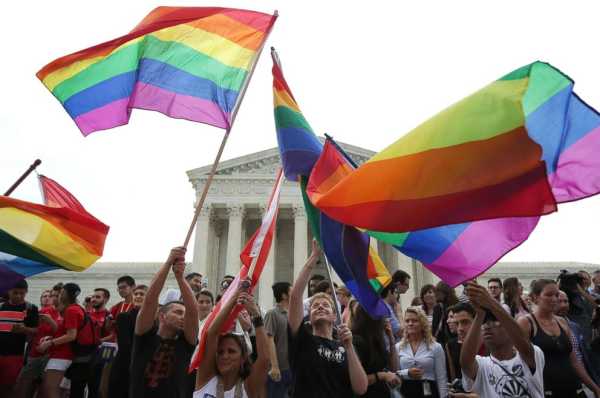
In this June 26, 2015, file photo, same-sex marriage supporters rejoice after the U.S Supreme Court hands down a ruling regarding same-sex marriage outside the Supreme Court in Washington, D.C.Alex Wong/Getty Images, FILE
While Kennedy said he did not personally know any gay parents or have gay friends at the time, he says he "began to learn about the hurt and the anguish and the desire these people had to live a wonderful life and contribute to our country."
His opinion in Obergefell was rooted in the idea that all people deserve "equal dignity in the eyes of the law," and portions of the text have since become a popular reading at wedding ceremonies of all kinds.
"It seemed to be a good lesson to teach," he said of the case, "that the law protects all."
Asked whether he believes that ideal also applies to transgender Americans, now at the center of a number of cases before the court, Kennedy suggested it has to.
"I don't think we can have a peaceful world unless all sides agree that whatever we think of your ambitions, or your beliefs, we will treat you with dignity, and we will discuss it in a thoughtful, rational, productive, decent way, respecting your dignity," he said. "You believe in X. We believe in Y. We can recognize that both of those have some merit to them."
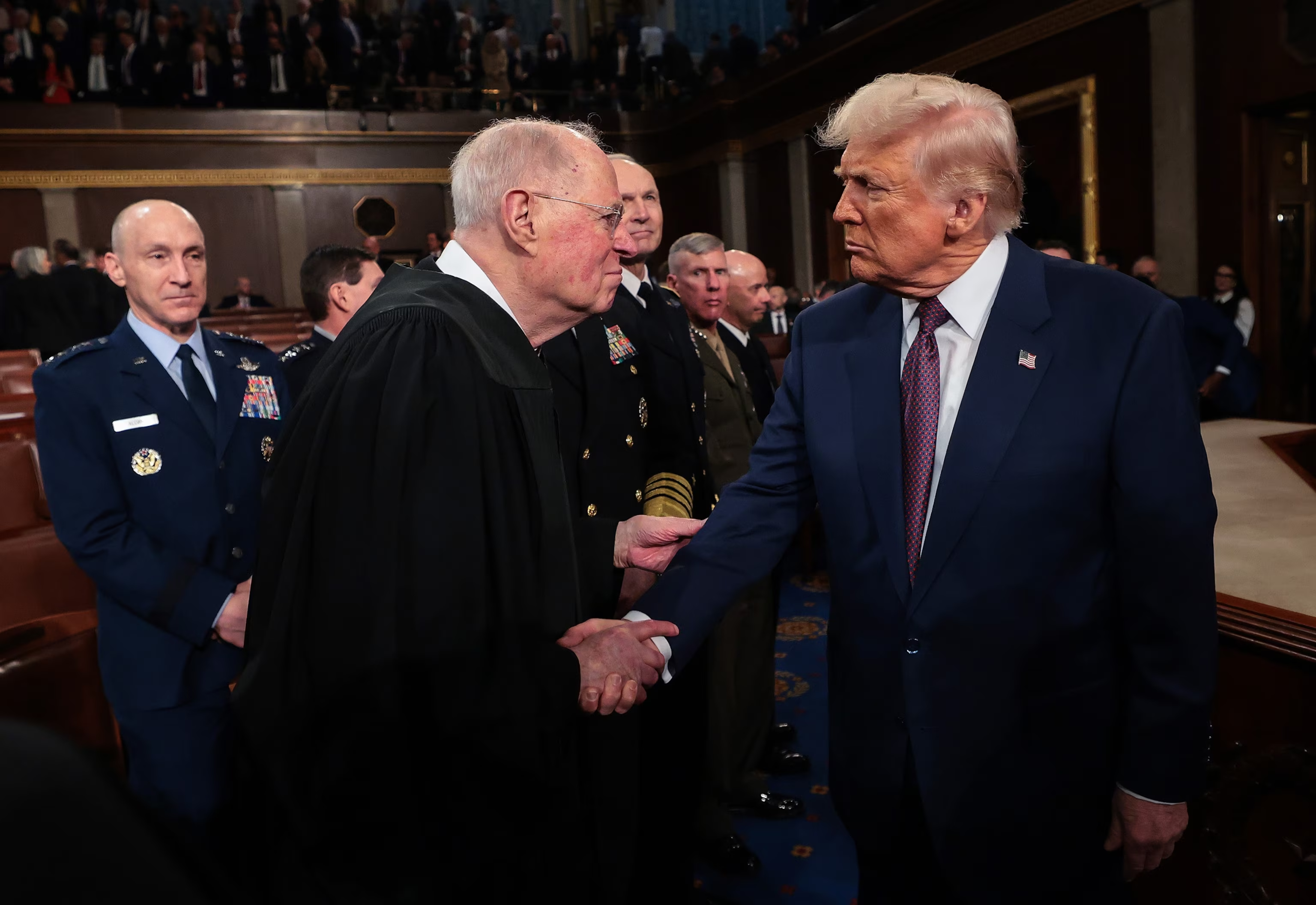
In this March 4, 2025, file photo, President Donald Trump shakes hands with retired Supreme Court Justice Anthony Kennedy after addressing a joint session of Congress at the U.S. Capitol in Washington, D.C.Win McNamee/Getty Images
Retired but still present
Kennedy sat down with ABC News following the release of his book, which offers candid reflections on his 30-year high court career that included some of the most consequential rulings in generations.
From free speech to abortion rights, ending the death penalty for juveniles, and resolving the contested 2000 presidential election, Kennedy was among the most influential figures for a generation and defied the conventional conservative-liberal judicial labels.
"It seemed to me that there wasn't one philosophy, one theory that was so prominent that I wanted to adhere to it," he explained.
When Time magazine put Kennedy on the cover in 2012 and called him "The Decider," the justice said he thought the characterization "might have been a little overblown."
"It seemed to me that it was necessary to look in each case to see if we could find a principle that both sides could or should agree on," he explained. On a court narrowly divided among liberals and conservatives, that mindset often put Kennedy in the middle.
"The law is a beautiful creation and it teaches you, first of all, about yourself. You have to know who you are," he said.
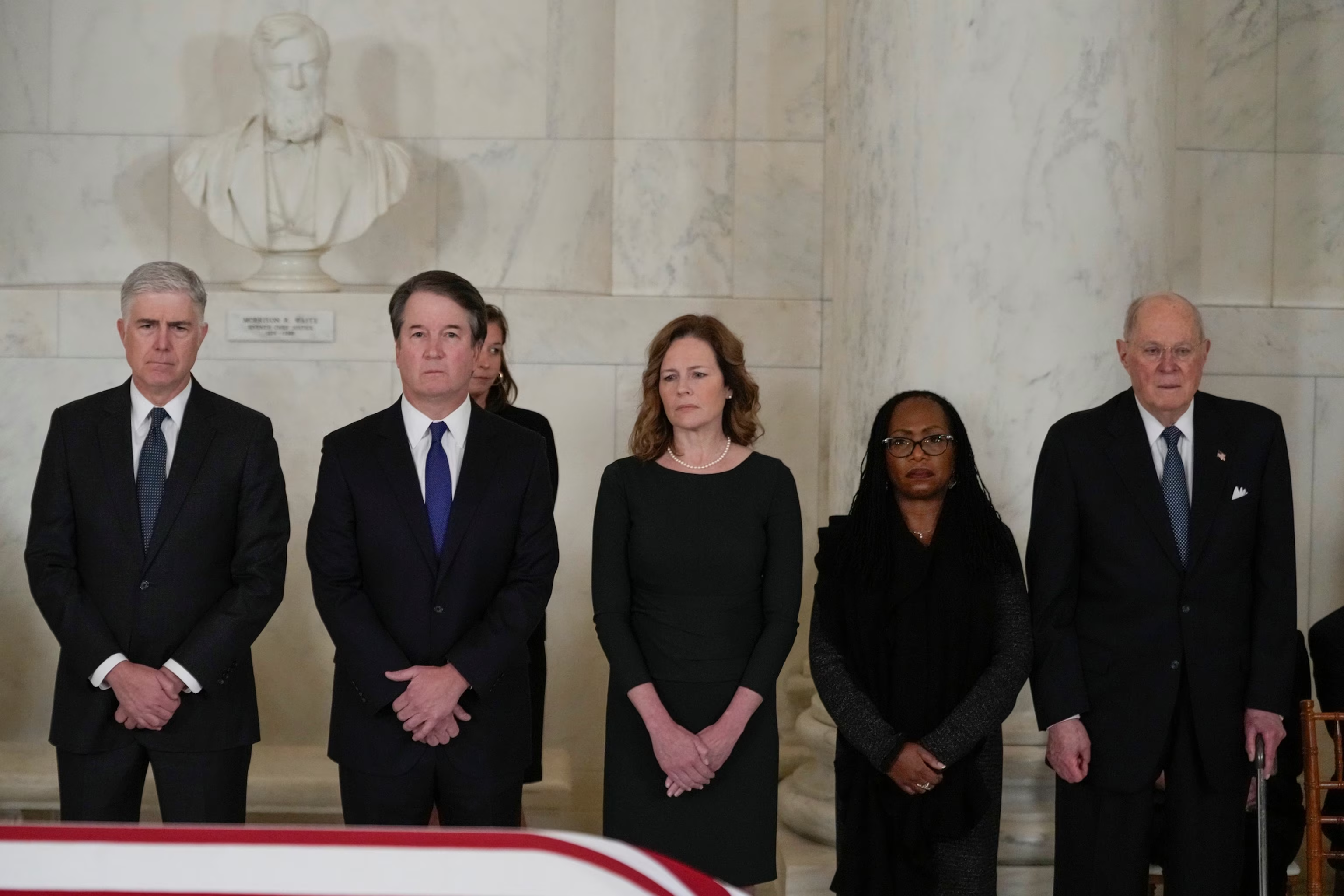
Supreme Court Justice Neil Gorsuch, Justice Brett Kavanaugh, Justice Amy Coney Barrett, Justice Ketanji Brown Jackson and retired Justice Anthony Kennedy listen during a private ceremony for retired Supreme Court Justice Sandra Day O’Connor before public repose in the Great Hall at the Supreme Court, Dec. 18, 2023.Jacquelyn Martin/AP, Pool
Today, almost eight years since stepping down, Kennedy still keeps chambers inside the Supreme Court building and regularly joins his former colleagues for lunch. His presence, he said, is at least partly intended to be a bulwark against creeping partisanship among his former colleagues.
"I worry a great deal about it," he said. "And I'm very concerned that some of the cases attack judges — fellow judges, with names for those judges — and this is not the way the court should write its opinions."
"The Supreme Court should lead the way in showing that discussions should be thoughtful, rational, civil, and friendly," he added. "The hostile, fractious rhetoric, it seems to me, brings partisanship back, and that's wrong."
His target audience includes two former clerks and mentees who joined the court in his footsteps — Justices Neil Gorsuch and Brett Kavanaugh — who are now part of Kennedy's legacy.
"They're wonderful. They're very fine judges," he said. As for their votes to overturn Kennedy's key abortion-rights-affirming precedent in the Dobbs decision and whether he was hurt by their position, he said it was not taken as a "personal hurt," saying, "you can't have personal 'hurts' in this profession."
A profound legacy
In his book, Kennedy says cases involving abortion were some of his most difficult as a judge, revealing that in 1992, as he crafted an opinion that would end up affirming a right to abortion, he was so conflicted that he contemplated resigning.
"It was necessary for me to put my name on the decision that the woman had a right to do what I thought was a grave moral wrong," Kennedy explained.
He also reflected on the most time-sensitive opinion he ever delivered: the 24-hour ruling in Bush v Gore that ended the Florida recount and handed a victory to George W. Bush in the 2020 presidential election.
"I think it was right," Kennedy said of the divisive ruling. "The thought that we would see a legal impropriety in a presidential election case and let the case stand and not hear it — hello?! [Al] Gore had insisted on extending the period of time in which the courts could hear the case, but we didn't think it should be extended."
A quarter century later, Kennedy laments intensifying partisanship in American politics and what he called "vulgar" rhetoric used by some of the country's leaders.
"Somebody has to start setting the right examples. We should have a campaign against vulgarity," Kennedy said. "We have a duty to show the rest of the world that free speech is necessary and that it works. And we do not do that if we have campaigns of vulgarity."
As the U.S. marks its 250th birthday, Kennedy maintains the country remains an "example for the world" even if it's "falling a bit short" of its ideals.
"In some parts of the world, there's culture that wants a single, ruling voice," he added. "This is not consistent with democracy, and we have to say that there's a voice of the people, that it has to be listened to, but that doesn't work unless there is a decent, civil dialogue."
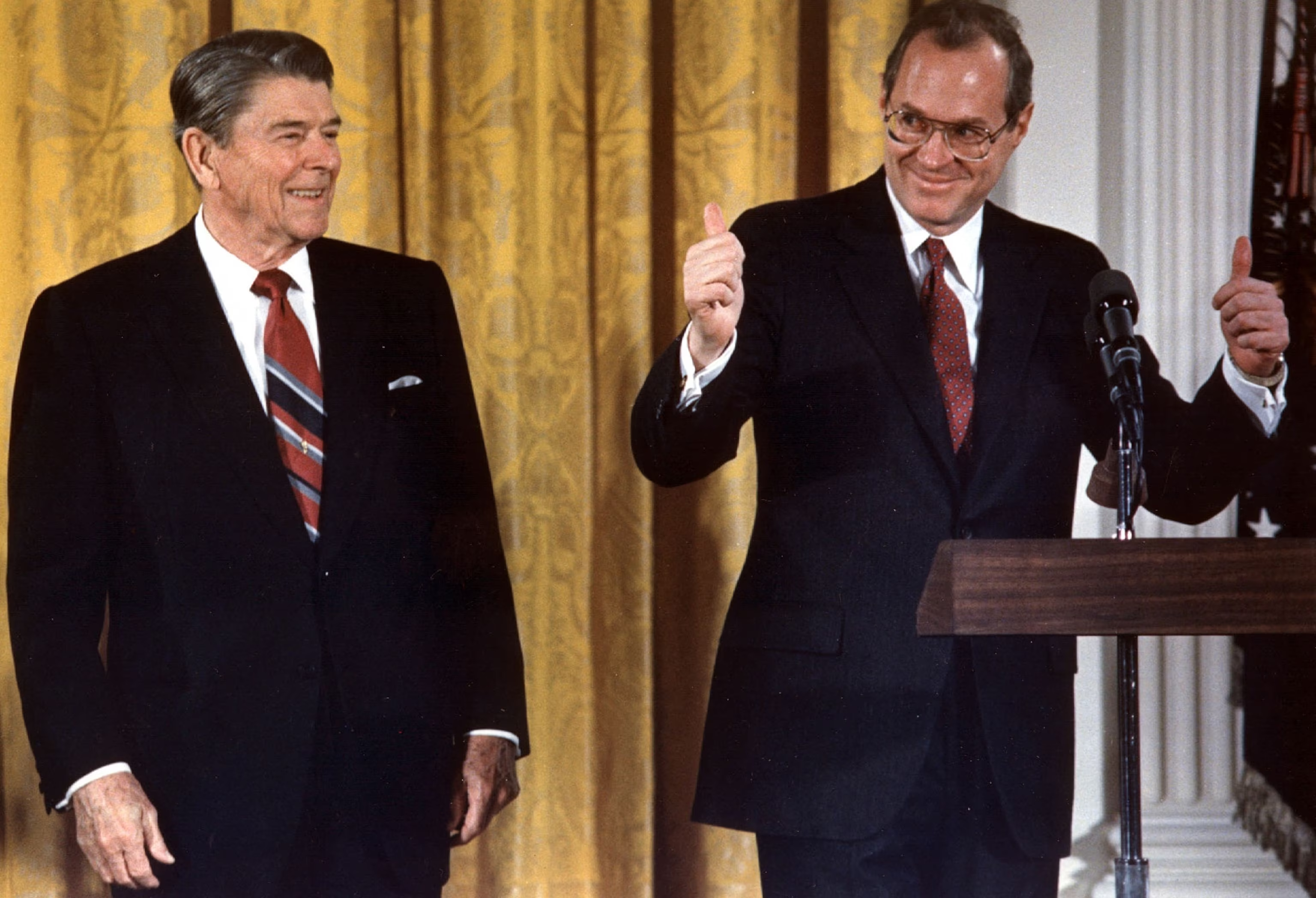
In this Feb. 18, 1988, file photo, Supreme Court Justice Anthony Kennedy gives a thumbs-up gesture to those who gathered to watch him be sworn in for the second time, in the White House East Room in Washington, DC. Kennedy’s first swearing-in was in a formal private ceremony at the Supreme Court building. At left is President Ronald Reagan.Mike Sargent/AFP via Getty Images, FILE
A Western spirit and deep humility
Kennedy says his California roots and deep devotion to family left an indelible mark on his view of the world. Early on, he says he learned lessons about our shared humanity and of love and loss with the sudden death of his sister Nancy, mother Gladys, and brother Tim, all within a year. And just this past year, the passing of his son Gregory.
"We often think that we're gonna be knocking on heaven's door. We forget the Lord is knocking on our door to say remember how beautiful this world is and remember how, despite sadness and grief, you can still find joy in the memories that you have and in the future that you build," he said.
His future would take him to Washington in 1988 after nomination by Reagan and unanimous confirmation by the Senate — the last justice to receive that level of support.
"That partisanship has become too important," Kennedy said. "And I've told senators they have to look, not just at political parties but at judgment, temperament, experience and so much else."
The justice maintains he never liked the national spotlight as the "swing vote" or "decider" on the Supreme Court — popular characterizations of his career — instead simply wanting to be remembered "as being fair and honest."
"You have to realize that you are a very small part of this ongoing search for truth and justice and wisdom and fairness," he said of his time on the court.
He said he does miss the work of judging, but doesn't regret stepping down when he did.
"I don't know what AI is," Kennedy said with a chuckle. "I mean, you know, really, it was time for somebody younger to get on the bench."
ABC News' Chris Donovan, Jon Schlosberg, Cameron Krakowiak, and Eric Fayeulle contributed to this report.
Sourse: abcnews.go.com