
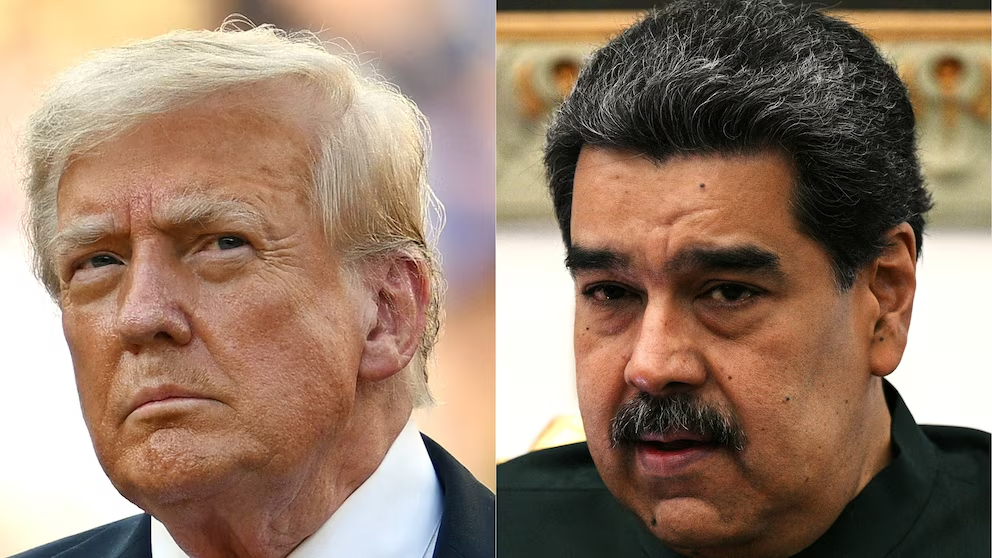
4:02In this July 13, 2025, file image, President Donald Trump is seen during the award ceremony for the FIFA Club World Cup 2025 Champions in East Rutherford, New Jersey. | In this Sept. 14, 2022, file image, Venezuela’s President Nicolas Maduro is present at a meeting held at the Miraflores presidential palace in Caracas. Angela Weiss, Federico Parra/AFP via Getty Images
Following reports that the U.S. executed a "large scale strike" on Venezuela overnight Saturday and apprehended the nation’s leader, Nicolas Maduro, Americans might be questioning why Trump, who assured voters of no more wars, would initiate a perilous ground mission to seize a foreign leader.
Up until now, Trump and his senior advisors have provided varying justifications since the commencement of Trump’s military buildup in Latin America earlier this year.
Initially, Trump justified his military presence near Venezuela as an effort to prevent drugs from entering the U.S., although analysts indicate that the cocaine transiting through Venezuela predominantly ends up in Europe, while fentanyl is primarily sourced from China.
Trump further accused Maduro of releasing prisoners from Venezuela’s jails and “mental institutions” into the U.S., despite the absence of supporting evidence. According to the nonpartisan Migration Policy Institute, countless Venezuelans have relocated to the U.S. in recent years due to the economic and political turmoil in their homeland.
By mid-December, Trump charged Maduro with "stealing" U.S. oil and territory. Trump seemed to refer to initiatives undertaken in the 1970s by Western oil companies in Venezuela before the government decided to nationalize its reserves, ultimately expelling American firms.
In a social media post on Dec. 17 – around the time sources claim Trump was deciding to authorize the Jan. 3 military action — Trump declared that the U.S. military threat to Venezuela will “only grow larger, and the shock to them will be unprecedented — Until they return to the United States of America all of the Oil, Land, and other Assets that they previously stole from us.”
Trump aide Stephen Miller echoed a similar assertion.
“American labor, innovation, and effort built the oil industry in Venezuela. Its tyrannical expropriation was the largest documented theft of American wealth and property,” Miller posted on X.
Two days later, during a press briefing, Secretary of State Marc Rubio provided a broader rationale beyond access to oil reserves, labeling Maduro’s presidency as “intolerable” for collaborating with “terrorist and criminal elements” instead of the Trump administration.
Rubio, the son of Cuban immigrants, has dedicated much of his political journey to opposing the communist Cuban regime. He has consistently held Maduro responsible for significant instability in the region, including in Cuba where the government continues to depend on Venezuela’s affordable oil.
“There is a regional threat, and in the case of Venezuela we have no collaboration,” Rubio informed reporters on Dec. 19. “To begin with, it is an illegitimate regime. Secondly, it is a regime that does not cooperate. It is anti-American in all its statements and actions. And thirdly, it is a regime that not only does not cooperate with us, but also openly collaborates with dangerous, terrorist and criminal elements.”
The Venezuelan government released a statement denouncing what it termed "the grave military aggression carried out by the current administration of the United States of America.”
Sourse: abcnews.go.com