
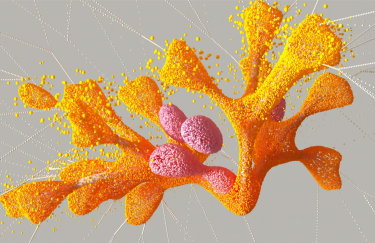
Illustration of the process of how artificial intelligence can predict patterns in biology / Photo: Khyati Trehan
At the DeepMind artificial intelligence laboratory, which is a subsidiary of Google, researchers have learned to use AI to speed up the diagnosis of diseases in humans caused by genetic mutations.
This was reported by the Financial Times newspaper, citing data from the scientific journal Science.
- AI in science – opportunities for geneticists
- The UK government is impressed by the effectiveness of AI
- Google's Artificial Intelligence – History
- Using AI does not guarantee success
AI in science – opportunities for geneticists
Using an artificial intelligence tool called AlphaMissense, scientists at DeepMind were able to evaluate all 71 million missense mutations, which change a single letter in a person's genetic code. Of these, 32% were classified as likely pathogenic, 57% as benign, and the rest were undetermined.
Only 0.1% of missense variants, which alter the structure of proteins, the body's basic working molecules, have shown clinical effects. Each protein is unique, and each experiment must be designed individually, which can take months.
“Experiments to identify disease-causing mutations are expensive and time-consuming. Using AI predictions, researchers can get a preview of results for thousands of proteins at once, which can help prioritize resources and speed up more complex studies.”

Zhyga Avsek Researcher of the DeepMind project

AlphaMissense mutations detected in two protein structures (red are harmful, blue are safe, and gray are undetermined) / Illustration: FT
The UK government is impressed by the effectiveness of AI
The UK government's Genomics England tested AlphaMissense's predictions against its own extensive records of genetic variants that cause rare diseases. They noted the accuracy of the prediction and were surprised by the capabilities of the AI.
The government is currently discussing the option of using AlphaMissense in healthcare as “a second pilot for clinical scientists, indicating which options they should focus on so they can do their work more effectively.”
Google's Artificial Intelligence – History
DeepMind was founded in 2010 as a specialist AI developer. Google acquired it in 2014 and made the tool “freely available to the scientific community.” Predictions generated by AlphaMissense will be incorporated into the widely used Ensembl Variant Effect Predictor, which is run by the European Bioinformatics Institute in Cambridge.
DeepMind rose to prominence in 2016 after its AlphaGo program defeated professional Go player Lee Sedol, the world champion, in a five-game match, which was the subject of a documentary. In April 2023, DeepMind merged with Google's Google AI division, Google Brain, to form Google DeepMind, as part of the company's efforts to accelerate its AI work in response to OpenAI's ChatGPT.
At the same time, Google's AI predictions for genetic diseases are general and don't tell scientists about the biophysical nature of what a variant does. So DeepMind plans to develop the AI tool to make predictions more precise in the future.
Using AI does not guarantee success
While some of DeepMind’s AI efforts have shown promise in genetics, a number of other attempts have been unsuccessful. For example, clinical trials of the first AI-designed molecule, announced in 2020 by Oxford-based Exscientia and Sumitomo Pharma, failed. And in May this year, London-based BenevolentAI announced it was laying off 180 staff after its lead drug candidate failed.
At the same time, scientists are not giving up on trying to implement AI in science. According to CB Insights, more than 200 startups are competing for market share. Recently, there has been a surge in acquisition deals for startups to implement AI in science. Here are just a few of them:
- German company BioNTech acquired British company InstaDeep for $682 million;
- Eli Lilly inked a $250 million deal with Xtalpi;
- Nvidia invested $50 million in American Recursion.